
A founder sends us the same message every few months. “Shopify has this Managed Markets thing where someone else handles duties and tax overseas. Can we switch it on for the US?” The honest answer, for an Australian business, is that the toggle is not there. Shopify’s help documentation lists Managed Markets as available to businesses based in the continental United States, with limited availability for certain stores in Canada and the United Kingdom. Australia is not listed.
That does not end the conversation. It starts a more useful one: who is the legal seller on a cross-border order, who registers for tax in the destination, who pays the duty, and who answers the customer when a parcel is held at the border? This article is the decision framework we use with Australian Shopify brands to answer those four questions. It covers what a merchant of record changes, what Managed Markets includes, the three routes that are open to an Australian store, the duty maths in AUD, and the checklist we run before any market goes live.
What a merchant of record actually changes
On an ordinary Shopify store, your business is the seller. You collect the money, you are responsible for tax in the jurisdictions where you have an obligation, and you are the party named on the commercial invoice that travels with the parcel. When you add a merchant of record (MoR), a third party becomes the legal seller of the international order. Shopify’s own description of Managed Markets is that Global-e is the merchant of record, handling duties, tax remittance, commercial invoices and carrier arrangements for a per-order fee.
That sounds like a small legal distinction. It changes four operational things, and each one is a place where Australian brands get caught out.
| Question | You are the seller (standard Shopify Markets) | A merchant of record is the seller |
|---|---|---|
| Who registers for tax in the destination? | You, if you cross a local threshold | The MoR, under its own registrations |
| Who pays duty and import tax? | You (DDP) or the customer on delivery (DDU) | Collected at checkout and remitted by the MoR |
| Whose name appears in the checkout disclaimer? | Your brand | The MoR (Shopify notes the disclaimer cannot be hidden or reworded) |
| Who handles product restrictions and HS codes? | You, or your broker | The MoR assigns codes and screens restricted items |
The trade is control for convenience. You hand over a chunk of compliance work and some customer-facing branding, and you pay a percentage of every international order for it. Whether that trade is worth making depends entirely on the numbers further down.
What Managed Markets includes, and where Australia sits
Shopify’s overview page for Managed Markets (the product formerly called Markets Pro) lists a clear set of requirements: a Basic plan or higher, an online store, and Shopify Payments. It lists the following fees on international orders: a 3.5% transaction fee on Basic, Grow and Advanced, 3.25% on Plus, plus the Shopify Payments currency conversion fee and normal processing fees. For context, 3.5% of AUD $500,000 in annual international sales is AUD $17,500, and 3.25% is AUD $16,250. That is the benchmark price of outsourcing the whole cross-border compliance function.
The feature list is strong. Managed Markets guarantees the duty and tax amounts shown at checkout and covers any customs difference, assigns HS codes automatically, ships delivered duty paid to most destinations, offers local currencies and payment methods, and uses the original conversion rate for refunds within 30 days. Shipping labels come from DHL Express, DHL eCommerce and FedEx for US stores, and DHL Express and FedEx for Canadian and UK stores.
The limitations matter just as much. Fraud review and chargeback protection through Shopify Protect apply to US-based stores only. Managed Markets cannot run at the same time as the standalone Global-e app. Assigned HS codes may differ from the ones you entered. And the help page does not mention Australia at all. A Canadian and UK rollout exists, which means the product is expanding, but as of October 2026 we have no published date or criteria for Australian stores. We treat that as unavailable and design around it. If that changes, the framework below still holds, because Managed Markets would simply become one more route on the page.
The August 2026 change that affects you anyway
Shopify announced in its 11 August 2026 changelog that, from 24 August 2026, it stops supporting delivered duty unpaid (DDU) in every country where it supports delivered duty paid (DDP) under Managed Markets. Markets using DDU convert to DDP automatically, and customers pay duties and taxes at checkout instead of to the carrier on delivery. This applies to Managed Markets only, so an Australian store is not forced to change anything. It is still a signal worth reading: the platform is pushing the whole ecosystem toward prepaid duties, because collecting money from a customer at the door is where delivery experiences fall apart. Our US duties setup guide, Shopify Duties and Import Taxes, covers the checkout configuration. This article covers the layer above it, which is who sits behind that configuration.
The three routes open to an Australian brand
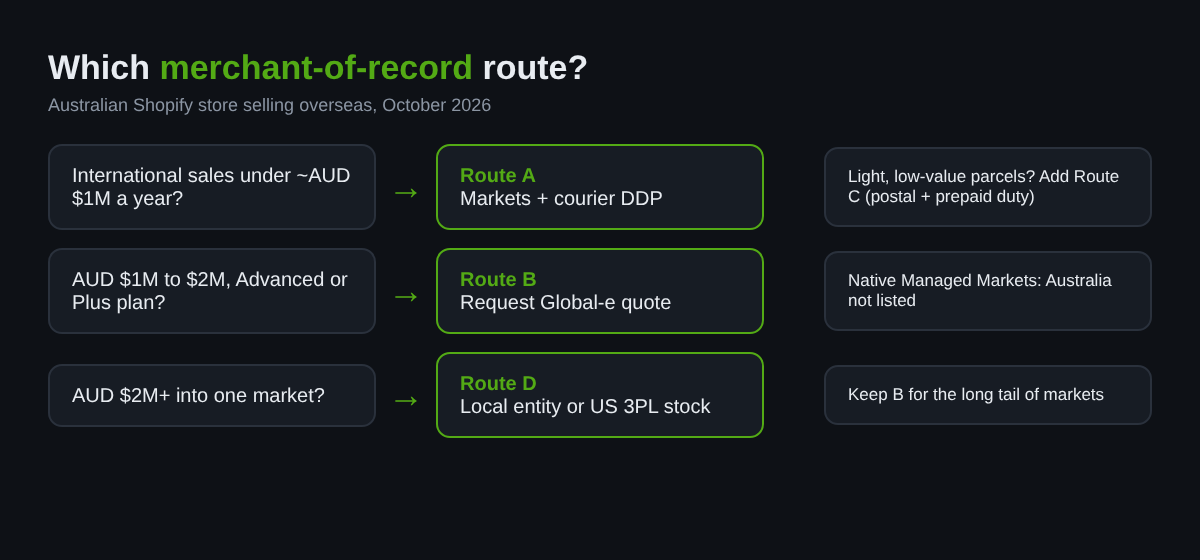
Once you accept that native Managed Markets is out, the realistic options for an Australian Shopify store are these.
Route A: Shopify Markets with DDP through an express courier
You stay the seller. In Shopify Markets you enable the destination, set local pricing, and configure duties and import taxes so the customer sees one landed price at checkout. You then ship with an express courier (DHL Express, FedEx or UPS), which acts as the customs broker, files the entry electronically and bills you for the prepaid duty. Interparcel’s guidance for Australian senders confirms couriers file entries through US Customs’ ACE system, and that express services were never paused during the US de minimis changes.
This is the default we recommend for brands doing under roughly AUD $1M a year across all international markets. There is no percentage fee on top of the duty. The cost is operational: your team owns HS code accuracy, product classification and refund handling.
Route B: Standalone Global-e on Shopify Advanced or Plus
Global-e documents a native Shopify integration where it runs as the merchant of record, embedded as a payment app in Shopify checkout and as a carrier service for shipping and duty calculation. The documentation states the native features are available on Shopify Advanced and Plus plans, and it does not mention Australia or publish fees, so we treat this as a commercial conversation, not a self-serve install. If your volume justifies it, you ask Global-e for a quote and a supported-country list before you commit anything. Our earlier comparison in Shopify Markets vs Multi-Store covers where a managed overlay fits against a second storefront.
Route C: Postal delivery with a prepaid-duty provider
For lightweight parcels, Australia Post to USPS remains an option. After the US ended its US$800 duty-free threshold on 29 August 2025, Australia Post paused US-bound shipments from 26 August 2025, then confirmed on 9 September 2025 that it would resume by 25 September 2025 or earlier. Interparcel describes the postal route as prepaid (PDDP): duties and taxes are paid before delivery, Zonos calculates and bills the sender, and USPS charges no brokerage fee. It also states the Zonos fee as 10% of duties and taxes plus AUD $1.69 per shipment.
A fourth option we mention for completeness
Brands moving AUD $2M or more into one destination should price a local entity or a US-based 3PL with a locally imported inventory position. That removes per-parcel duty collection altogether, because stock enters in bulk. It is a different project with different risk, and our guide to selling into the US from Australia walks through the tax and shipping setup that comes with it.
| Route | Who is the seller | Plan needed | Percentage fee | Best fit |
|---|---|---|---|---|
| A. Markets + courier DDP | You | Any | None (duty and brokerage pass-through) | Under ~AUD $1M international |
| B. Global-e standalone | Global-e | Advanced or Plus | Quote required | Multi-country, compliance-heavy catalogue |
| C. Postal + prepaid duty | You | Any | 10% of duty + AUD $1.69/parcel | Light, low-value parcels |
| D. Local entity or US 3PL | You (local) | Any | Project cost | AUD $2M+ into one market |
The duty maths, in AUD
Decisions like this get made on feeling unless someone builds the model. We build it before we touch a Shopify setting. The inputs are simple: annual sales into the destination, average order value, the duty rate, and the fee structure of each route.
Here is a worked example using published figures. An Australian brand sells AUD $500,000 a year into the US at an average order value of AUD $180. That is about 2,778 orders. Interparcel states that Australian-origin goods typically attract a 10% ad valorem duty (it varies by material and product type), so a AUD $180 order carries AUD $18 in duty. On the postal route, the Zonos fee on that order is 10% of AUD $18 (AUD $1.80) plus AUD $1.69, which is AUD $3.49. Total prepaid at the border for that order: AUD $21.49.
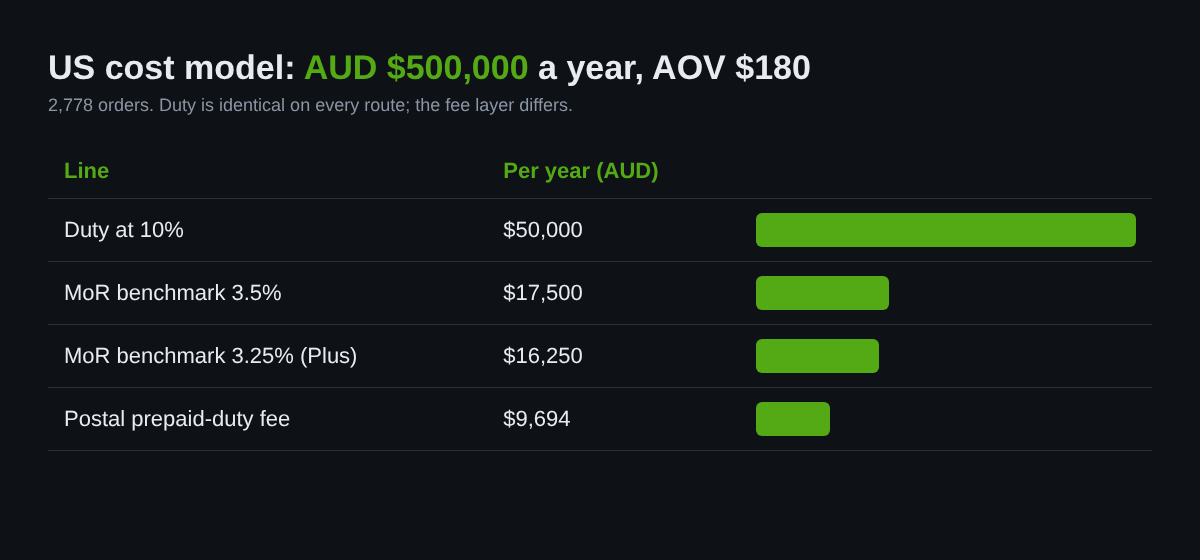
| Line | Per order (AUD) | Per year, 2,778 orders (AUD) |
|---|---|---|
| Duty at 10% on AUD $180 | $18.00 | $50,000 |
| Postal prepaid-duty fee (10% of duty + $1.69) | $3.49 | $9,694 |
| MoR benchmark fee at 3.5% of sales (Shopify’s published Managed Markets rate) | $6.30 | $17,500 |
| MoR benchmark fee at 3.25% of sales (Plus) | $5.85 | $16,250 |
Two things stand out. First, duty dominates: AUD $50,000 a year in this example, which is far larger than any fee layer, and it is the same on every route. The real commercial question is whether you absorb it, pass it to the customer in the landed price, or split it. Second, the MoR benchmark fee costs more than the postal fee layer in this example, but it also replaces brokerage fees, tax registration, restricted-goods screening and some support load. The model tells you what you are paying for, not which option is cheapest in isolation. Note that the 3.5% figure is the rate Shopify publishes for Managed Markets in the countries where it is offered. It is a useful benchmark for how the market prices this service, not a quote available to an Australian store.
We run the same calculation in a short script so the numbers can be rerun when the AOV, duty rate or volume changes.
# duty_model.py - landed-cost comparison for one destination (AUD)
annual_sales = 500_000
aov = 180
duty_rate = 0.10          # check HS code, material and origin per SKU
orders = annual_sales / aov

duty_per_order = aov * duty_rate
postal_fee = duty_per_order * 0.10 + 1.69     # Zonos postal route, as published
mor_fee_rate = 0.035                           # benchmark only, not an AU quote

print(f"orders/yr:        {orders:,.0f}")
print(f"duty/yr:          {duty_per_order * orders:,.0f}")
print(f"postal fee/yr:    {postal_fee * orders:,.0f}")
print(f"MoR benchmark/yr: {annual_sales * mor_fee_rate:,.0f}")
Where each route breaks in practice
The fee table hides the failure modes. These are the ones we have seen cause real problems on Australian builds.
Classification drift. If your HS codes live in a spreadsheet nobody owns, duty at checkout and duty at the border will not match under Route A. The customer’s landed price is then wrong in one direction or the other. Under a merchant of record, Shopify notes the assigned HS code may differ from the one you entered, which is a different version of the same risk: you lose visibility of what was declared.
The disclaimer problem. Shopify states customers see a notice at checkout that they are buying from Global-e, and that you cannot hide or reword it. For a premium brand, that is a brand experience decision, not a compliance footnote. Test it with a real checkout before you sign anything.
Returns. Duty recovery on a return behaves differently under each route. Managed Markets refunds duties on a full refund before fulfilment, and states there is no refund of duties, customs fees or VAT after fulfilment. If you run a self-managed route, you pay the broker’s process for drawback or you write the duty off. Our cross-border returns guide sets out the routing rules.
Carrier mismatch. A DDP checkout promise only works if the carrier service actually prepays. If a store enables duty collection at checkout and then ships with a service that defaults to DDU, the customer pays twice. We cover rate and service mapping in Shopify International Shipping.
The build artefacts: what we configure and check
Whichever route is chosen, the Shopify side has a short list of configuration points. The first is a read-only audit of what each market is currently set to. This GraphQL query is a starting point for Admin API access. Pin it to the API version your app uses and adjust fields if your version differs.
query MarketAudit {
  markets(first: 25) {
    nodes {
      id
      name
      handle
      currencySettings {
        baseCurrency { currencyCode }
        localCurrencies
      }
    }
  }
}
The second is storefront messaging. If the landed price includes duty, the customer should know before checkout, not after. A small Liquid snippet in the cart and product templates handles that, driven by the shopper’s detected country.
{% assign dest = localization.country.iso_code %}
{% if dest != 'AU' %}
  <p class="landed-note">
    Prices shown for {{ localization.country.name }} include
    duties and import taxes. No payment due on delivery.
  </p>
{% endif %}
That second snippet is only correct when the market is actually set to prepay. We add a guard so it only renders for destinations flagged as DDP in a metafield, because showing a “no payment on delivery” promise for a market that still ships DDU is worse than showing nothing.
Choosing by revenue band
These are the rules of thumb we start from. They are starting positions, not rules, and a catalogue full of restricted or regulated goods moves everything one band up.
| International revenue (AUD/yr) | Starting route | Why |
|---|---|---|
| Under $250,000 | A, courier DDP, one or two markets | Fee layers cost more than the effort they save |
| $250,000 to $1M | A, plus postal (C) for light parcels | Mix routes by parcel weight and value |
| $1M to $2M | A or B; request a Global-e quote | Compliance load starts to justify a percentage fee |
| $2M+ into one market | D, local stock position, with B for the long tail | Bulk import beats per-parcel clearance |
How We Do It at Insiteful
This is the sequence we run on a cross-border scoping project. It is deliberately short, because most of the value is in the first two steps.
Step one: a landed-cost model before any configuration. We take 90 days of order data, group SKUs by likely HS code and duty rate, and build the model above with the client’s real AOV and mix. The output is a one-page comparison of routes in AUD, with the assumptions written down.
Step two: a test-order pass. Before launch, we place orders to a real destination-country address, using the live checkout and the real carrier services. We check the displayed landed price, the carrier label and the duty declared, and we reconcile all three. Any mismatch blocks launch.
Step three: market configuration. We set up the Shopify Market, local pricing, rounding and the duties and import taxes setting, then map carrier services so a DDP promise at checkout is never paired with a DDU service in fulfilment. We build the storefront messaging snippet against a market metafield so it can be switched per destination.
Step four: returns and support playbooks. We document who handles a held parcel, who handles a refused parcel and how duty is recovered on a return. The team gets a one-page runbook, not a policy PDF.
Step five: a review at 60 days. We compare declared duty against collected duty, look at refused-parcel and ticket volume, and re-run the model with actual numbers. If the volume has crossed a band, we revisit the route. If you want to see how we scope this kind of work, the steps are laid out on our build process page.
Pre-launch checklist for a new destination
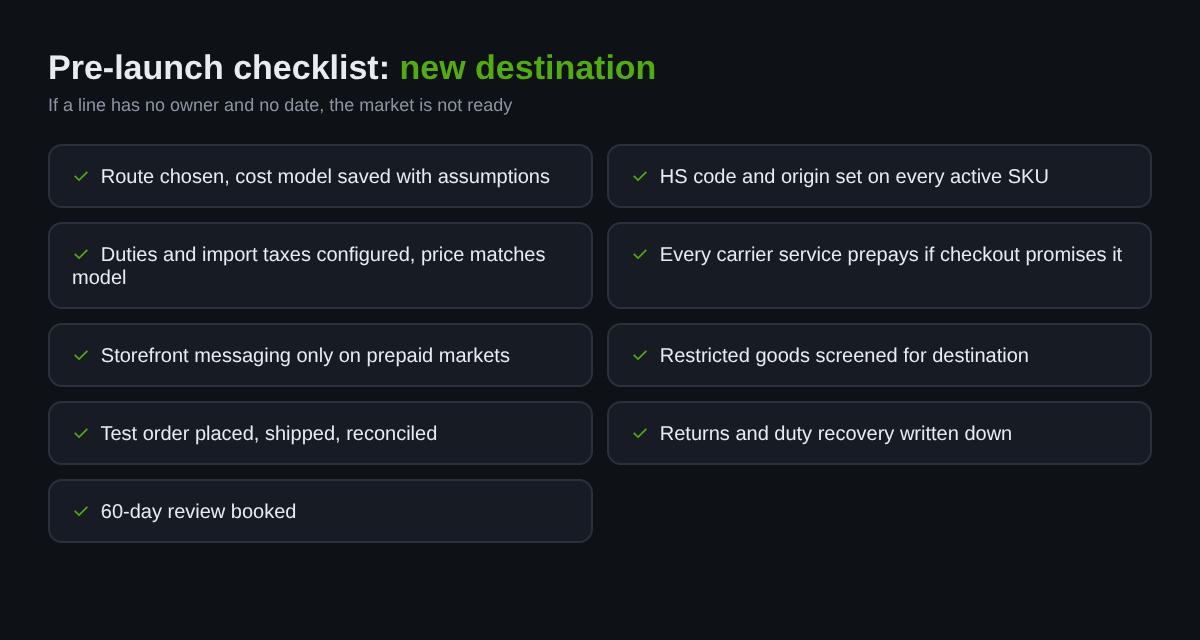
Run this list for every market. If a line cannot be answered with a name and a date, the market is not ready.
- The route (A, B, C or D) is chosen and the cost model is saved with its assumptions.
- HS codes and country of origin are set on every active SKU, with an owner named for ongoing maintenance.
- Duties and import taxes are configured in the Market, and the displayed price matches the model within a tolerance you set.
- Every carrier service mapped to the market prepays duty if the checkout promises it.
- Storefront messaging only appears for markets flagged as prepaid.
- Restricted goods (cosmetics, electronics, food, health products are the usual suspects) are screened for the destination.
- A real test order has been placed, shipped and reconciled end to end.
- The returns route and duty recovery process is written down.
- A 60-day review date is in the calendar.
What to do this week
If you are an Australian brand already selling overseas, pull your last 90 days of international orders and run the script above with your real numbers. If the fee layer is under 2% of sales, stay on Route A and fix classification and carrier mapping. If you are comparing a managed overlay, ask for a written quote, a supported-country list, and a screenshot of the customer-facing checkout disclaimer before you sign anything. If you are not sure which band you sit in, we would rather scope it with you than guess. Start with our build assessment process and tell us which markets you are targeting.
Sources
- Shopify Help Center: Overview of Managed Markets (eligibility, fees, limitations).
- Digital Applied, 20 August 2026: Managed Markets DDU sunset, citing Shopify’s 11 August 2026 changelog.
- Global-e documentation: Shopify native integration.
- Starshipit: Ship to the US, de minimis updates and guidance.
- Interparcel Australia: Shipping to the US, two clearance paths (Zonos fee, typical duty rate, MPF).
- Power Commerce: Managed Markets for Canadian and UK merchants.