
Most Australian Shopify brands that try to sell into the United States make the same three mistakes in the same order. They flip on a USD currency switch in their theme, copy their AU shipping table across to a US zone, and assume “Shopify will sort the tax thing out at some point.” Six months later they have a few hundred US orders, no idea which states they owe tax to, refund tickets from customers who got hit with a customs invoice they did not expect, and a shipping margin that quietly went negative on every order over two kilograms.
The US corridor is not the same animal it was eighteen months ago. The $800 de minimis exemption ended on 29 August 2025, which means every single parcel landing in the US now attracts duties and import taxes, regardless of value. According to Shopify’s own news desk, one in five merchants on the platform relied on de minimis, and a third of those had more than ninety percent of their shipments qualifying. That entire model is now gone. From 28 February 2026, postal carriers handling US-bound shipments can no longer use the flat-fee-per-item option and must use ad valorem duty calculation instead. The “throw it in a satchel and hope” approach is officially dead.
This is the exact technical setup we use when an Australian brand asks us to build their US corridor on Shopify. We have shipped this configuration on apparel brands sending hundreds of US orders a week, supplement brands navigating FDA labelling alongside customs, and homewares brands moving freight at twenty kilograms a unit. The stack changes around the edges. The spine of the configuration does not.
What changed in 2025 and why the old playbook does not work
Until August 2025, an Aussie brand could ship sub-$800 parcels into the US duty-free under the de minimis rule. That was the floor most cross-border launches were built on. You priced in USD, you used Australia Post International Standard, you absorbed the conversion fee, and you let the customer worry about the rare oversized order that exceeded the threshold.
The repeal blew that model up overnight. Every shipment now carries duty exposure. Carriers are restructuring fee schedules. Customs brokerage costs that used to be optional are now baked into every B2C parcel. And US Customs and Border Protection has the staffing to enforce it, because the policy goal was to slow down the wave of low-value direct-from-China parcels that had been entering duty-free for years.
For an Australian merchant, the practical effect is this: if your US checkout does not collect duties and import taxes at the point of sale, your customer gets a surprise invoice from DHL or FedEx three days after they order. Industry data on the post-de-minimis period shows package abandonment at the door climbing into double-digit percentages once that bill arrives. You do not get a chargeback. You get a one-star review and a refund request you cannot decline.
The Shopify Markets configuration we ship for every AU to US build
We run every AU to US launch on standard Shopify Markets, not Managed Markets. The reason is structural: Managed Markets (Shopify’s merchant-of-record service that bundles tax registration, duties, fraud screening, and global shipping) is currently restricted to US-based merchants fulfilling out of US locations. Per Shopify’s own help docs, an Australian-based store cannot route an order through Managed Markets even if the destination is the US. Aussie operators have to use standard Markets and bolt on the missing pieces.
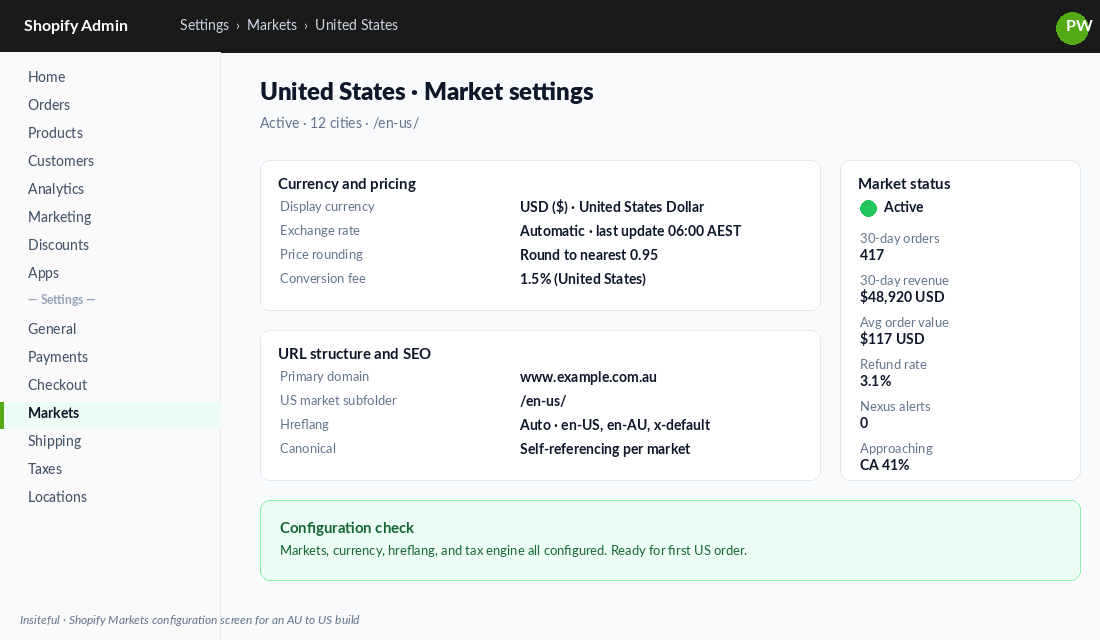
Here is the configuration we apply in Shopify Admin under Settings then Markets:
- Create a dedicated United States market. Do not lump it into a “Rest of World” bucket. The US needs its own market because the tax, duty, and currency settings differ from Canada, the UK, and the EU.
- Set the URL structure to /en-us/ subfolder. Shopify Markets automatically generates hreflang tags for every market subfolder, so your US pages get the right “en-US” language-region pairing and your AU pages stay on the root domain with “en-AU”. Subfolders keep domain authority consolidated on the primary domain rather than splitting it across country code top-level domains.
- Enable USD pricing with manual or automatic exchange rates. Automatic rates pull daily from Shopify’s currency feed. Manual rates let you stabilise prices and protect margin during AUD volatility. Most brands we build for sit on automatic with a 5 to 8 percent margin buffer baked into the AUD price.
- Turn on price rounding. Round to nearest 0.95 or nearest whole number depending on the price band. Without rounding, US shoppers see prices like $47.32 next to a competitor’s $49.95 and the perceived value drops.
- Set Shopify Payments to accept USD. The conversion fee is 1.5 percent in the United States and 2 percent in most other regions. As of 6 April 2026, that fee is calculated on the gross order amount, so the stated rate now matches the actual rate exactly. Budget this into your contribution margin model.
The one configuration mistake we see on almost every store we audit is leaving the US market on the merchant’s primary AUD currency with “show prices in customer’s local currency” toggled at the theme level. That is not Markets. That is a presentation layer with no underlying market structure. The checkout still settles in AUD, the conversion fee gets applied at the gateway level, and the customer’s bank charges them an additional foreign-transaction fee they will absolutely notice. Done properly, the US market should settle in USD with the conversion handled inside Shopify Payments.
Sales tax nexus: when an Australian brand actually has to register
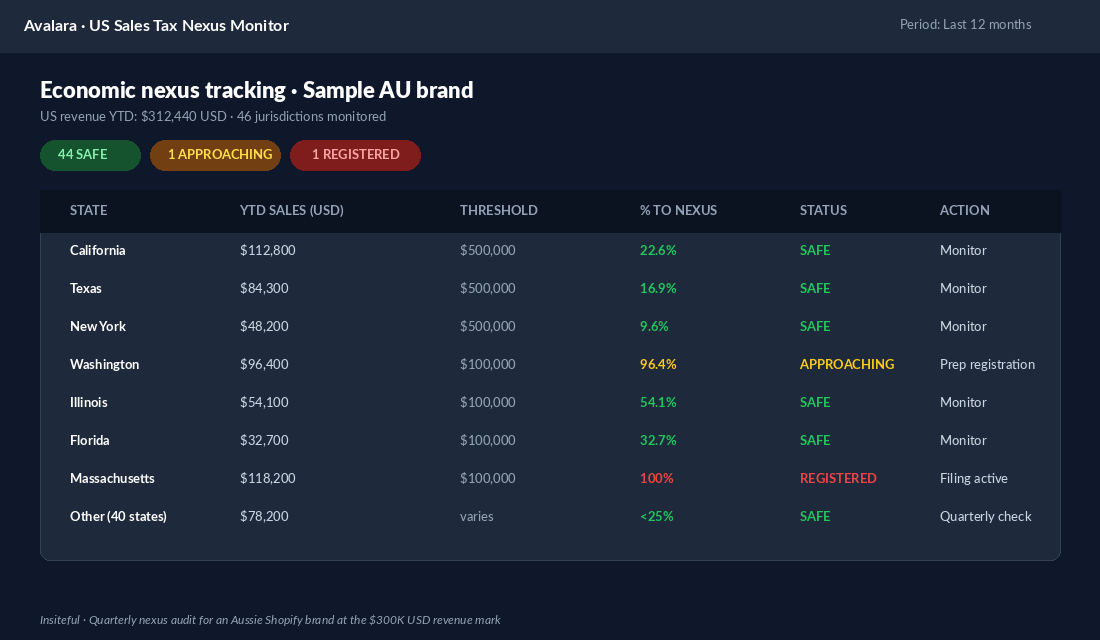
This is the part most Aussie founders get wrong, and it is the part that costs the most when it goes wrong. The US does not have a single national sales tax. Forty-six jurisdictions (forty-five states plus the District of Columbia) levy sales tax independently, and each one decides when a remote seller is obligated to collect.
That obligation is called economic nexus, and the trigger is generally one of two things: you exceed a dollar threshold of sales into that state, or you exceed a transaction-count threshold. The most common threshold sits at $100,000 USD in gross sales per state per year. California sits higher, at $500,000 USD. New York requires both more than $500,000 in sales and more than 100 transactions. As of 1 January 2026, sixteen states have removed their transaction-count thresholds entirely and now use revenue only, which simplifies the picture but does not lower the obligation.
For most Australian brands sending parcels into the US, here is the actual mental model we give them: you will not trigger nexus in most states for a long time. A brand doing $250,000 USD a year in the US spread across all fifty states will rarely hit nexus anywhere. The brand that gets caught is the one doing $400,000 USD a year with 40 percent of sales concentrated in California, where they have already blown past the $500,000 threshold mid-year and did not notice.
The setup we ship looks like this:
- Enable Shopify Tax for the US market. Shopify’s US tax liability dashboard tracks your sales against the threshold in every state and tells you when you are approaching the trigger.
- Wire in Avalara or Numeral for jurisdiction-level rate calculation. Shopify Tax handles the obvious states. Avalara fills in the long tail and handles filing once you cross nexus. We typically default to Avalara for clients running over $200,000 USD a year into the US, and Numeral for leaner stacks.
- Add a “tax collected on your behalf” line to your checkout breakdown. US buyers expect tax to be visible at checkout. Leaving it bundled into the price kills trust on review-stage shoppers comparing your site to Amazon and US-domestic competitors.
- Document a nexus monitoring cadence. Quarterly is enough for most brands. Stick it in the SOPs you hand to your finance person. The day you cross nexus is the day you have thirty to ninety days to register and start collecting, depending on the state.
For a brand doing $750,000 AUD in US revenue, we typically see Avalara fees land in the $200 to $400 USD per month range once you are collecting in three or four states. That is the genuine cost of doing this properly. Brands that try to skip it usually find out about the obligation when a state mails them a back-tax assessment two years later.
Duties at checkout: DDP is non-negotiable now
You have two ways to handle import duties on a US order. DDU (Delivered Duty Unpaid) means the customer pays the carrier when the parcel lands. DDP (Delivered Duty Paid) means you collect the duty and import tax at checkout and remit it through your carrier or duty engine.
Pre-2025, DDU was the lazy default. With de minimis killing most small-parcel duty exposure, the customer often paid nothing. Now that de minimis is gone, DDU means every customer gets an unexpected bill at the door, and that bill comes from a carrier they do not have a relationship with. The conversion damage is not theoretical. We have rebuilt three AU brands that had US repeat-purchase rates collapse from 28 percent to 11 percent in the four months after the de minimis change, before they moved to DDP.
The DDP stack we ship:
- Shopify duty calculation at checkout. Shopify’s native duties feature, available on all plans, calculates HS-code-based duty and import tax at checkout. The calculation fee was temporarily reduced to 0.5 percent on 2 February 2025 and remains at that rate as of our most recent client builds.
- HS code mapping on every product. The product’s harmonised system code determines the duty rate. We map this once during product import, then audit quarterly. The wrong HS code on a single SKU can swing duty by twelve percent and is the most common error we find on existing builds.
- Zonos as the fallback engine. For brands with more than 200 SKUs or complex assemblies, Zonos handles HS code suggestion, landed cost prediction, and customer-facing duty display in a way native Shopify cannot match. Zonos sits in front of checkout and feeds the calculated duty back into the cart.
- Carrier-side duty remittance. DHL Express and FedEx International Priority both support DDP at the label level. UPS Worldwide Saver does as well. Australia Post International Express does not handle DDP cleanly for high-value parcels, which is one reason we route most US shipments through DHL or FedEx for orders over $500 AUD.
Shipping carriers: what we actually use, what we remove
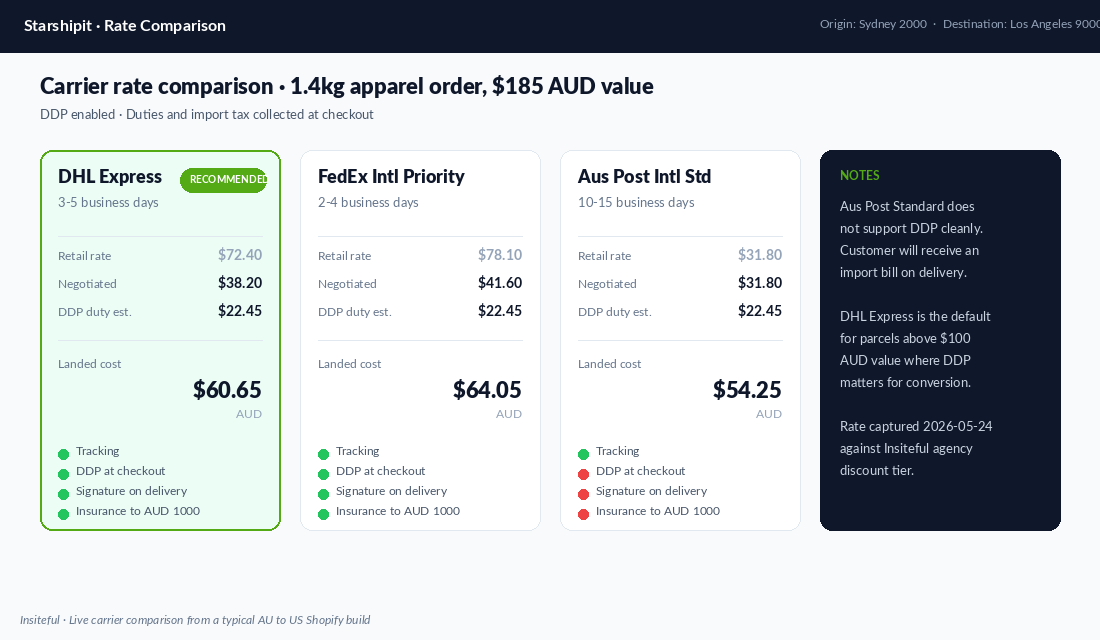
Shipping cost is where AU to US economics get won or lost. We benchmark every build against the same three-carrier matrix.
- Australia Post International Express or Standard. Cheapest at the low end, slowest, no real DDP support. We use it only for parcels under 500g and under $100 AUD value where customers have explicitly chosen “economy” on the shipping selector.
- DHL Express Worldwide. Three to five business days door-to-door. Clean DDP integration. Our default for orders between $100 and $1,500 AUD value.
- FedEx International Priority. Two to four business days. Slightly more expensive than DHL on small parcels, often cheaper on dim-weight-heavy shipments. We use it for fragile or oversized items.
- UPS Worldwide Saver. Competitive on certain US-east-coast routes. We bench it in every quote but rarely default to it for AU origin.
The Shopify Shipping native rate engine handles DHL Express and Sendle natively for Australian merchants and quotes discounts of up to 88 percent off retail on supported lanes. For everything else, we wire in Starshipit or Easyship as the multi-carrier orchestration layer. Both pull live rates from each carrier, apply your negotiated discounts, and feed back into the Shopify checkout in under 400 milliseconds.
The carrier rule we apply on almost every US build: do not display flat-rate shipping above a certain order threshold. Below $200 USD cart value, a flat-rate “$24.95 to US” works. Above that, switch to carrier-calculated rates so dim weight does not silently eat margin on a single oversized item. We have rebuilt three brands this year where a single 18-kilogram bedding bundle was losing them $80 AUD per US order under a misconfigured flat rate.
The currency display details that quietly cost conversions
This section is the small-stuff that founders ignore and that has compound effect on US conversion rate. Get all five right and US conversion typically lifts 0.4 to 0.9 percentage points without any other change to the store.
- Currency selector visible above the fold. US visitors landing on /en-us/ should see “USD” confirmed in the header, not buried in the footer. Trust comes from explicit confirmation that they are looking at US pricing.
- Free returns policy localised to the US. The US shopper expects returns to be free or close to free. If your AU policy stays visible on the US store, conversion drops. We localise the return policy page and the checkout assurance copy for the US market.
- Phone number formatted to US conventions. If you have a US contact number, format it +1 (555) 555-5555. If you only have an AU number, omit it on the US market rather than displaying a +61 number that signals “international charges may apply” to US callers.
- Sizing in US conventions. Apparel needs US size mapping. Homewares need imperial measurements. Beauty needs fluid ounce conversions alongside millilitres.
- Cents in checkout, not pounds. US shoppers expect prices like $49.95 and totals like $52.13. Round to nearest .95 in Markets settings and the perceived legitimacy of the store doubles.
The five-store data we audit before recommending a US launch
We do not let an Australian brand turn on the US market until we have looked at five specific data points. Two of these are pre-launch. Three are 30-day post-launch checks.
- Pre-launch one: AOV and margin model in USD. Build a contribution-margin spreadsheet in USD with shipping, duty, tax, and Shopify fees stripped out. If contribution margin falls below 35 percent on the average US order, the corridor is not viable yet. Either the AUD-to-USD pricing buffer needs widening or the product mix is wrong for the market.
- Pre-launch two: US-specific landing page traffic test. Send 500 visits of US-geotargeted Meta traffic to the new /en-us/ collection. Check that page-load is sub-2.5 seconds for US-IP visitors (it will be slower than AU because the request is travelling further). If LCP is over 3 seconds, fix the hosting region setup before opening checkout.
- Post-launch one: customs invoice rate. In the first 30 days, log every customer support ticket mentioning a customs invoice, duty, or DHL fee. If more than 5 percent of US orders generate one of these tickets, your DDP setup is broken and you are quietly leaking trust.
- Post-launch two: refund rate vs AU benchmark. US refund rate should sit within 1.5 percentage points of your AU refund rate by day 30. If it spikes higher, the cause is almost always either delivery time confusion or sizing issues.
- Post-launch three: state distribution. Pull a sales-by-state report at day 30. If 40 percent or more of revenue is coming from one state, you are at higher risk of hitting nexus in that state mid-year. Plan registration accordingly.
The brands that do well on this corridor treat the US as a separate business unit with its own P&L, not a “we also ship to America” extension of the Australian store. That mental model change is half the work.
How We Do It at Insiteful
When an Australian Shopify brand briefs us on a US corridor build, we run a fixed seven-step process. The shape of it has not changed in three years, even as the rules underneath have moved.
- Step one: corridor audit. We look at your current US data (if any), your AUD landing model, your existing carrier accounts, and your tax position. This is a half-day exercise and tells us whether the brand is actually ready to ship into the US or whether a unit-economics problem needs solving first.
- Step two: Markets architecture spec. We document the exact Markets configuration, currency settings, URL structure, hreflang plan, and theme localisation requirements. This becomes the build brief.
- Step three: tax and duty stack selection. We choose Avalara vs Numeral vs Shopify Tax based on the brand’s revenue projection and existing finance stack. We choose Zonos vs native duties based on SKU count and product complexity.
- Step four: carrier setup and rate testing. We open or migrate the DHL, FedEx, and Australia Post accounts, wire them into Shopify Shipping or Starshipit, and run rate-shop simulations on the top fifty SKUs to validate margin.
- Step five: build and stage. The US market gets stood up on a development theme branch, fully localised, with the duty calculator and tax engine wired in. We run end-to-end test orders from US-IP traffic before launch.
- Step six: soft launch. We open the US market to a single segment (typically Meta retargeting of US site visitors) for the first two weeks. This gives us live data without exposing the brand to a full-funnel launch on a configuration we have not stress-tested.
- Step seven: handover and dashboards. We hand the brand a Shopify dashboard tab pinned to US-market metrics, a quarterly nexus check SOP, and a runbook for what to do when a state mails them a notice. The brand owns it from there.
The US corridor is one of the hardest configurations we ship on Shopify. The tax surface area is larger than any other market we build for, the duty mechanics changed mid-2025, and the carrier landscape rewards brands that have negotiated DHL or FedEx rates already. It is also the corridor where doing the work properly compounds the most. The brands we have shipped through this process are typically running US revenue at 20 to 40 percent of their AU base by month twelve, with margins that hold up because the configuration is built for the actual rules rather than the 2023 version of the rules.
If you are weighing up a US launch
The shortcut version of all of this: standard Shopify Markets with a dedicated US market, USD pricing with manual or automatic rates and price rounding, Shopify Tax plus Avalara or Numeral for nexus monitoring and filing, DDP through Shopify’s native duty calc or Zonos depending on SKU complexity, DHL or FedEx as your default carriers above $100 AUD value, and a 30-day post-launch audit cycle on customs invoices, refund rate, and state distribution. That is the spine. Everything else is the brand-specific work we do in the build.
If you are running an Australian Shopify or Shopify Plus store and the US is the next market on your plan, that is exactly the kind of call we help founders make. Talk to the Insiteful team and we will walk you through the corridor audit before you commit to a build.