
For a decade, Australian brands shipping internationally have been quietly subsidised by de minimis thresholds. Orders under $800 USD entered the United States duty free. Parcels under €150 slid into the EU without customs duty. The UK waved through anything under £135. You could run a growing export business from Melbourne or Brisbane without ever thinking about a tariff schedule.
That era is finished. The US scrapped its threshold in August 2025, the EU follows this month, and the UK has locked in its own removal for 2028. Every one of those parcels now attracts duty, and someone has to pay it: either your customer at the door, with all the refused deliveries and chargebacks that come with that, or your checkout, calculated upfront and collected cleanly.
This is a build problem, not a policy problem. Shopify has a native duties engine that handles the calculation and collection, but it only works when the underlying product data, market configuration and carrier setup are done properly. This article covers the full setup we now run for every Insiteful client selling offshore: what changed, what Shopify charges, the HS code data work, market-by-market configuration, and the carrier reality out of Australia.
The three dates that ended duty-free ecommerce exports
Three separate governments have dismantled their low-value import exemptions, on three different timelines. If you sell into the US, EU and UK from Australia, you are dealing with all three.
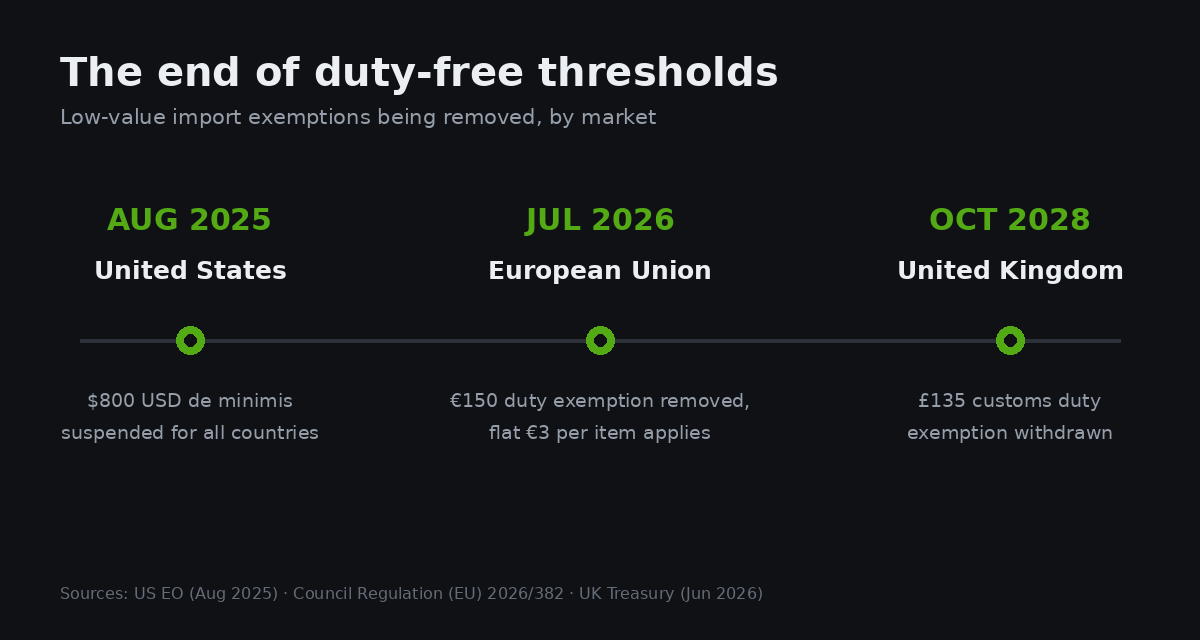
United States, 29 August 2025. The $800 USD de minimis exemption was suspended for all countries by executive order. More than 1 billion packages entered the US under de minimis in 2024, which tells you how much cross-border commerce was built on that single rule. The disruption was severe enough that Australia Post temporarily paused US-bound shipments while it worked out how to handle duty collection. The Australian government’s own export guidance at business.gov.au now warns exporters that every US shipment can attract duty regardless of value.
European Union, 1 July 2026. The €150 customs duty exemption is gone as of this month. Under Council Regulation (EU) 2026/382, low-value B2C consignments now attract a flat €3 customs duty per product line item, with the associated product identifiers becoming mandatory on customs declarations from 1 November 2026. IOSS still handles the VAT side for consignments up to €150, but duty is now a separate, unavoidable line.
United Kingdom, 1 October 2028. The UK Treasury brought forward the removal of its £135 customs duty exemption from March 2029 to October 2028. The £135 supply VAT rule already requires overseas sellers to register with HMRC and charge UK VAT at checkout on low-value consignments. Duty joins the picture in just over two years.
The pattern is obvious. Treasuries have noticed the revenue leaking through low-value parcels, and the political appetite for taxing imported ecommerce is strong everywhere. Building your international checkout around duty-free thresholds is building on land that governments are actively reclaiming.
DDP or DDU: decide who pays, and when
Every international order resolves to one of two incoterm models. Delivered Duty Paid (DDP) means the duty and import tax are calculated and collected at your checkout, the carrier invoices you, and the parcel clears customs with everything prepaid. Delivered Duty Unpaid (DDU, formally DAP) means the parcel arrives at the border unpaid, the carrier or postal operator fronts the duty, and your customer gets a demand for payment plus a disbursement fee before delivery.
DDU is how most Australian stores still ship, because it was invisible under de minimis: no duty applied, so nobody ever received the demand. Now the demands are real. A US customer who bought $180 AUD of knitwear gets an email from the carrier asking for duty, brokerage and a processing fee before the parcel moves. A meaningful share refuse to pay, the parcel comes back, and you are out the freight both ways plus the refund.
The conversion data says shoppers punish surprise costs harder than almost anything else. Baymard Institute’s meta-analysis puts the average cart abandonment rate at 70.19%, and the number one stated reason, cited by 48% of US shoppers who abandoned, is extra costs that were too high or unexpected: shipping, taxes and fees. A duty demand that lands after purchase is the worst version of this, because the shopper has already paid once and the second bill arrives from a courier they never chose.
DDP at checkout is the fix, and it is what the platforms, carriers and now regulators are all converging on. The customer sees the true landed cost before paying, the carrier gets prepaid clearance data, and the delivery completes without a doorstep negotiation.
What Shopify’s native duties engine actually does
Shopify’s duties and import taxes feature calculates landed cost at checkout: duty, import tax and applicable fees, based on the destination, the product’s HS code, its country of origin and its declared value. It is configured from Settings, then Taxes and duties, and per market from the Markets screen.
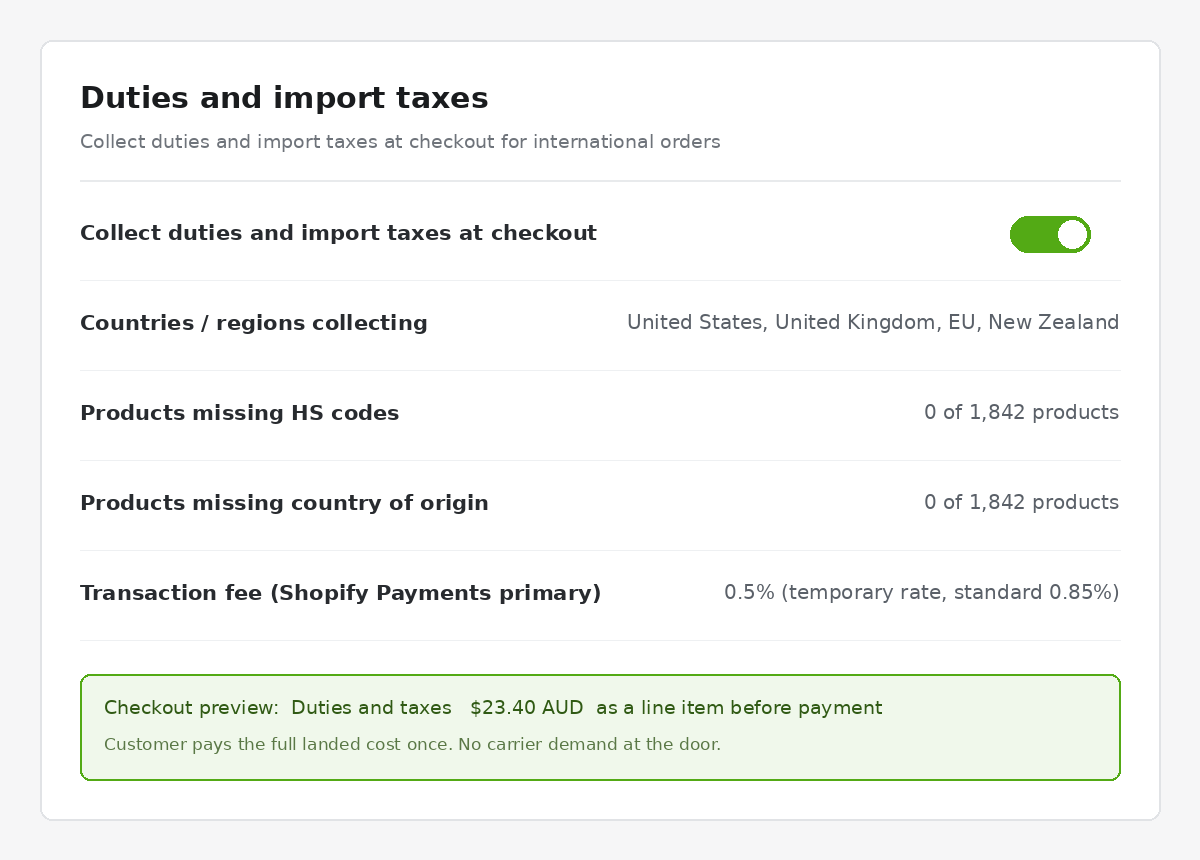
The commercial terms matter, because they land straight on your margin. Shopify charges a transaction fee on every order where duties are calculated at checkout: 0.85% where Shopify Payments is the primary gateway, 1.5% where it is not. Since 2 February 2025 the fee has been temporarily lowered to 0.5% for all merchants, and Shopify has not committed to an end date. On $400,000 AUD of annual international sales, the difference between 0.5% and 1.5% is $4,000 AUD a year, which is a decent argument for keeping Shopify Payments primary if you were on the fence.
The prerequisites are where most stores fall over, and they are exactly the things a quick setting toggle does not fix:
- A DDP-capable carrier. If you buy labels through Shopify Shipping, the carrier has to support DDP labels. If you use a third-party fulfilment integration, it has to pass the prepaid duty data through. More on the Australian carrier picture below.
- HS codes on your products. Without them, Shopify falls back to estimating duty from your product description and category, which is exactly as accurate as it sounds. A wrong estimate at checkout becomes a second charge at the border, which defeats the entire purpose.
- Country of origin on your products. Origin determines whether preferential trade agreements apply. Australian-made goods entering markets with an active free trade agreement can attract reduced or zero duty, but only if the origin data is present and correct.
One more operational note: the fee applies to every order where a calculation ran, even when the calculated duty is zero. Domestic orders and intra-EU shipments are excluded, but you should model the fee across your whole international order file, not just the orders that attract duty.
Why Managed Markets will not save Australian merchants
The obvious question from clients is whether to hand the whole problem to Shopify’s Managed Markets, the merchant-of-record service where Shopify’s partner entity becomes the legal seller, guarantees landed cost and files the tax paperwork.
The answer for Australian brands is blunt: you cannot use it. Managed Markets requires the business to be based in the continental United States, with US fulfilment locations. Canada and the UK are in early access. Australia is not on the list, and there is no announced timeline for it. Unless you operate a US entity with US fulfilment, which changes your tax position entirely and is a decision for your accountant rather than your developer, the managed route is closed.
That leaves Australian merchants exactly one path: the self-managed setup. Your store, your carrier accounts, your HS data, your market configuration. This is genuinely fine. The self-managed stack is capable and the fees are lower than a merchant-of-record cut. It just means the work described in the rest of this article cannot be outsourced to a toggle, and the stores that do it properly will convert measurably better than the stores that let the courier ambush their customers.
HS codes and country of origin: the data work nobody wants
Every product you ship internationally needs a Harmonized System code, the six-digit classification used by customs authorities worldwide, optionally extended with country-specific digits. Shopify uses the country-specific code where you have supplied one and falls back to the six-digit global code otherwise. Switzerland additionally requires product weight, so if you sell there, your weights need to be real numbers rather than the 0.0 kg placeholder we find in most audits.
On a catalogue of 40 products this is an afternoon in the admin. On a catalogue of 4,000 SKUs it is a data project, and we run it through the duties CSV rather than the product screen. Shopify exports a file of products with missing customs data from Settings, then Taxes and duties, then Manage; you classify, fill and re-import. The file structure is simple:
Product Handle,Variant SKU,Country of origin,HS code
merino-crew-navy,MC-NVY-M,AU,6110.30
merino-crew-navy,MC-NVY-L,AU,6110.30
canvas-weekender,CW-OLV,VN,4202.92
trail-sock-3pk,TS3-BLK,AU,6115.95
For stores where product data is managed outside Shopify, in a PIM or ERP, we set the same fields programmatically. HS code and origin live on the inventory item in the Admin API, so the mutation is:
mutation {
  inventoryItemUpdate(
    id: "gid://shopify/InventoryItem/41234567890",
    input: {
      countryCodeOfOrigin: AU,
      harmonizedSystemCode: "6110.30"
    }
  ) {
    inventoryItem { id countryCodeOfOrigin harmonizedSystemCode }
    userErrors { field message }
  }
}
Two practices keep this accurate over time. First, set a default country of origin in Settings so that new products created without explicit origin data inherit something sensible, then treat the default as a safety net rather than a strategy. Second, make HS classification part of the product creation workflow, not an annual cleanup. The classification itself is worth real attention: knitted versus woven garments carry different chapters, completeness matters, and a systematically wrong code is a customs compliance problem, not just a conversion problem. For ambiguous categories we cross-check against the destination country’s tariff lookup rather than trusting the first autocomplete suggestion.
Matching settings to each market’s tax rules
Duties collection in Shopify is configured per market, and the right configuration differs by destination because the tax rules differ by destination. This is where the setup stops being a checkbox and starts being an architecture decision.
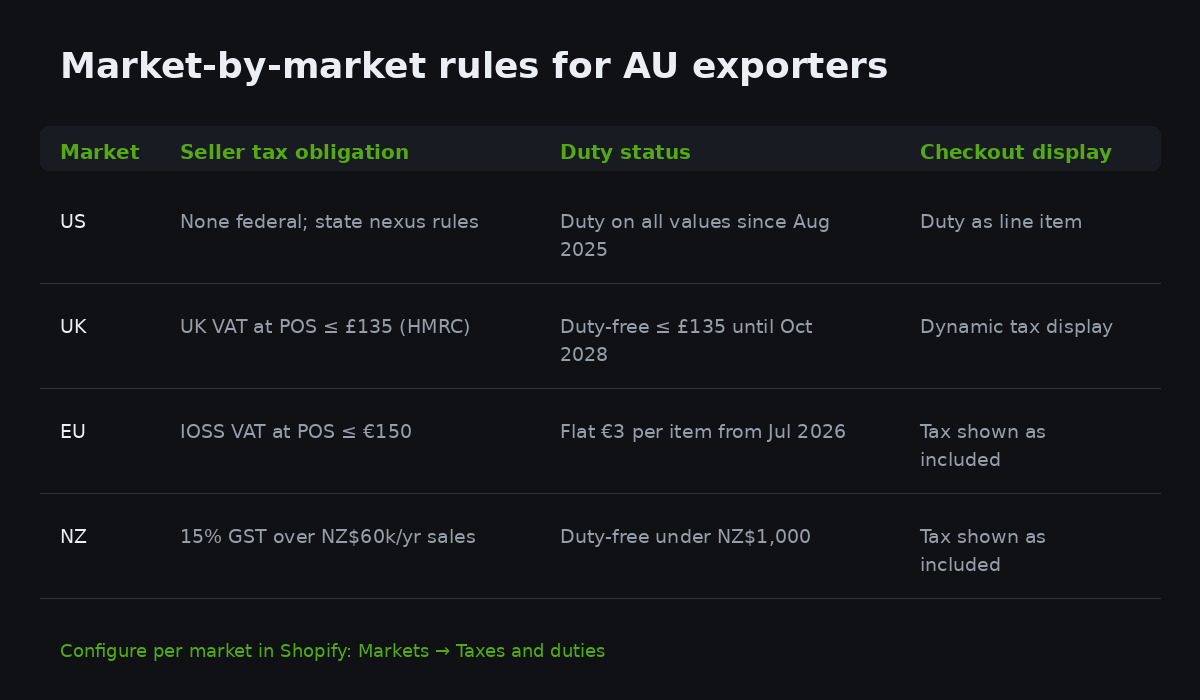
United States. No de minimis, so every order can attract duty. Collect duties at checkout as a line item, and make sure your product pages set expectations for US shoppers. With no federal VAT equivalent, the duty line is the whole story.
United Kingdom. Consignments of £135 or less require you to register for UK VAT, charge it at the point of sale and remit to HMRC. Above £135, import VAT and duty apply at the border, which is where DDP collection earns its keep. From October 2028, duty applies at all values. Shopify’s dynamic tax display handles the inclusive-pricing expectation UK shoppers have.
European Union. Register for IOSS and collect destination-country VAT at checkout for consignments up to €150, then let the duties engine add the new flat €3 per-item customs duty that applies from this month. Display taxes as included for EU markets: European shoppers read a tax-exclusive price as a broken price.
New Zealand. Sellers over the NZ$60,000 annual threshold to NZ consumers must register for NZ GST and charge 15% at checkout on low-value goods. For most Australian brands NZ is the second market by volume, so this threshold arrives earlier than founders expect.
In each market’s configuration you also choose whether duties appear as a separate line item or get absorbed into product prices. For premium brands we generally absorb into the displayed price in tax-inclusive markets and show a line item in the US, where itemised charges are culturally normal. Whichever you choose, the total at the payment step must be the final number the customer ever sees. If you already run market-specific pricing, this slots alongside the setup covered in our multi-currency pricing guide, and your geolocation routing should be sending shoppers to the right market in the first place, which we covered in the country selector build.
The carrier problem: DDP labels out of Australia
Collecting duty at checkout only works if your carrier can clear the parcel as prepaid. This is the step Australian merchants have the least control over, and it is where the August 2025 disruption actually bit: the duty calculation was never the problem, the postal network’s ability to remit collected duty to US customs was.
The practical hierarchy out of Australia today: the express integrators, DHL Express, FedEx and UPS, all offer genuine DDP services with billed-back duty, and they are the dependable route for DDP into the US. Australia Post’s international services have restored US delivery through its partner arrangements, but capabilities differ by service tier, so verify DDP support for your specific product and lane rather than assuming it. Freight-forwarder platforms that sit between Shopify and carriers can also handle prepaid clearance on postal-economy rates, which matters for low-AOV brands where express freight would eat the margin.
Whatever the mix, your checkout settings and your fulfilment reality must agree. Collecting duty on a lane where your carrier ships DDU is worse than collecting nothing: the customer pays at checkout and then gets charged again at the door. When we audit international setups, the checkout-to-carrier mismatch is the single most damaging fault we find, precisely because it looks like the job is done.
How we do it at Insiteful
International duties setup is part of every build and replatform we scope for a brand selling offshore, and we run it the same way each time.
First, an export audit. We pull twelve months of international orders and model landed cost by lane: order values, destinations, current incoterms, refusal and return rates. For one Victorian apparel client doing about $700,000 AUD a year into the US, the August 2025 change put roughly $95,000 AUD of annualised revenue at risk on lanes that were shipping DDU with no duty collection at all. That number is what gets a board to approve the fix.
Second, the data build. HS classification and country of origin across the full catalogue, via the duties CSV for merchant-managed data or the Admin API for PIM-driven stores, with spot checks against destination tariff schedules on the top revenue products.
Third, market configuration. Duties collection switched on per market, tax display matched to local expectation, pricing rounded per market so the duty-inclusive totals still land on clean price points.
Fourth, the carrier proof. Before anything goes live we run test orders on every active lane and confirm the label, the customs data and the prepaid clearance actually line up end to end, then we recheck whenever a carrier or fulfilment partner changes. The theme-level work, delivery estimates and duties messaging on the product page and in the cart, ships with the same release so customers are never surprised.
The result on that apparel client: US checkout conversion recovered to within 4% of domestic within two months of go-live, and duty-related delivery refusals went to effectively zero. The setup pays for itself on avoided returns alone.
Duty-free is gone. Surprise fees are optional.
The thresholds that made international shipping simple are not coming back, and the brands that respond with accurate landed-cost checkouts will take share from the ones that let couriers deliver the bad news. If you are selling into the US from Australia, the wider setup, tax, currency and shipping, is covered in our Australia-to-US playbook, and the international SEO side lives in our hreflang and URL structure guide.
If you would rather have it built properly once, that is what we do. Start with a build assessment and we will audit your international setup, model what the threshold changes cost you, and scope the fix.