
Most Australian Shopify brands reach a point where local growth plateaus and international starts looking like the obvious next move. The US ecommerce market is worth roughly 14 times the size of the Australian market. The UK, Canada, and Germany collectively represent another enormous opportunity for brands with the right product and positioning.
The question is never whether to go international. It is how to set up your store to do it properly.
We see two failure modes repeatedly when new clients come to us. First: brands who forced their existing single-store setup into every market simultaneously, with no localised pricing, no tax compliance, and no geo-routing, and watched international conversion crater as a result. Second: brands who spun up a separate Shopify store for every country and ended up with an operational nightmare they could not sustain. In 2026, Shopify gives you three distinct paths to international: Shopify Markets, Markets Pro, and deliberate multi-store architecture. Each solves a different problem. Choosing the wrong one costs you in conversion, compliance, and complexity.
What Shopify Markets Actually Does in 2026
Shopify Markets is the platform’s built-in framework for selling across multiple countries from a single store. It launched in 2021 and has been significantly expanded since. In 2026, it is the default starting point for almost every international expansion strategy we recommend.
The core mechanism: you define a “market” (a country or group of countries), then configure pricing, currency, language, domains, shipping, and tax rules specific to that market. Shopify routes incoming visitors to the correct market version using geo-IP detection, serving locally configured content, pricing, and checkout.
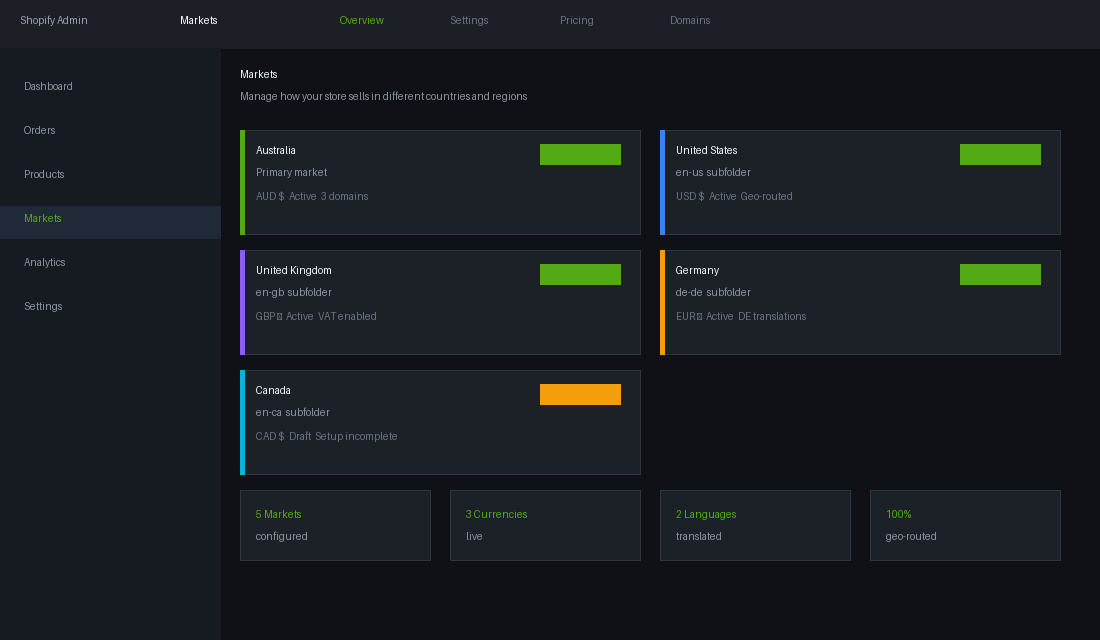
Here is what Markets handles natively in 2026:
- Domains and URL structure. You can serve each market from a subdirectory (/us/, /uk/, /de/), a subdomain (us.yourstore.com), or a separate custom domain (yourstore.co.uk). Subdirectory is our recommended setup for most brands because it consolidates SEO authority under one root domain rather than splitting it across multiple properties.
- Currency and local pricing. Shopify can auto-convert prices from your base currency, or you can set fixed local prices per market. Fixed local pricing almost always converts better. AU $79.99 presented to a US customer as US $51.84 raises questions. US $54.99 does not.
- Payment methods. Shopify Payments supports local payment methods across most major markets. Germany gets SOFORT and giropay. The Netherlands gets iDEAL. The US gets ShopPay, Apple Pay, and Google Pay. These are enabled automatically when you activate the relevant market.
- Language and translation. Shopify’s free Translate and Adapt app handles machine translations with manual override capability. For brands where copy quality is a differentiator, a human translator reviewing PDPs, the homepage, and the checkout is still worthwhile.
- Shipping rates. Market-specific shipping zones and rates mean AU customers see AUD shipping prices and US customers see USD rates with appropriate carrier options for their region.
- Tax collection. Shopify automatically calculates and collects tax for supported regions, including US sales tax via Shopify Tax, EU VAT for digital goods, and UK VAT for shipments under £135. Whether you are registered to collect tax in those jurisdictions is still your responsibility.
Markets is not a plug-and-play international solution. It removes the technical complexity of multi-currency and multi-language, but it does not handle duties at checkout, complex tax registration, or cross-border logistics. That is where Markets Pro comes in.
What Markets Pro Adds (and What It Costs)
Markets Pro is Shopify’s managed cross-border commerce solution, built on a partnership with Global-e. If standard Markets is the framework, Markets Pro is the full service. The critical difference: Markets Pro has Global-e act as the Merchant of Record for international orders, which shifts the legal and operational responsibility for cross-border compliance onto the platform.
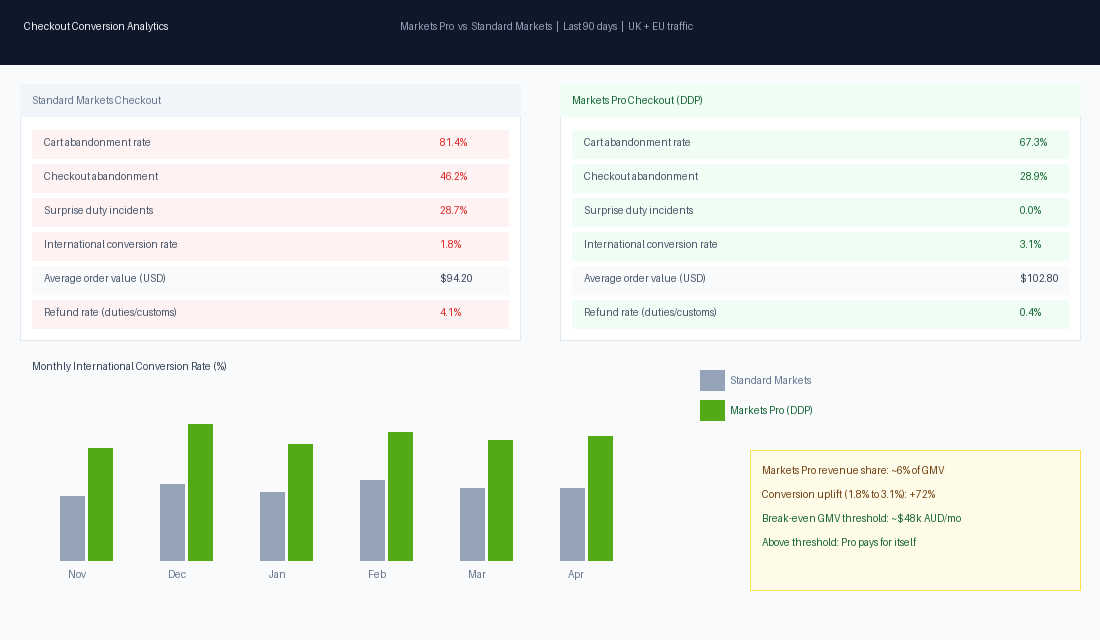
- Duties and taxes calculated at checkout (DDP). Every Markets Pro checkout shows the customer the fully landed cost: product price, shipping, duties, and import taxes, calculated in real time. No surprise customs bills. No abandoned parcels at the border. In our experience working with brands expanding into the UK and EU, DDP checkout lifts international conversion rates by 15 to 25% compared to DDU (Delivered Duty Unpaid) checkout, where the customer discovers the extra cost weeks later.
- 100+ local payment methods. Beyond what standard Shopify Payments covers, Markets Pro adds Klarna, iDEAL, Bancontact, PayU, and dozens of regional options collectively covering over 95% of global ecommerce transaction volume.
- Fraud protection. Global-e handles fraud screening for international orders. For brands that have been burned by high fraud rates on cross-border transactions, this is a material operational benefit.
- Managed returns. Markets Pro includes a cross-border returns solution. This is one of the highest pain points for brands selling internationally, particularly into the EU where consumer return rights are strong and logistics are complex.
The cost: Markets Pro charges a revenue share fee rather than a flat subscription. The rate is typically in the range of 5 to 7% of GMV processed through the platform, depending on your volume and negotiated terms. For a brand generating $500,000 AUD in international revenue annually, that is $25,000 to $35,000 per year.
That sounds significant until you calculate the alternative: a compliance consultant, manual returns management, checkout friction on duties, and a higher international refund rate. Markets Pro makes economic sense for brands moving serious cross-border volume, roughly $50,000 AUD or more per month internationally, into high-friction markets like the UK, EU member states, and Japan. For an Australian brand testing the US market with a few thousand dollars per month in international sales, standard Markets is almost always sufficient.
The Multi-store Alternative: When It Still Makes Sense
Multi-store architecture was the only real option for international expansion before Markets launched. Most agencies still have legacy clients running this setup, and there are legitimate use cases where it remains the right answer.
Shopify Plus expansion stores. Shopify Plus includes up to nine expansion stores at no additional platform cost beyond the Plus subscription itself. If you are already on Plus and need near-complete separation between markets, different product catalogues, different brand identities, different team access structures, expansion stores are effectively free to add from a platform perspective.
Genuinely different product ranges. If your AU store sells 800 SKUs and your US store would only carry 150 of them due to import restrictions, certification requirements, or distribution agreements, a separate store avoids the operational complexity of managing catalogue visibility rules per market inside a single store. Markets does support market-specific product availability, but at high catalogue complexity levels a separate store is often cleaner to maintain.
Regulatory isolation requirements. Some industries, particularly food, supplements, pharmaceuticals, and certain apparel categories, face such different regulatory environments by country that a single-store setup creates real compliance risk. Separate stores with separate legal entities and separate Shopify accounts provide cleaner audit trails.
Different brand identities. If your international market operates under a different brand name, common in licensed product situations and some franchise models, separate stores make more sense than attempting to serve two distinct brand identities from a single Shopify store.
The real cost of multi-store is operational, not technical. Every product update happens in two or five or nine places. Every sale or promotion is configured separately. Inventory sync between stores requires either a dedicated app (Syncio, Multiorders, or Trunk) or custom development. For brands without Plus, every expansion store requires a separate Shopify subscription, another $79 to $399 AUD per month per store at minimum.
Decision Matrix: Markets vs Markets Pro vs Multi-store
Here is how the three architectures compare across the eight dimensions that matter most for international operations:
| Dimension | Shopify Markets | Markets Pro | Multi-store |
|---|---|---|---|
| Catalogue management | Single catalogue, per-market visibility rules | Same as Markets | Separate catalogues, requires sync tooling |
| Currency and pricing | Auto-convert or fixed local prices | Same, plus 100+ local payment methods | Fully independent per store |
| Tax and duties | Shopify Tax (US), manual VAT elsewhere | Fully managed DDP via Global-e | DIY or via app per store |
| Shipping configuration | Market-specific zones and rates | Same, plus Global-e managed logistics | Fully independent per store |
| Language and translation | Translate and Adapt app, per-market | Same as Markets | Fully independent themes per store |
| SEO and hreflang | Automatic hreflang injection (subdirectory) | Same as Markets | Manual hreflang across separate domains |
| Cost and complexity | Included in all Shopify plans | 5 to 7% GMV revenue share | Additional subscriptions per store |
| Brand and UX control | High, within one theme | High, Global-e overlay on checkout | Complete, independent per store |
SEO and Hreflang Reality Check
hreflang is the HTML attribute that tells search engines which version of your content targets which language and region. Getting it wrong means Google may index the wrong market version of your store for international searches, or show AU pricing to US visitors. It is one of the most common technical SEO failures we see on international Shopify stores.
Shopify Markets handles hreflang automatically for subdirectory and subdomain configurations. When you activate a market and assign it a URL format, Shopify injects the correct hreflang tags across all templated pages:
<link rel="alternate" hreflang="en-AU" href="https://www.yourstore.com.au/" />
<link rel="alternate" hreflang="en-US" href="https://www.yourstore.com.au/en-us/" />
<link rel="alternate" hreflang="de-DE" href="https://www.yourstore.com.au/de-de/" />
<link rel="alternate" hreflang="x-default" href="https://www.yourstore.com.au/" />
The x-default tag is critical. It tells Google which version to serve when no other hreflang rule matches the visitor’s locale. This should always point to your primary market. Omitting it is one of the most common hreflang mistakes we see on Shopify Markets builds.
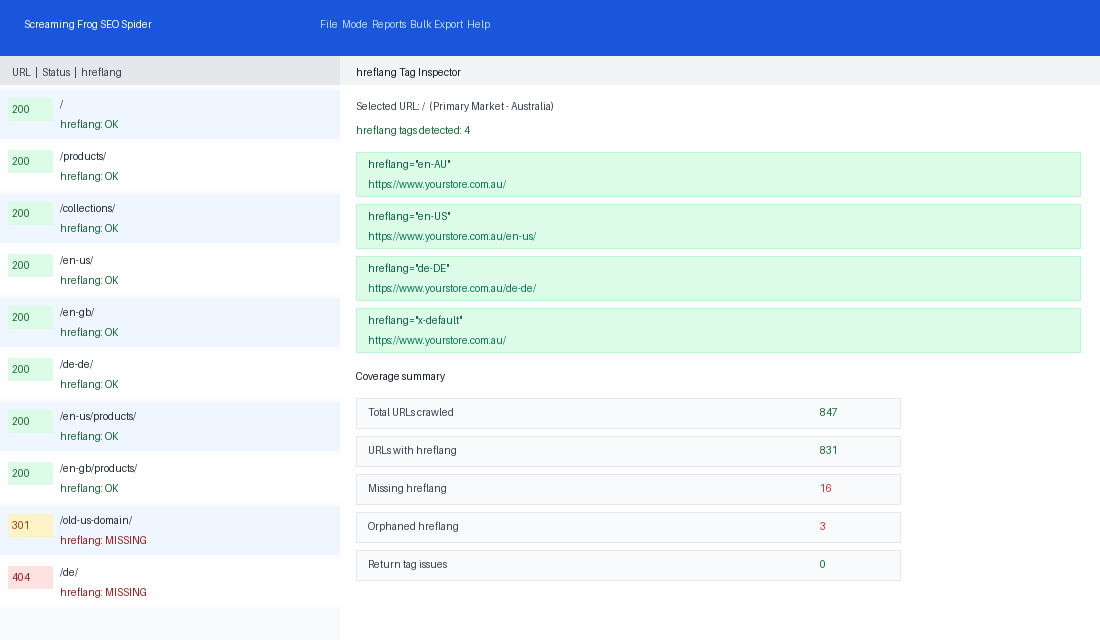
For multi-store setups, hreflang is entirely your responsibility. You will need to either hardcode cross-domain hreflang tags in each store’s theme head, use a hreflang sitemap approach, or rely on a dedicated SEO app. Missing or incorrect hreflang tags across multiple stores is one of the top technical SEO issues we resolve when brands migrate from multi-store to Markets.
One practical limitation of Markets: the automatic hreflang injection only covers pages generated by Shopify’s Liquid template system. Custom sections, third-party page builder content, and any components sitting outside the standard template pipeline will not get hreflang tags automatically. Auditing coverage after launch is a non-negotiable part of every international build we do.
The geo-routing configuration Shopify uses by default redirects visitors based on IP address. A critical setting to get right is whether the redirect allows user override:
{
  "market": "en-US",
  "domain_type": "subfolder",
  "subfolder": "/en-us/",
  "redirect_mode": "auto",
  "allow_override": true
}
With allow_override set to true, a visitor who manually navigates to a different market URL keeps that preference. Without it, you create a redirect loop where users who want to view a specific market version of your store keep getting bounced back to their geo-detected market. This particularly affects international journalists, influencers, and customers using VPNs, all of whom are disproportionately valuable traffic.
Tax and Duties Operational Impact
Tax compliance is the part of international commerce that catches brands out most often, and most expensively. Here is the operational reality for Australian brands expanding into the major markets.
United States. There is no federal sales tax in the US. Each of the 46 states that levies sales tax has its own rates, thresholds, and filing requirements. Shopify Tax calculates and collects the correct rate automatically once activated. Your obligation: register for sales tax collection in states where you meet the economic nexus threshold, typically $100,000 in annual sales or 200 transactions in that state. Most brands start triggering nexus in California, Texas, and Florida well before other states.
United Kingdom (post-Brexit). If UK annual sales exceed £85,000 (roughly $175,000 AUD), you must register for UK VAT. For individual shipments valued under £135, VAT is collected at point of sale and remitted by you. Above £135, duties apply at the border and the customer is responsible unless you are using DDP. Markets Pro handles UK VAT and duties automatically via Global-e’s Merchant of Record arrangement.
European Union. The EU’s One Stop Shop (OSS) scheme simplifies VAT registration. Register in one EU member state and file a single quarterly return covering all EU consumer sales. For goods shipped from outside the EU with a value under EUR 150, the Import One Stop Shop (IOSS) scheme handles import VAT collection at checkout. Above EUR 150, customs duties apply at the border. Markets Pro automates IOSS compliance; standard Markets does not.
Here is a worked AU-to-US tax and duty calculation for typical consumer goods shipments:
| Scenario | Product Value (AUD) | USD Equivalent | US Duty | US Sales Tax | Total Add-on Cost |
|---|---|---|---|---|---|
| Standard apparel item | $120 | ~$78 | $0 (below $800 de minimis) | Collected by Shopify Tax if nexus met | $0 in duties |
| Premium leather bag | $450 | ~$293 | $0 (below $800 de minimis) | Collected at checkout | $0 in duties |
| High-end watch | $1,550 | ~$1,008 | ~$101 (10% on watches, HS 9102) | Collected at checkout | ~$128 inc. processing fee |
| Premium apparel bundle | $1,850 | ~$1,202 | ~$240 (20% avg. on apparel above $800) | Collected at checkout | ~$267 inc. processing fee |
The US $800 de minimis threshold means the vast majority of Australian brands’ US shipments are duty-free. This is one reason AU-to-US is often the lowest-friction international expansion for brands in the $80 to $400 AUD product price range. The UK and EU are significantly more complex, which is where the Markets Pro conversation becomes commercially relevant.
How We Scope International Rollouts at Insiteful
When a client comes to us wanting to go international, the first conversation is not about which technology to use. It is about their order profile, their product catalogue complexity, and the specific markets they want to enter. The architecture decision follows from those inputs, not the other way around.
Step 1: Define markets by priority, not ambition. Most brands want to sell everywhere. Most brands should start with one or two markets and do them well. We look at where existing organic traffic originates, where Instagram followers are concentrated, and where wholesale enquiries come from. A brand already getting 30% of its traffic from the US is being told something important by the data.
Step 2: Audit catalogue complexity. If all products ship to all markets under the same HS codes and there are no regulatory exclusions, standard Markets is almost always the right call. If a significant portion of the catalogue cannot be sold in certain markets due to compliance restrictions, we model the overhead of managing visibility rules per market against running separate expansion stores.
Step 3: Map the compliance threshold. We project the client’s international revenue trajectory and map it against registration thresholds in each target market. A brand projecting $30,000 AUD per month to the UK needs to think about UK VAT registration from day one. Waiting until HMRC makes contact is a very expensive strategy.
Step 4: Select the architecture. Standard Markets suits most brands under $100,000 AUD per month in international revenue. Markets Pro becomes compelling above that threshold, particularly for EU and UK sales where duties and VAT compliance friction is highest. Multi-store is the answer when Plus expansion store economics apply, or when genuinely different catalogues or brands are involved.
Step 5: Build for handoff, not heroics. We document every market configuration, every tax setting, every domain redirect rule, and every hreflang coverage decision. The biggest failure mode on agency-built international stores is a configuration that only the agency understands. Our builds include a market management playbook the client’s team can run independently after handoff.
International expansion on Shopify in 2026 is genuinely more accessible than it has ever been. But accessible does not mean simple. The difference between a Markets build that converts at 3%+ internationally and one that struggles at under 2% is almost always in the configuration details: DDP versus DDU at checkout, correct hreflang coverage, fixed local pricing versus auto-converted, and tax compliance set up before the first international order ships rather than after the first compliance notice arrives.
If you are weighing up the right international architecture for your Shopify build, that is exactly the kind of scoping call we run with founders every week. Talk to the Insiteful team and we will map the right setup for your catalogue, your markets, and your growth trajectory.