
Neto was the default answer for a certain kind of Australian retailer for the best part of a decade. If you sold on your own site plus eBay, ran wholesale accounts alongside retail, and printed shipping labels from the same screen you managed orders on, Neto did all of it in one box. Then Maropost bought it in 2021, and over the past two years the deal changed. Subscriptions moved to USD. Bills doubled, then doubled again for some merchants. Support moved offshore. The product roadmap went quiet.
We are now getting more Neto migration enquiries than Magento and BigCommerce combined. This article is the playbook we run when we move a Neto (now Maropost Commerce Cloud) store onto Shopify: what actually transfers, what breaks, how to keep your eBay revenue alive through the cutover, and what the whole exercise costs in AUD. It is the companion piece to our migration SEO guide and the platform-specific playbooks we have already published for WooCommerce, BigCommerce and Squarespace.
Why Neto stores are moving now
The trigger is almost always the bill. On ProductReview.com.au, Neto merchants report subscription increases of 70 percent followed by a further 84 percent on the next invoice, with several describing a roughly 3x total increase over three years. The pattern that stings most for Australian businesses is the shift from a flat AUD subscription to a revenue-based model billed in USD. One reviewer’s $80 AUD per month plan became a revenue-calculated charge of around $250 USD per month. Several merchants report lodging complaints with the ACCC and the small business ombudsman over how the changes were communicated.
Meanwhile the platform they are moving to keeps compounding. Shopify runs roughly 26 percent of all ecommerce sites globally, and Australia is its third-largest market with more than 52,000 active stores. The buyer side justifies the investment: Australians spent a record $82.6 billion online in 2025 according to the Australia Post eCommerce Report, up 14 percent year on year, with online now representing 24 percent of total retail spend.
The numbers that matter for a Neto merchant weighing this up:
- Reported Neto price increases of 70 to 84 percent per renewal cycle, billed in USD (ProductReview.com.au, 2025)
- $82.6 billion AUD spent online by Australians in 2025, up 14 percent (Australia Post eCommerce Report 2026)
- 52,000+ active Australian Shopify stores, Shopify’s third-largest market globally (Demandsage, 2026)
- Shopify Marketplace Connect syncs eBay and Amazon listings free up to 50 marketplace orders a month, then 1 percent per order capped at $99 USD a month (Shopify App Store, 2026)
- Around 80 percent of Australian households shopped online in 2025, averaging four more purchases each than the year before (Australia Post, 2026)
None of that means you migrate carelessly. Neto is a deep platform, and the stores still on it tend to be the complex ones: multichannel, wholesale-plus-retail, high SKU counts. That complexity is exactly where migrations go wrong.
There is also a timing consideration that catches people out. Maropost contracts renew annually, and the painful pricing typically lands at renewal. If your renewal is four months away and a proper migration takes six to eight weeks plus a stabilisation period, the window to avoid paying for another full year at the new rate is tighter than it looks. We now ask for the renewal date on the first call and work the project plan backwards from it. Merchants who start scoping 5 to 6 months out cut over calmly; merchants who start six weeks out either rush the B2B rebuild or eat another year of USD billing.
What you are actually replacing: the feature map
The first document we produce on any Neto scoping call is a feature map. Neto bundles functions that Shopify splits between native features and apps, so you need to know where every workflow lands before you commit to a timeline or a budget. This is the standard mapping we start from:
| Neto function | Where it lands on Shopify | Notes |
|---|---|---|
| Products, variants, SKUs | Native | Watch the 100-variant limit per product on standard plans; 2,048 with the new variant model |
| eBay listing management | Shopify Marketplace Connect app | Built in Australia (formerly Codisto); links to existing eBay listings rather than recreating them |
| Wholesale / B2B pricing groups | Native B2B on Shopify Plus, or apps on standard | Companies, locations, price lists and net payment terms are native on Plus |
| Shipping label printing (AusPost, couriers) | Starshipit or Shippit app | Both are Australian, both print AusPost, both do live rates at checkout |
| Multi-warehouse inventory | Native (up to 10 locations, 200 on Plus) | Neto warehouse zones map to Shopify locations |
| Customer groups and account pricing | Native customer segments + B2B catalogs | Neto price groups need explicit mapping, do this before export |
| Kitting and bundled SKUs | Shopify Bundles app or Functions | Component-level inventory tracking needs testing, this is a common breakage point |
| Built-in POS | Shopify POS | See our POS Pro vs Lite breakdown for which tier you need |
| Accounting sync (Xero) | Xero integration via app | We covered the full setup in our Shopify Xero guide |
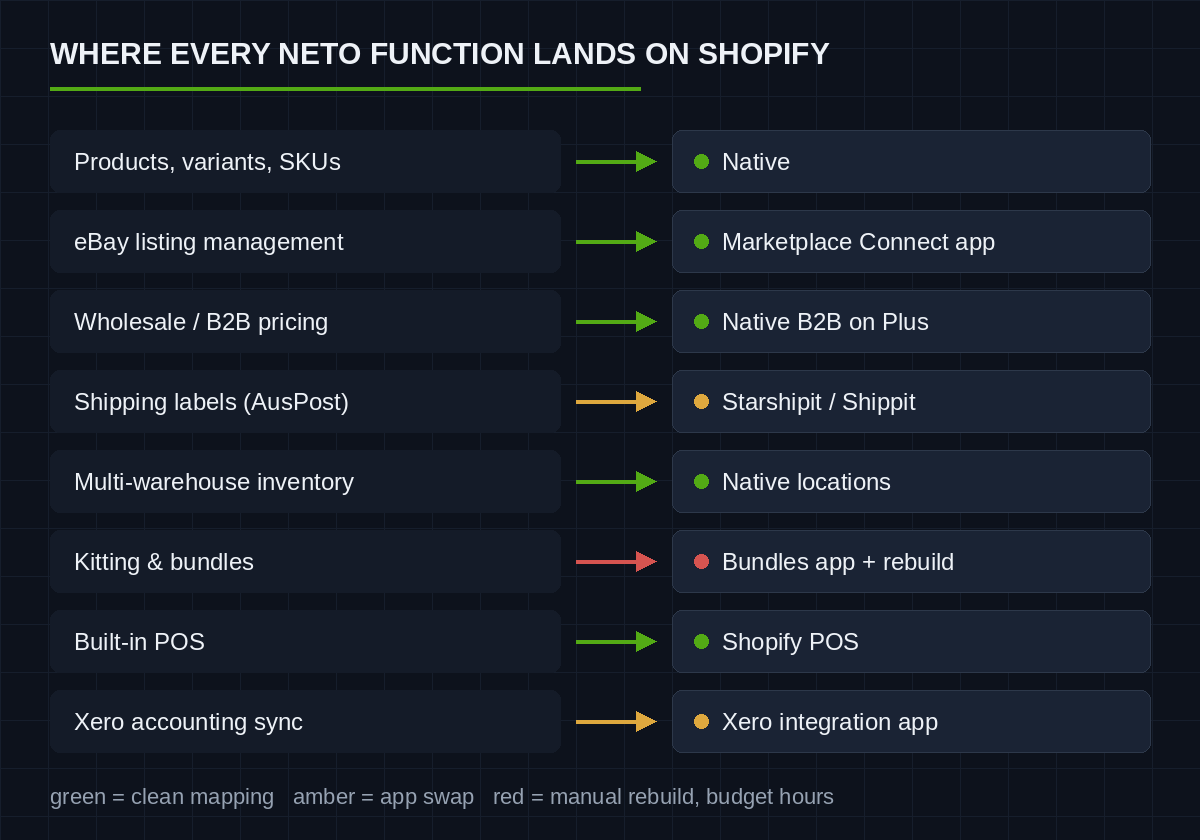
Two honest observations from running this exercise dozens of times. First, a Neto store almost always needs three to five paid apps on Shopify to reach feature parity, typically $150 to $400 AUD a month across the stack. Second, even after adding those apps, most merchants still come out ahead against Maropost’s current USD pricing, and they gain a theme ecosystem, an app ecosystem and a checkout that converts measurably better.
The data migration: what moves cleanly and what breaks
Neto’s export tooling is actually decent, which makes the extraction side easier than Magento. You can export products, customers and orders to CSV from the control panel, and the API is stable if you prefer a scripted pull. The problems are not in getting data out. They are in the shape of the data.
Here is the field-level reality:
| Data set | Migrates cleanly? | The catch |
|---|---|---|
| Products and variants | Yes | Neto specifics (product types, custom fields) become Shopify metafields; plan the schema first |
| Customers | Yes | Passwords never migrate on any platform; run a reset campaign at launch |
| Order history | Yes, as archived orders | Import order matters: products first, then customers, then orders, or nothing links up |
| Stored payment cards | No | Card data is never exportable; subscriptions must re-authorise |
| Wholesale price groups | Partially | Neto price groups export as columns; they must be rebuilt as Shopify price lists or app rules |
| Kitting components | No | Bundle relationships need manual reconstruction; budget real hours here |
| Gift voucher balances | Partially | Export balances, reissue as Shopify gift cards via API |
| Loyalty points | No | Needs a loyalty app on the Shopify side plus a balance import |
On a recent 12,000-SKU Neto migration we ran, the product and customer import was two days of work. The kitting reconstruction and wholesale price list rebuild was six. That ratio surprises people, and it is why quotes that only mention “data migration” without itemising B2B and bundle logic are usually underscoped.
For the import itself we script against the Shopify Admin API rather than pushing CSVs through the admin, because scripted imports are repeatable. We run the full import against a development store, QA it, throw the store away, fix the transform script, and run it again. By cutover week the import has usually been rehearsed three or four times. A simplified version of the product transform looks like this:
# Neto CSV -> Shopify product payload (simplified)
def transform(neto_row):
    return {
        "title": neto_row["Name"],
        "handle": slugify(neto_row["Name"]),
        "body_html": neto_row["Description"],
        "vendor": neto_row["Brand"],
        "variants": [{
            "sku": neto_row["SKU"],
            "price": neto_row["Price (Default)"],
            "inventory_quantity": int(neto_row["Qty In Stock"]),
            "barcode": neto_row["UPC"],
        }],
        "metafields": [
            {"namespace": "neto", "key": "legacy_id", "value": neto_row["Inventory ID"]},
        ],
    }
That legacy_id metafield is not optional housekeeping. It is the key that lets us verify every single product made the trip, and it powers the redirect map in the next section.
SEO: the redirect map is the whole game
Neto URL structure does not match Shopify’s. Neto product URLs typically live at the root or under custom paths, while Shopify enforces /products/, /collections/ and /pages/ prefixes. Every indexed Neto URL that returns a 404 after launch is rankings and revenue you paid for, thrown away. We covered the full methodology in our Shopify migration SEO playbook, so here is the Neto-specific version.
First, crawl the live Neto site and export every URL that has impressions in Search Console over the past 12 months. That union of crawled plus impression URLs is your redirect universe. Then generate the map programmatically using the legacy ID we stored during import:
# Redirect map: old Neto path -> new Shopify path
old_url,new_url
/big-red-widget,/products/big-red-widget
/widgets,/collections/widgets
/brand/acme,/collections/acme
/n/shipping-info,/pages/shipping
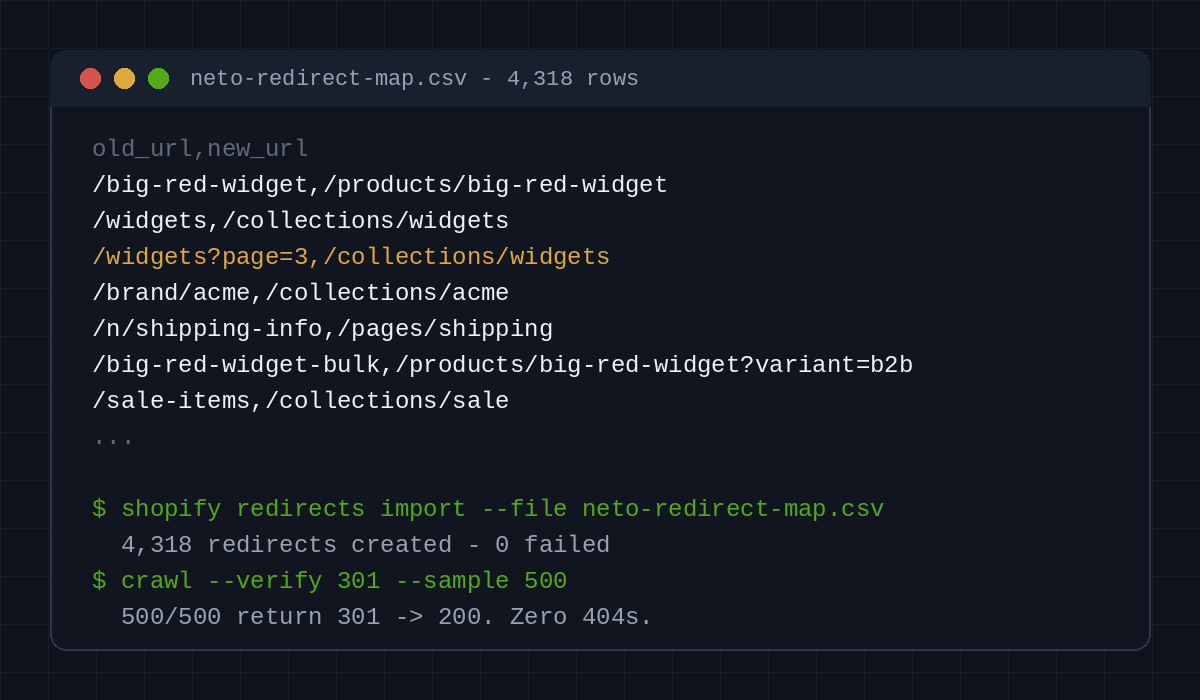
Shopify ingests this via the native URL Redirects importer or the Admin API, and it handles the 301s at the edge. The three Neto-specific traps we check every time:
- Category pagination and filter URLs. Neto generates crawlable filtered category URLs that often carry impressions. Redirect them to the parent collection rather than letting thousands of them 404.
- The sitemap lag. Submit the new sitemap the hour you launch, but leave the redirect layer in place permanently. We still see Neto-era URLs getting crawled 18 months after cutover.
- eBay referral links. Years of eBay listings, emails and marketplace descriptions contain hard-coded links to Neto URLs. Those keep sending traffic for years, and they only convert if the 301s hold.
Keeping eBay revenue alive through the cutover
This is the part that makes Neto migrations different from every other platform we move. A large share of Neto stores earn 30 to 60 percent of revenue on eBay, managed through Neto’s built-in listing engine. If the migration breaks those listings, the project has failed no matter how good the new site looks.
The good news: the strongest marketplace sync tool in the Shopify ecosystem is Australian. Marketplace Connect, formerly Codisto, was built in Sydney, was acquired into Shopify, and is now the first-party marketplace app. It is free up to 50 marketplace orders a month, then 1 percent per synced order capped at $99 USD a month. Critically, it can link to your existing eBay listings rather than deleting and relisting them, which preserves your sales history, your reviews and your search placement inside eBay.
Our cutover sequence for eBay continuity:
- Install Marketplace Connect on the new Shopify store before launch and connect the existing eBay seller account in link mode.
- Match listings to Shopify products by SKU. This is where disciplined SKU hygiene during the product import pays off; mismatched SKUs are the number one cause of double-selling after a migration.
- Run both systems in read-only overlap for 48 hours, comparing inventory counts on a 20-product sample every few hours.
- Flip order ingestion to Shopify, then disable Neto’s eBay sync. Never run two sync engines against one eBay account simultaneously.
Done in that order, eBay buyers never notice the replatform. Done out of order, you get stockouts, oversells and defect rates that take months of eBay account health to repair.
Shipping and fulfilment: replacing Neto’s label engine
Neto’s other genuinely sticky feature is integrated shipping: AusPost and courier labels, pick lists and packing workflows in the core platform. Shopify’s native shipping is thinner in Australia, so we replace this with Starshipit or Shippit, both Australian-built. Both print AusPost, StarTrack, Aramex and the major couriers, both do live rates at checkout, and both handle pick and pack workflows that warehouse staff coming off Neto will recognise within a day.
The decision between them usually comes down to volume and 3PL plans. Starshipit’s flat monthly tiers suit merchants doing their own fulfilment; Shippit’s per-label pricing and carrier network suit merchants who want negotiated rates without holding carrier accounts. On a recent migration for a Brisbane retailer shipping about 3,000 orders a month, the Starshipit setup replaced Neto’s label workflow one-for-one, and picking errors actually dropped because barcode scan-to-verify was included in the tier they chose.
The checklist we run before signing off the shipping workstream:
- Every Neto shipping service (AusPost parcel, express, international, courier) has a mapped equivalent in the new app, with live rates verified at checkout against the old store’s quotes on five real cart scenarios.
- Label formats print correctly on the warehouse’s existing thermal printers. This sounds trivial and it delays more launches than any API issue.
- Tracking notification emails are sent from the shipping app or Shopify, not both. Duplicate tracking emails are the most common day-one complaint.
- MyPost Business or AusPost contract rates are attached to the new account before launch, not after, so you never pay retail postage during cutover week.
If a 3PL is on your roadmap, we wire that differently; see our Shopify 3PL integration guide for how that architecture changes.
Timeline and cost in real numbers
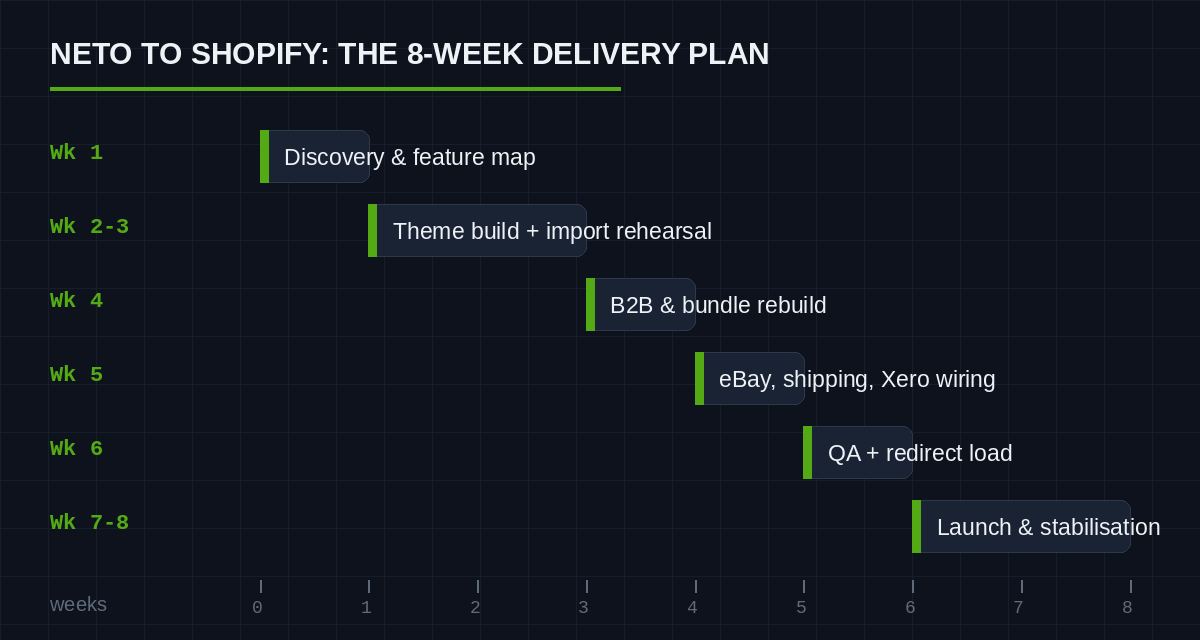
A Neto migration is a mid-weight project. It is heavier than Squarespace or WooCommerce because of the B2B logic and marketplace continuity work, and lighter than a Magento rebuild because Neto’s data exports cleanly. Our standard delivery runs six to eight weeks:
| Weeks | Workstream | Output |
|---|---|---|
| 1 | Discovery and feature mapping | Feature map, app stack decision, redirect universe crawl |
| 2-3 | Theme build and data transform scripts | Staging store, first full import rehearsal |
| 4 | B2B rebuild and bundle reconstruction | Price lists, company accounts, kit logic live on staging |
| 5 | Integrations | Marketplace Connect linked, shipping app configured, Xero connected |
| 6 | QA, redirect load, content freeze | Rehearsed cutover runbook |
| 7-8 | Launch and stabilisation | DNS flip, eBay sync handover, daily monitoring |
On cost: a straightforward Neto retail store with clean data lands at the lower end of our build range, around $8,500 to $12,000 AUD. Add wholesale price groups, kitting and a large eBay operation and you are realistically in the $15,000 to $25,000 AUD range. The recurring picture matters just as much: merchants coming off Maropost’s revenue-based USD billing routinely cut their platform-plus-apps line item by a third, and for stores doing $2M AUD or more in revenue the arithmetic gets better as you grow, because Shopify’s subscription does not scale with your turnover.
If you are still weighing whether Shopify is the right destination at all, our replatforming decision tree walks through the standard versus Plus versus stay-put logic honestly.
How we do it at Insiteful
We have been building ecommerce sites for 25 years and we run migrations as an engineering discipline, not a data-entry exercise. Every Neto project gets a scripted, rehearsed import that has been run end-to-end against a disposable development store at least three times before cutover week. Every product carries its Neto legacy ID as a metafield so we can reconcile counts to zero missing records. The redirect map is generated from a crawl plus Search Console impressions, not guessed from a sitemap. eBay sync is handed over in link mode with a 48-hour inventory overlap watch. And the B2B logic, the part most agencies underscope, is rebuilt and signed off by your wholesale customers’ actual login flows before anything goes live.
The result we aim for is boring: launch day where revenue does not dip, eBay does not blink, and the only thing your customers notice is that the site got faster. That is what a replatform should feel like.
Thinking about getting off Neto?
If Maropost’s pricing has forced the conversation, get the scoping done properly before you commit to anyone, including us. Walk through our build process and request an assessment. We will map your Neto feature set against Shopify honestly, tell you what the migration really costs, and flag anything in your setup that makes it harder than the sales pitch suggests.