
There is a quiet assumption baked into most agency pitches: if you want a genuinely fast Shopify store, you have to go headless. Rip out Liquid, stand up a React frontend on Hydrogen and Oxygen, and accept the build cost as the price of speed. It sounds technically credible. It is also, for the overwhelming majority of brands we work with, wrong.
We build exclusively on native Shopify at Insiteful. No Hydrogen, no Storefront API frontends, no composable stack. And the stores we ship routinely hit the same Core Web Vitals thresholds that headless builds are sold on, at a fraction of the cost and with none of the maintenance drag. This article is the technical case for why that is possible in 2026, and the exact build stack we use to get there.
If you are weighing a headless rebuild because someone told you your theme is the bottleneck, read this first. The architecture is almost never the problem. The implementation is.
What the 2026 performance data actually shows
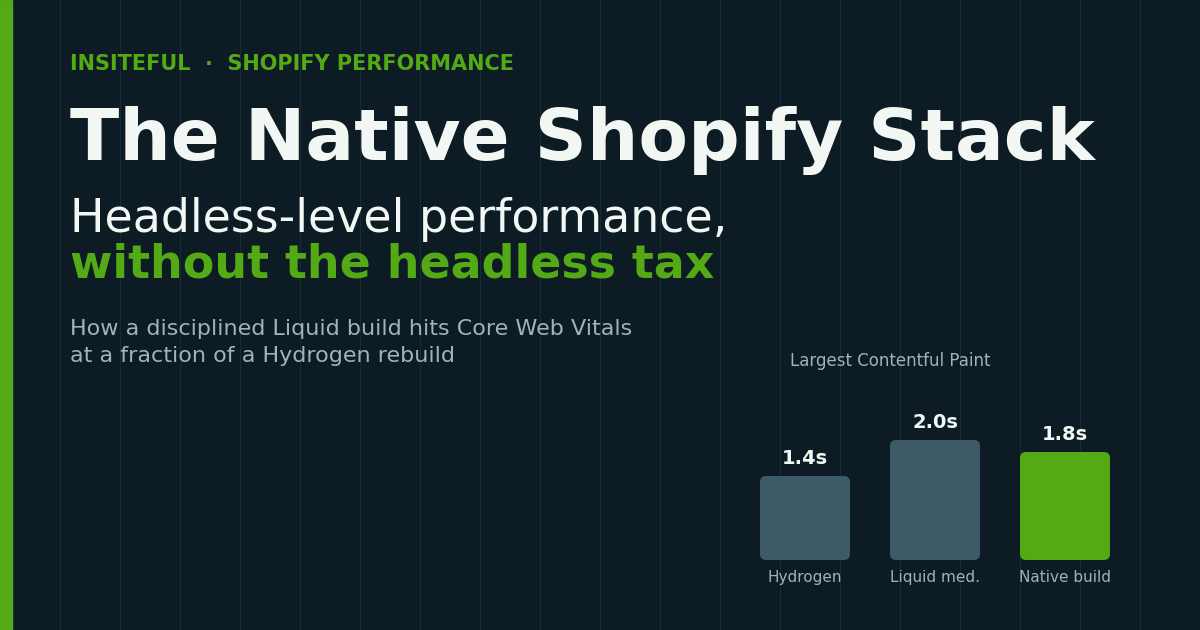
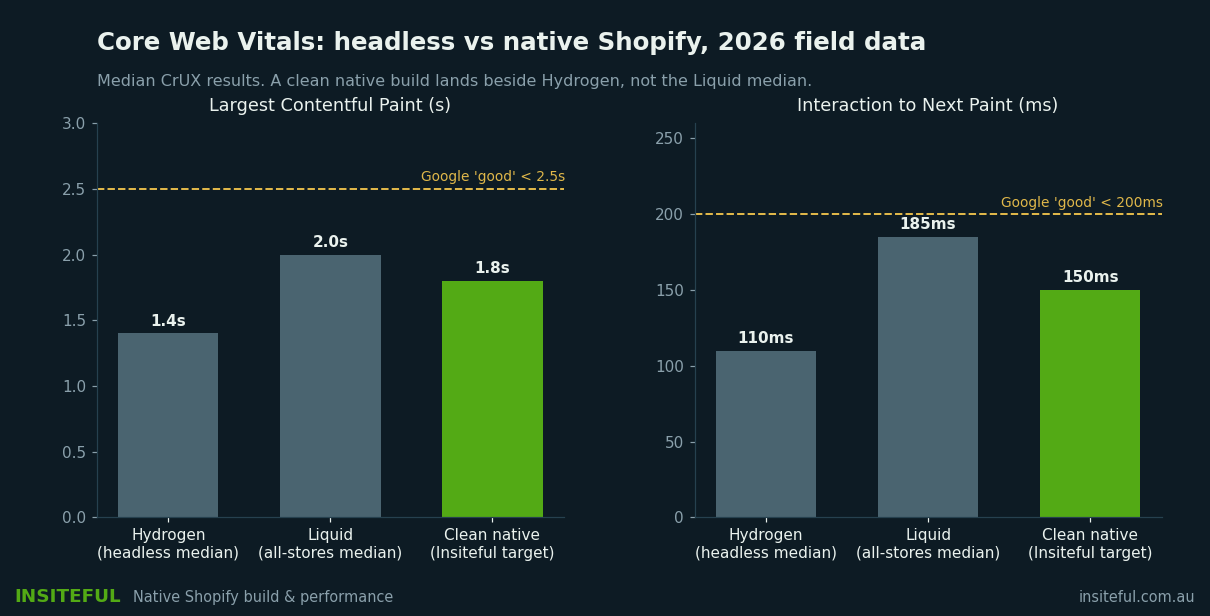
The headless speed argument rests on a real number. According to CrUX field data compiled across Hydrogen-powered stores in early 2026, the median Hydrogen storefront records a Largest Contentful Paint of 1.4 seconds, an Interaction to Next Paint of 110 milliseconds, and a Core Web Vitals pass rate of 78 percent. That is genuinely fast.
But the comparison that gets quietly left out is what well-built native themes are doing now. The same CrUX Technology Report shows traditional Shopify stores on Liquid and Online Store 2.0 recording a median LCP of 2.0 seconds, an INP of 185 milliseconds, and a 60 percent pass rate. That is the median across every Liquid store, including the bloated, app-stuffed, never-optimised ones. A clean, deliberately built theme sits much closer to the Hydrogen figures than to that median.
The honest conclusion, and the one the data keeps pointing to, is that architecture is not the primary determinant of storefront speed. Implementation quality is. A properly built Online Store 2.0 theme is no longer embarrassed in a side-by-side comparison with most headless implementations. The gap that remains is small, and it is reachable without leaving Liquid.
Here is the part that matters commercially. Google measures the field experience of real users, not a lab score. Only 42 percent of mobile sites pass all three Core Web Vitals, and mobile now accounts for 62 percent of ecommerce traffic. The opportunity is not to win a benchmark against Hydrogen. It is to be in the top 40 percent of mobile experiences while your competitors are not, and to do it without a six-figure rebuild.
The headless tax nobody quotes upfront
When a brand asks us to price a headless build against a native one, the sticker shock is rarely the build cost alone. It is everything that follows it.
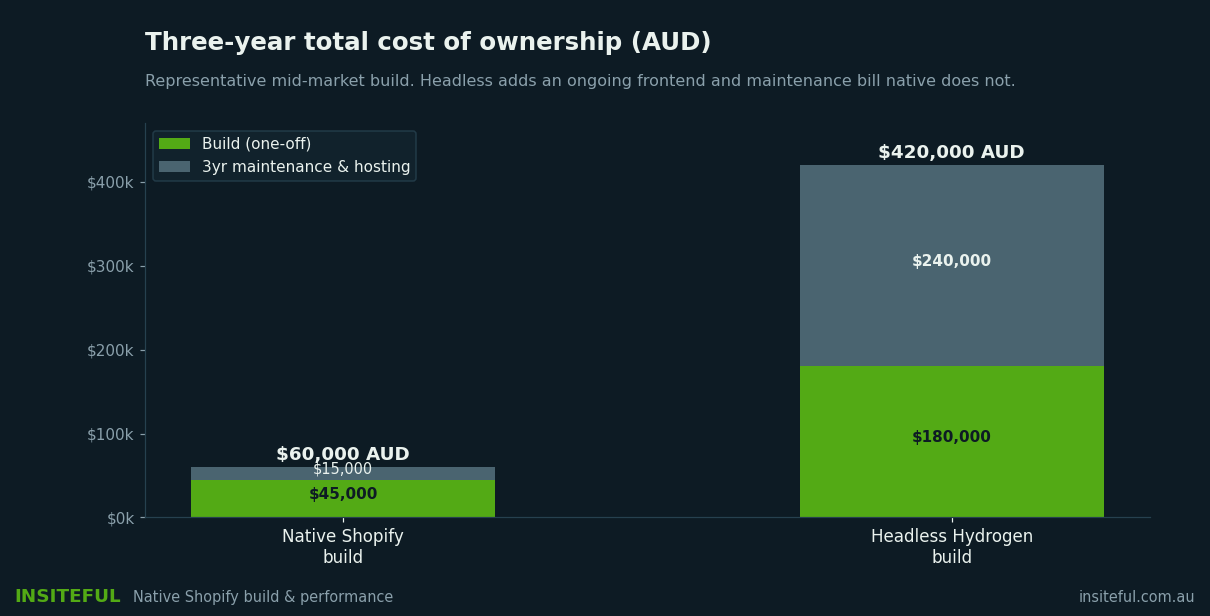
A production-ready headless Shopify storefront typically lands between $40,000 and $200,000 AUD to build, depending on complexity, and the ongoing cost is where it really bites. Headless storefronts cost roughly three to five times more to build and maintain than a traditional theme, because you become responsible for the frontend, the hosting, the CMS layer, and every custom integration. On native Shopify, platform updates and security patches are handled for you. On headless, they are your problem, indefinitely.
Consider a brand turning over $2M AUD a year. A typical conversion lift from a headless rebuild might be worth $120,000 AUD annually if everything goes perfectly. If the build costs $180,000 AUD and maintenance runs another $80,000 AUD a year, you have spent more than the upside before you see a dollar of return. For brands under roughly $5M AUD in revenue, the same budget spent on conversion optimisation and acquisition reliably returns three to five times more than the headless rebuild would.
Then there are the failure modes the brochure leaves out:
- App compatibility breaks. More than 80 percent of Shopify apps were built on the ScriptTag API, which injects JavaScript into Liquid themes. That injection point does not exist in a headless frontend. As of 2026, many mid-tier apps still ship no headless-native integration path, so reviews, upsells, and loyalty widgets you rely on may simply stop working.
- Maintenance is underestimated. A 2025 Gartner survey found that 62 percent of brands that adopted headless architecture overestimated their internal capacity to maintain it. The build ships, the team that built it moves on, and the store slowly rots.
- Migrations cost you traffic. Many brands see a three to six month organic traffic dip during a headless migration even with a technically correct implementation, simply because Google has to re-crawl and re-evaluate the entire site.
There is a softer cost too, and it is the one founders feel most. A headless store makes you dependent on developers for changes that take minutes on native Shopify. Want to reorder a homepage section, swap a hero image, or launch a landing page for a sale? On Online Store 2.0 your marketing team does it in the theme editor before lunch. On a headless frontend, that same change is a ticket, a sprint, and a deploy. The agency that built it becomes a permanent toll booth between you and your own store. For a family-founded brand where speed of execution is a competitive advantage, that loss of control is often more expensive over three years than the build itself.
None of this means headless is never right. For a $20M AUD brand with an in-house React team and a genuine need for a bespoke frontend, it can pay back inside 12 to 18 months. But that is a narrow band of businesses, and it is not the brand reading this.
Where native Shopify actually loses speed
If the theme architecture is not the bottleneck, what is? In nearly every slow store we audit, the answer is the same: apps and the JavaScript they drag in.
The data backs this up bluntly. The biggest INP gap is not between Hydrogen and Liquid. It is between a clean Liquid theme with no apps and a Liquid theme carrying fifteen of them. A stock Dawn theme with zero apps achieves an INP of around 120 to 140 milliseconds, which is within touching distance of the median Hydrogen store. Layer on the usual suspects, a reviews app, an email capture popup, an upsell engine, a photo-review widget, and a drag-and-drop page builder, and INP climbs to between 250 and 400 milliseconds. That is the entire performance gap, and it has nothing to do with whether you are running Liquid or React.
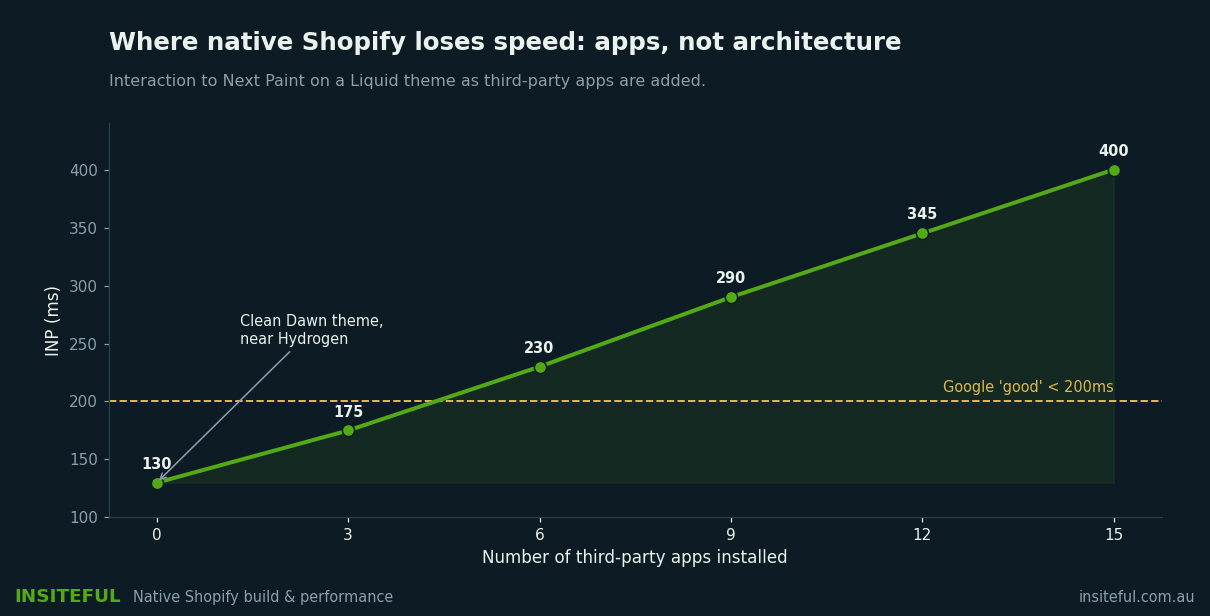
This is why our first move on any performance engagement is never “rebuild the theme.” It is an app audit. We map every third-party script, measure its main-thread cost, and ask a single question of each one: does the revenue this app produces justify the milliseconds it costs every visitor? Usually, three or four apps are doing real work and the rest are quietly taxing conversion. We have documented one audit that cut a client’s LCP from 4.8 seconds to 1.6 seconds by rationalising the app stack alone, without touching the underlying architecture.
The reason this gets missed so often is that apps fail silently. A reviews widget does not announce that it is adding 180 milliseconds to every interaction. A page builder does not flag that it is shipping a render-blocking script on pages that never use its features. The cost accrues invisibly across every session, every device, every customer, and it only shows up in the one place owners rarely look: field data on a mid-range Android phone over a suburban Australian mobile connection. That is the device and the network most of your customers are actually on, and it is nothing like the new laptop on office fibre where the store gets tested before launch. When we re-measure a slow store on a representative device, the culprit is almost always a stack of apps nobody has reviewed since they were installed, not the theme they were installed on.
The native build stack we ship
Here is the concrete part. When we build for speed on native Shopify, this is the stack of techniques that gets a store into the passing band. None of it requires leaving Liquid.
1. Responsive images served from the Shopify CDN in WebP
Images are the single largest contributor to LCP on most product pages. We never upload a 3000px image where 1500px will do, we keep hero images under 150KB and product images under 200KB, and we let the Shopify CDN do the format and resize work. WebP now has support across more than 96 percent of browsers, so it is our default with a JPEG fallback. The Liquid that drives this is simple and native:
<img
  src="{{ product.featured_image | image_url: width: 1200 }}"
  srcset="{{ product.featured_image | image_url: width: 600 }} 600w,
          {{ product.featured_image | image_url: width: 1200 }} 1200w,
          {{ product.featured_image | image_url: width: 1800 }} 1800w"
  sizes="(min-width: 750px) 1200px, 100vw"
  width="1200" height="1500"
  loading="eager" fetchpriority="high"
  alt="{{ product.featured_image.alt | escape }}">
The hero image loads eager with high fetch priority. Everything below the fold gets loading="lazy", which on its own typically saves between 0.5 and 1.2 seconds on product and collection pages.
2. Critical CSS inlined, the rest scoped per page
We inline the minimum CSS needed to paint above-the-fold content directly in the document head, so the browser can render the hero without waiting for a full stylesheet to download. Below that, we lean on a platform change Shopify rolled out in April 2026: per-page CSS scoping. Shopify now subsets CSS from {% stylesheet %} tags so each page only loads styles for the sections actually rendered on it, rather than serving every stylesheet on every page. To get the benefit, the rule we hold to is strict: each file’s CSS classes are used only within that file or within files it directly renders. Discipline in the theme structure is what makes the platform feature pay off.
3. JavaScript as progressive enhancement, never as a dependency
Our themes are built so that core functionality, navigation, add to cart, and content rendering, works in HTML and CSS first. JavaScript is layered on top only where there is no HTML or CSS solution. This is the discipline that keeps INP low, because every script that has to execute before a user can interact is a script that pushes interaction latency up.
4. Bundled section rendering for dynamic updates
When a store needs to update part of the page in response to a cart change, an upsell appearing, a free-shipping bar moving, we use Shopify’s native Section Rendering API rather than reaching for a heavy framework. The bundled approach lets a single request re-render up to five sections at once and returns clean rendered HTML keyed by section ID:
fetch('/cart/add.js', {
  method: 'POST',
  headers: { 'Content-Type': 'application/json' },
  body: JSON.stringify({
    items: [{ id: variantId, quantity: 1 }],
    sections: 'cart-drawer,cart-icon-bubble,free-shipping-bar'
  })
})
.then(function (r) { return r.json(); })
.then(function (data) {
  // data.sections['cart-drawer'] is rendered HTML, ready to swap in
});
This is the native answer to the interactivity that brands think they need headless for. It updates the page surgically, on the platform, with no client-side rendering library to ship and maintain.
5. A hard ceiling on third-party scripts
Every app request goes through the same gate described earlier. We set a JavaScript budget for the store before the build starts, and an app only earns a place if it clears it. This is the least technical item on the list and the one that protects the other four. A perfectly optimised theme with fifteen unvetted apps bolted on will still fail Core Web Vitals.
The budget is a governance tool as much as a technical one. Once a number is written down, every future “can we just add this app” conversation has a frame, because the question stops being whether the app is useful and becomes whether it is useful enough to spend part of a fixed performance budget on. Where an app earns its place but ships more than it needs, we deliver its functionality natively instead. A free-shipping bar, a sticky add-to-cart, a recently-viewed-products strip, and most simple upsell logic can all be built in Liquid and a few lines of vanilla JavaScript, replacing an app that would otherwise load an entire framework to do one small job. That is usually where the last few hundred milliseconds come from, and it is work a native build is uniquely positioned to do because it owns the whole theme rather than renting widgets inside it.
6. Native prefetch so the next page is already loading
One of the quiet reasons headless stores feel instant is client-side routing: the next page is fetched before the customer clicks. Native Shopify has a platform-level answer to this now. Shopify ships Speculation Rules support that lets the browser prefetch or prerender the most likely next page based on hover and viewport signals, so by the time a customer taps through from a collection to a product, the product page is frequently already in memory. Combined with predictive prefetch on key navigation links, the perceived speed of moving through a native store closes most of the remaining gap with a single-page-application feel, without shipping a routing framework or owning the hydration logic that comes with it. It is the clearest example of the broader pattern in this article: the capability headless was sold for keeps arriving natively, on the platform, maintained by Shopify rather than by you.
The targets we hold every build to
Speed work without a number is just opinion. Before we start, we agree the thresholds the finished store has to clear in field data, not lab simulations, and we hold the build to them. These are the targets we set for a native Shopify build in 2026:
| Metric | Google “good” | Insiteful build target | What it protects |
|---|---|---|---|
| LCP (Largest Contentful Paint) | Under 2.5s | Under 2.0s mobile | First impression, bounce rate |
| INP (Interaction to Next Paint) | Under 200ms | Under 160ms | Add-to-cart and checkout feel |
| CLS (Cumulative Layout Shift) | Under 0.1 | Under 0.05 | Mis-taps, accidental clicks |
| Mobile JS payload | No standard | Budget agreed pre-build | INP, battery, data cost |
Why push past Google’s thresholds? Because the revenue maths is unforgiving and it compounds. Every 100 milliseconds of load time costs roughly 1 percent of conversions, and a one-second delay on mobile cuts conversions by around 7 percent. Run it the other way and the upside is just as concrete: a 0.1-second improvement in load time has been measured to lift conversions by 8.4 percent and average order value by 9.2 percent. On the SEO side, a 31 percent improvement in LCP correlated with 8 percent more sales in one retail study, and a 40 percent LCP improvement drove 28 percent more organic traffic in another. For a brand doing $2M AUD a year, a few hundred milliseconds is not a vanity metric. It is a five-figure swing.
A representative rebuild, by the numbers
To make this concrete, here is the shape of a typical native rebuild we run for a mid-market Australian brand, with the figures rounded but representative of the pattern we see repeatedly. The store arrives on a heavily customised premium theme carrying nineteen apps, accumulated over four years of “just add this one.” Field data on mobile shows an LCP of 4.1 seconds, an INP of 340 milliseconds, and a failing grade on all three Core Web Vitals. The brand has been quoted $165,000 AUD for a headless rebuild as the fix.
What we find on audit is predictable. Six apps account for roughly 70 percent of the main-thread cost, and three of those six duplicate functionality the theme could handle natively. The hero image is a 1.9MB PNG. There is no critical CSS, so the browser blocks on a 280KB stylesheet before painting anything. None of this requires React to fix.
The native rebuild removes nine apps outright, rebuilds three app functions in Liquid, ships responsive WebP images off the Shopify CDN, inlines critical CSS, and sets a mobile JavaScript budget the finished store has to live inside. Post-launch field data settles at an LCP near 1.7 seconds, an INP under 150 milliseconds, and a passing Core Web Vitals grade. The build runs at well under half the quoted headless figure, with no ongoing frontend hosting or framework maintenance bill attached. The brand keeps full control of its own store in the theme editor. That is the trade the headless pitch asks you to give up, and the data shows you do not have to.
How we do it at Insiteful
Our performance engagements follow the same sequence every time, because guessing is what produces expensive headless rebuilds that do not move the number.
We start with field data, never a lab score. We pull the store’s real CrUX history and Shopify’s in-admin performance reporting to see what actual customers experience on real devices and connections, then segment it by mobile and desktop because the mobile story is almost always the one that matters. From there we run the app and script audit, mapping every third-party request to its main-thread cost and its revenue contribution, so the cuts we recommend are defensible rather than ideological.
Only then do we touch the theme. We rebuild on Online Store 2.0 with the image, CSS, and JavaScript discipline laid out above, set the performance budget as a build constraint rather than an afterthought, and re-measure against the agreed targets before anything ships. The brands we have moved off slow, app-heavy stores onto a clean native build consistently land in the passing band of Core Web Vitals, the same band the headless pitch promised, for a build cost that usually sits well under half of what a comparable Hydrogen project would run.
That is the whole argument for native, made concrete. You are not trading performance for cost. With disciplined implementation, you get both. The headless tax is optional, and for most Australian brands scaling from one to ten million, it is the wrong cheque to write. If you want to see the principle in practice, our reasoning on why we do not build headless stores and our approach to Core Web Vitals on Shopify both go deeper on the specifics.
Before you sign off on a headless rebuild
If an agency is recommending headless to fix your store speed, ask them one question: have you measured where the time is actually going? If the answer is a CrUX export showing your INP wrecked by app scripts, the fix is an app audit and a clean theme rebuild, and it will cost a fraction of a composable build. If the answer is a slide about React being faster than Liquid in the abstract, you are being sold the tax, not the outcome.
We will give you the honest version. We measure your store against the targets above, tell you exactly what is costing you speed, and rebuild it on native Shopify to hit the numbers headless promised, without the ongoing maintenance burden hanging over your team. If your store is slow and you want to know whether the problem is your architecture or your implementation, that is precisely what our build and performance assessment is for. See how we work and book a build assessment, or look at the native Shopify stores we have shipped.