
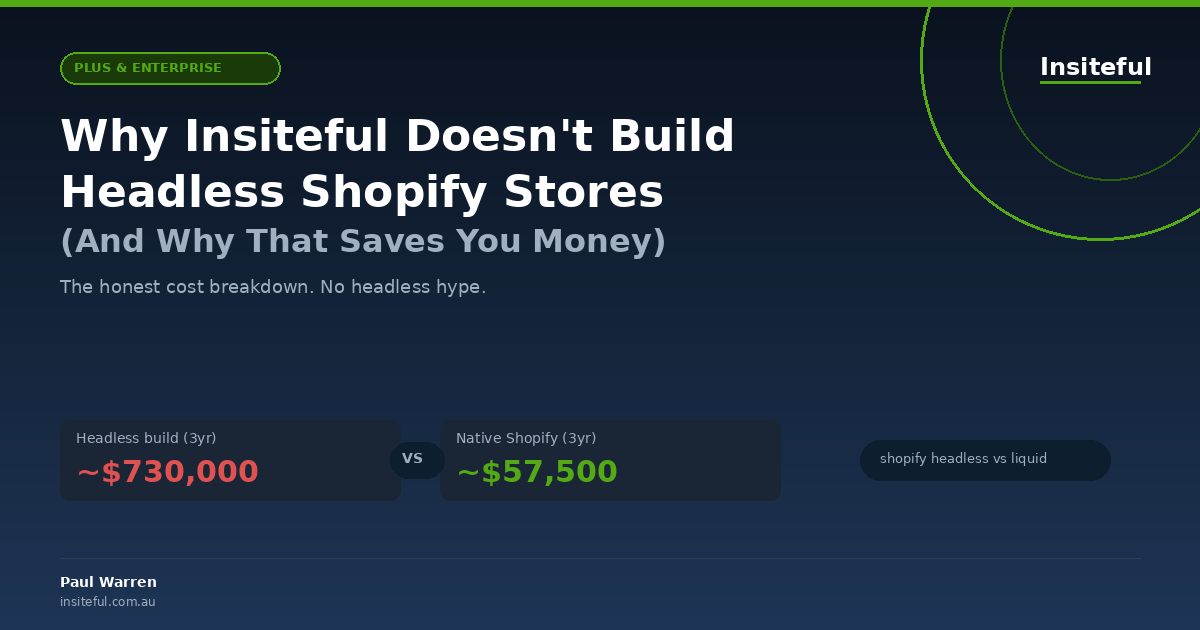
Every few months, a founder comes to us having just been pitched a headless Shopify build by another agency. The proposal looks impressive. Hydrogen. React. Oxygen hosting. A custom storefront that promises blazing performance, total flexibility, and a future-proof architecture.
And the quote is somewhere between $120,000 and $300,000 AUD. Plus $5,000 to $20,000 a month in ongoing engineering retainer. Year-one all-in cost: $300,000 to $600,000.
We don’t build those stores. Not because we can’t. Because for 95% of Shopify brands, headless commerce is a solution looking for a problem, and the price you pay for that mismatch is enormous. This article explains our thinking, backed by the numbers that rarely appear in the sales pitch.
What “Headless” Actually Means in Shopify in 2026
The term “headless” gets thrown around loosely, so let’s be precise. A traditional Shopify store uses Liquid, Shopify’s native templating language, to render your storefront. The front-end (what customers see) and the back-end (product data, checkout, orders) are tightly coupled inside Shopify’s infrastructure.
A headless Shopify store decouples those two layers. The back-end stays in Shopify, but the front-end is rebuilt as a separate application, typically using Shopify’s Hydrogen framework (built on React and Remix), hosted either on Shopify’s own Oxygen service or a third-party CDN like Vercel. The two communicate via the Storefront API.
In theory, this gives you total control over the user interface. You can build anything React can render. In practice, it means you have just taken on full responsibility for a production React application that happens to display your products. That shift in responsibility is where the real cost begins, and it compounds every month you operate the store.
The architecture is not new. Headless commerce has been pitched as the premium option for Shopify merchants since around 2019. What has changed dramatically since then is what native Shopify can do. The gap that headless used to fill has largely closed, but the price tag has not.
The Hidden Tax: Real Cost Breakdown Over Three Years
We ran the numbers on what a mid-market headless Shopify build actually costs over three years. The figures below are drawn from real project data and published agency benchmarks. They are not edge cases. They are representative of what Aussie founders building headless stores actually pay.
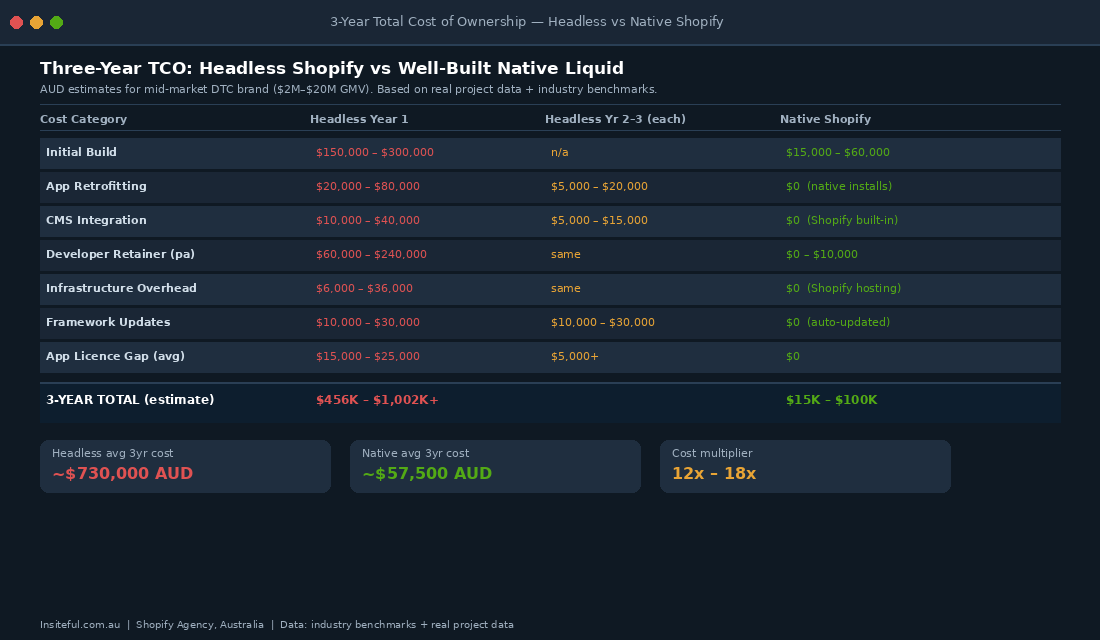
The initial build is only the beginning. A quality Hydrogen build for a DTC brand turning over $2M to $20M AUD requires 12 to 20 weeks of professional services. That is before the hidden line items most agencies don’t surface upfront.
- App retrofitting ($20,000 to $80,000). Most Shopify apps are built for Liquid. When you go headless, apps that normally install with a click now require custom API integration. A $79/month app becomes a $15,000 to $25,000 development project before you have feature parity with a standard Shopify theme.
- CMS integration ($10,000 to $40,000). If you want a content team to update pages without touching code, you need a headless CMS like Contentful or Sanity on top of your Shopify back-end. That is another system to build, maintain, and pay for.
- Developer retainer ($60,000 to $240,000 per year). Your custom front-end is a live React application. Every meaningful change requires a React developer. This is not a contingency item. It is a structural operating cost that does not go away.
- Infrastructure overhead ($6,000 to $36,000 per year). If you host on Vercel instead of Oxygen, add monthly infrastructure costs on top. Traffic spikes require API upgrades and additional CDN resources that scale with your volume.
- Framework updates ($10,000 to $30,000 per cycle). Hydrogen is an evolving framework. Shopify ships major version changes, and keeping your storefront current requires dedicated engineering sprints, not a simple plugin update.
Add it up over 36 months and a headless build that started at $150,000 routinely lands at $500,000 to $800,000 in total expenditure. A well-architected native Shopify store covering the same commercial requirements typically costs a fraction of that, with lower ongoing maintenance and no developer dependency for day-to-day content updates.
The 12x to 18x cost multiplier we see in the data is not a theoretical calculation. It shows up in the real conversations we have with founders who come to us after the fact, looking to rebuild what they have into something sustainable.
What You Give Up When You Go Headless
The headless pitch focuses on what you gain: flexibility, custom UI, theoretically faster page loads. What it rarely addresses is what you lose. And the list is significant for any Shopify brand that relies on the app ecosystem to run their business.
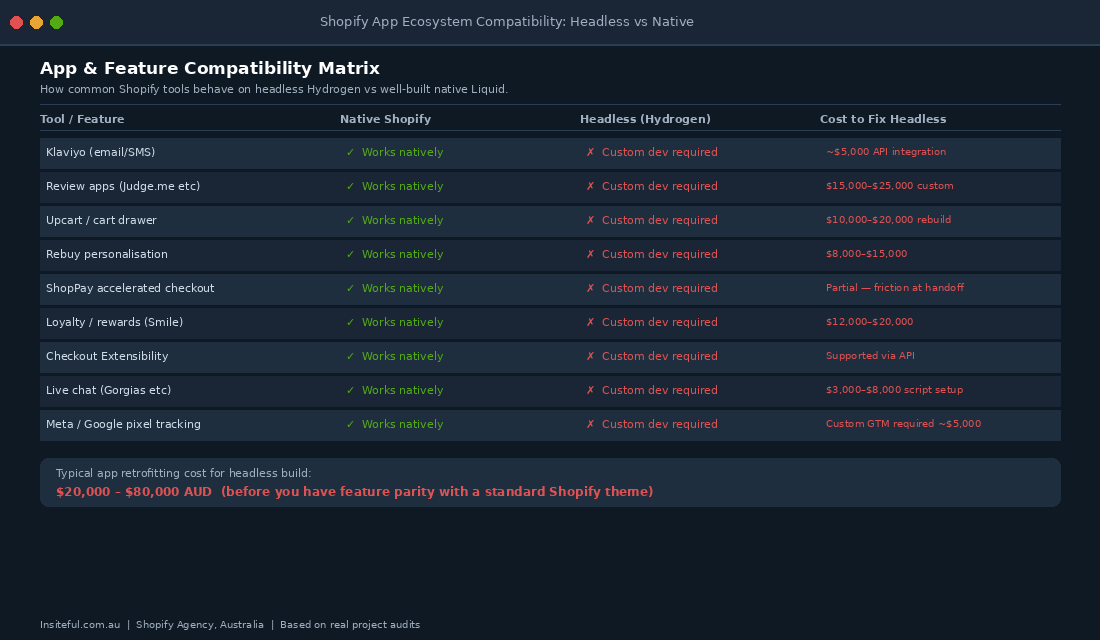
The Shopify app ecosystem has over 8,000 apps. The vast majority are built for Liquid storefronts. When you go headless, you are no longer a standard Shopify store from the app’s perspective. That creates three categories of problem.
- Apps that simply don’t work. Many review apps, loyalty platforms, upsell tools, and live chat integrations inject scripts directly into Liquid templates. On a headless front-end, those scripts have nowhere to land. That $79/month app becomes a custom development project costing $15,000 to $25,000.
- ShopPay and native checkout friction. Shopify’s native checkout with ShopPay converts at significantly higher rates than guest checkout. Headless storefronts can use Shopify’s hosted checkout, but the handoff between a custom front-end and Shopify’s checkout introduces friction points that typically reduce conversion. Any checkout customisation beyond Shopify’s Checkout Extensibility requires bespoke engineering work.
- Marketing tools and personalisation stack. Klaviyo embedded forms, Rebuy personalisation widgets, Upcart drawer upsells: all of these have native Shopify integrations that take hours to configure on a standard theme and weeks of custom development on a headless build. Every tool in your marketing stack gets re-evaluated against the question: “Does this work with our front-end?”
Beyond apps, you lose operational independence. On a native Shopify store, your marketing team can update banners, add sale badges, create landing pages, and adjust content without touching code. On a headless store, every content change outside a headless CMS requires a developer pull request, a deployment pipeline, and a review cycle. We have spoken to founders paying $5,000 a month in retainer fees for changes that should take fifteen minutes.
The hidden casualty is speed-to-market. When you need to spin up a flash sale, test a new landing page, or respond to a competitor’s campaign, a native Shopify store responds in hours. A headless store responds in developer sprints.
What Native Shopify Can Do Now That It Couldn’t in 2020
A lot of the headless argument is built on 2019 assumptions. Back then, Liquid was genuinely constrained. Page builder tools were clunky, themes were rigid, and meaningful customisation often meant hacking template files and breaking things in production. That world no longer exists.
Online Store 2.0, launched in 2021 and significantly expanded since, transformed what native Shopify can do. Sections everywhere means you can build fully custom page layouts without touching Liquid. Metaobjects allow structured custom content types across any template. Theme blocks give developers component-level flexibility that was simply not possible in the legacy architecture. A well-built OS 2.0 theme is meaningfully different from a 2019 Liquid theme, and the difference matters to the headless comparison.
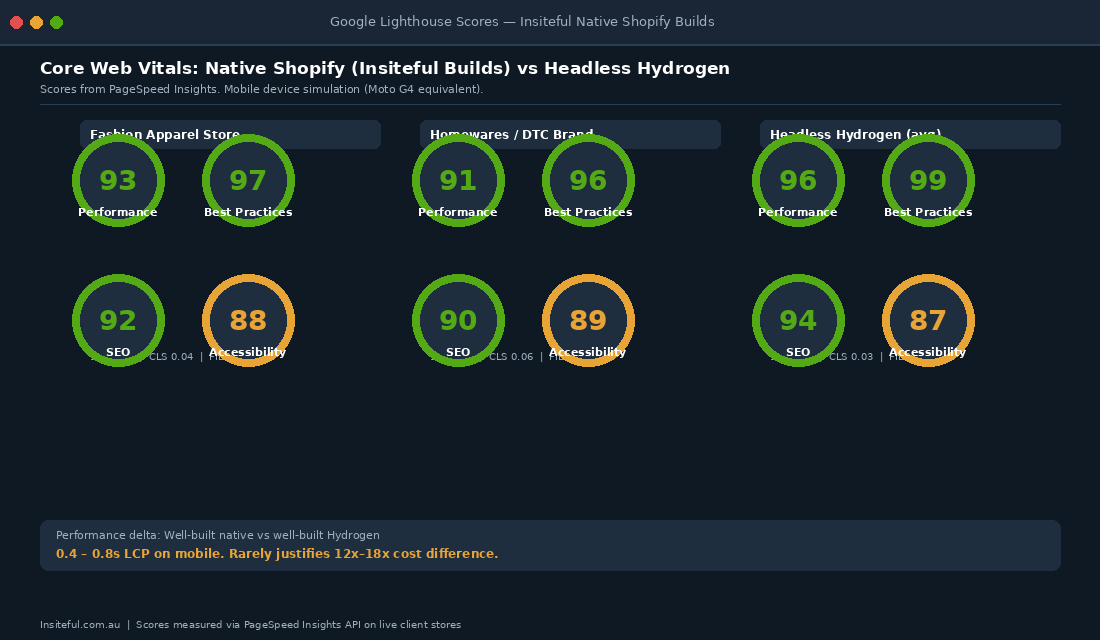
On performance, the gap has narrowed to a point where it rarely justifies the cost differential. A well-built native Shopify store on a lean OS 2.0 theme hits mobile LCP in the 1.8 to 2.2 second range. Hydrogen, done properly, sits at 1.2 to 1.6 seconds. That 0.5 to 1.0 second delta is real, but it is not the transformative difference the headless pitch implies.
Shopify’s own benchmark themes score 95 or above on desktop Lighthouse. Premium themes like Blum and Prestige regularly hit 92 to 97 across all Core Web Vitals when built correctly. The Insiteful native builds we deliver consistently achieve 88 to 95 on mobile, which places them in the top performance tier for ecommerce globally.
The honest comparison is not “well-built Hydrogen versus a bloated out-of-the-box theme.” It is “well-built Hydrogen versus a well-built native Shopify store.” At that level, the performance gap is incremental. The cost gap is not.
Shopify has also been investing heavily in platform capabilities that previously required headless workarounds. Checkout Extensibility allows deep customisation of the checkout experience within Shopify’s native infrastructure. Shopify Functions enables custom logic for discounts, shipping, and cart behaviour. Shopify Markets handles multi-currency and multi-language at scale without a bespoke internationalisation layer. The platform has grown into territory that headless used to own.
The 5% Where Headless Does Make Sense (And Why We Still Don’t Take Those Builds)
We are not saying headless is never the right call. There is a narrow category of brand where it makes genuine commercial sense. In our assessment, that is roughly 5% of Shopify operators, and the profile is specific.
Headless makes sense when all of the following are true: you have a catalogue with 500 or more SKUs requiring complex real-time filtering and faceted search that Shopify’s native collection pages genuinely cannot handle at scale; you are running a multi-region operation where each market needs a fundamentally different storefront experience, beyond what Shopify Markets can deliver; your content architecture is so complex (editorial publishing, interactive tools, real-time data overlays) that a standard theme cannot express it; and you have an in-house React engineering team already on staff who will own and maintain the front-end indefinitely.
If all four of those conditions are true, headless may be the right architecture. That profile does not match most Australian Shopify brands. It matches enterprise companies with dedicated engineering departments and GMV well above $50M. Brands at that scale have the internal resources to absorb the technical debt headless creates.
Even when a brand does meet that profile, we still don’t take those builds. Not because they are too complex. Because the agency that builds a headless Shopify store becomes load-bearing infrastructure in that business. Every marketing campaign, every seasonal update, every app evaluation gets filtered through whether the custom front-end can support it. We have watched that dependency erode trust between brands and agencies in ways that are difficult to repair.
Our model is built around delivering a store your team can operate confidently from day one. A headless architecture works against that outcome, even when the technology choice is technically defensible. So we are honest about it, refer those enquiries to the right specialist, and focus on the 95% of builds where native Shopify delivers results that headless only promises.
How We Do It at Insiteful
When we take on a Shopify build, the stack we use is deliberate, not default. Native Shopify is not our fallback from headless. It is the architecture we have refined across more than 200 builds over 25 years of combined ecommerce experience, and it delivers outcomes that headless proponents often claim as exclusive to their approach.
Every Insiteful build starts with what we call Conversion Architecture: the structured approach to store design that treats every page as a sales system, not a display unit. Product pages built around purchase psychology, not just aesthetics. Collection pages architected for discovery behaviour and filtering intent. A homepage that speaks to acquisition and retention simultaneously. This is the foundational work that determines whether a store converts. The technology stack supports that work; it does not replace it.
On the technical side, our standard builds run on a custom or heavily modified premium Shopify theme built on Online Store 2.0. We use structured metafields and metaobjects for content flexibility without the overhead of a headless CMS. Checkout Extensibility handles any customisation that goes beyond standard Shopify checkout functionality. Our app stack is curated around tools with deep native Shopify integration and proven conversion impact: Klaviyo for retention and email automation, Rebuy or Upcart for post-purchase and cart upsells, Judge.me or Okendo for social proof, and attribution tools that connect cleanly to Shopify’s native analytics.
We build with Shopify Markets for international expansion where needed, Shopify Functions for custom discount and shipping logic, and clean section architecture that lets a non-technical marketing team make meaningful updates without developer involvement. That last point matters more than most agencies admit. The store your team can operate confidently is the store that will actually get updated, tested, and improved over time. A store that requires a developer for every change is a store that stagnates.
Performance is treated as a first-class requirement, not an afterthought. We run a full image optimisation and lazy-loading audit on every build, remove render-blocking scripts, and test Core Web Vitals across real mobile devices before handoff. Our native builds consistently achieve Lighthouse scores within a few points of what a well-built Hydrogen store delivers, at a fraction of the cost and without the ongoing engineering dependency.
The stores we build are designed to work with the full Shopify ecosystem from day one. Klaviyo connects in minutes. Rebuy or Upcart installs without custom integration. Review apps, loyalty programs, and attribution tools all function as intended. There is no app tax, no custom development required to maintain feature parity with what the platform natively supports.
The Question That Cuts Through the Hype
Before you engage any agency for a Shopify build, migration, or rebuild, the question is not “should this be headless or native?” The real question is: “What does this store need to do, and what is the simplest architecture that achieves it reliably and sustainably?”
In our experience working with hundreds of Aussie Shopify brands, the answer to that question is almost always a well-built native store. One that performs strongly on Core Web Vitals, converts at a high rate, integrates cleanly with the tools the marketing team actually uses, and can be maintained and updated without a development retainer hanging over every campaign.
Headless is a compelling pitch. It sounds premium, technically ambitious, and future-proof. For most brands, it is selling you a $500,000 solution to a $50,000 problem. The founders who have learned that lesson the hardest way are often the ones who come to us after the fact, looking to rebuild what they have into something their team can actually run.
We would rather be the agency you hire first.
The Shopify platform has grown significantly in the past three years. What you could only achieve through a custom React application in 2021 is now available as a native Shopify feature. Before committing to a headless architecture, spend 30 minutes with an experienced native Shopify agency mapping your actual requirements against what the platform can deliver today. In most cases, the gap you are trying to close with headless architecture has already closed.
If you are weighing up whether your next Shopify build should go headless or native, that is exactly the kind of decision we help founders work through. Talk to the Insiteful team and we will give you a straight answer based on your actual store requirements, not on what makes for a more impressive proposal.