
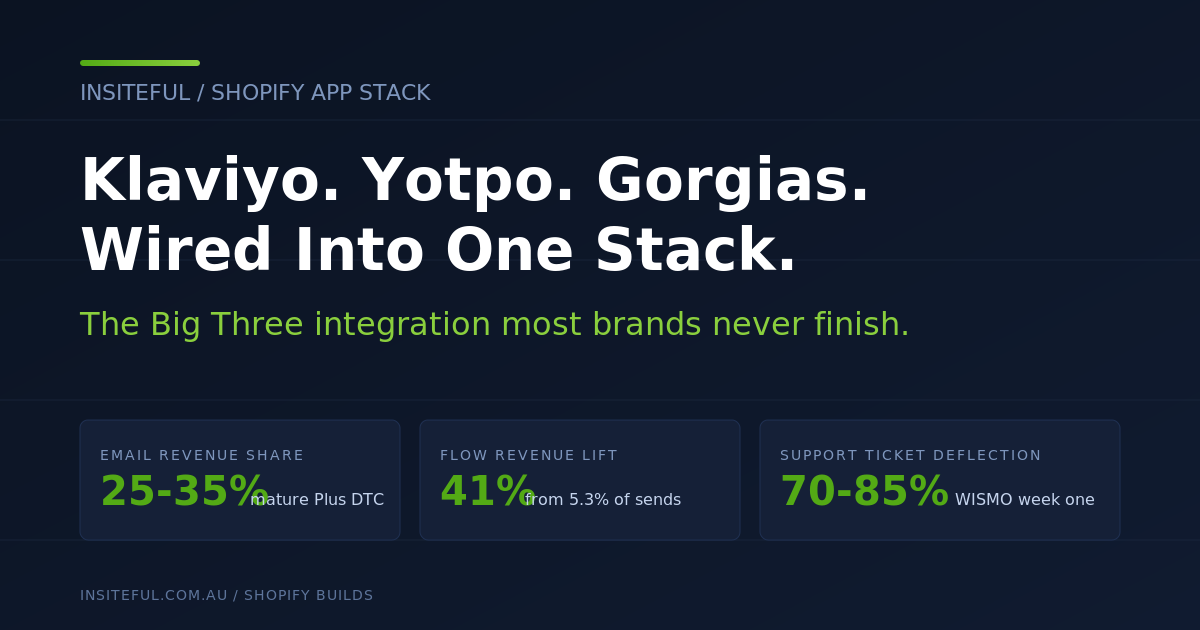
Most brands we audit have all three apps installed. Klaviyo handles email and SMS. Yotpo runs reviews and loyalty. Gorgias is the helpdesk. The logos sit in the Shopify admin like a trophy cabinet. The problem is none of them are actually talking to each other in the way the vendor demos promised.
We see the same picture every week: three powerful platforms running as three separate silos. The Klaviyo welcome flow ignores the fact that a customer left a 5-star Yotpo review the day before. The Gorgias agent answering a refund ticket cannot see that the same customer is sitting in the top 10% of Klaviyo’s predicted CLV segment. The Yotpo loyalty tier promotion gets emailed to a customer who is mid-complaint with the support team. Each app is doing its job in isolation, and the brand pays three subscriptions for a fraction of the lift the integration is supposed to deliver.
This is a build problem, not an app-selection problem. The Big Three are the right call for most Shopify and Shopify Plus brands above roughly $2M AUD in revenue. They are the apps we recommend more than any other combination. But wiring them together is an engineering job that gets glossed over by the marketing copy on every vendor page. Below is how we do it for clients, and what changes when the data finally flows the way it is supposed to.
Why the Big Three (and not the fashionable alternatives)
The Shopify app marketplace is full of newer entrants pitching reviews, loyalty, helpdesk, and email under one roof. They look attractive on paper. The pitch is always the same: one vendor, one bill, one onboarding. We have built on most of them. The reason we still recommend the Big Three to most of our agency clients in 2026 comes down to depth and integration surface area.
Klaviyo’s 2026 benchmark data, drawn from more than 183,000 customers, shows email flows produced roughly 41% of email revenue from 5.3% of sends. Flows deliver 3x higher click rates than broadcast campaigns and 13x higher placed-order rates. That gap only exists because Klaviyo has the segmentation depth and the event-trigger flexibility that the all-in-one alternatives have not matched. Mature DTC brands on Klaviyo regularly produce 25 to 35% of total store revenue from email and SMS, with the median at 18%. The all-in-one platforms we have tested tend to land closer to 8 to 12%, because their flows lack the conditional logic and the customer-property depth that lifts performance in the back third of the funnel.
Yotpo holds the same position for reviews and loyalty. The reason is not the front-end widget quality. It is the API and webhook surface. Yotpo will fire a webhook to Klaviyo within seconds of a 5-star review with a photo, and it will sync loyalty-tier changes as Klaviyo customer properties. The simpler review apps cannot trigger a downstream marketing flow with that granularity. We covered the wider stack reasoning in our piece on the Shopify app stack we recommend in 2026.
Gorgias is the helpdesk because of the Shopify integration depth and the rule engine. Gorgias reports merchants seeing 70 to 85% ticket deflection on order-status, refund, and subscription queries within the first week of going live, and up to 60% of all support inquiries resolved without human involvement once the automation rules are tuned. We have seen that hold up across the agency portfolio: a sub-100-SKU fashion client cut their support headcount need by 1.5 FTE inside six weeks of the rewire we are about to describe.
The Big Three are not the cheapest stack. They are the stack with the highest ceiling when the integration is built properly. Most brands never reach that ceiling, which is the entire reason this article exists.
The reference architecture we build to
Before any of the three apps gets touched, we draw the same architecture diagram every time. It is the picture the client should keep on their wall.
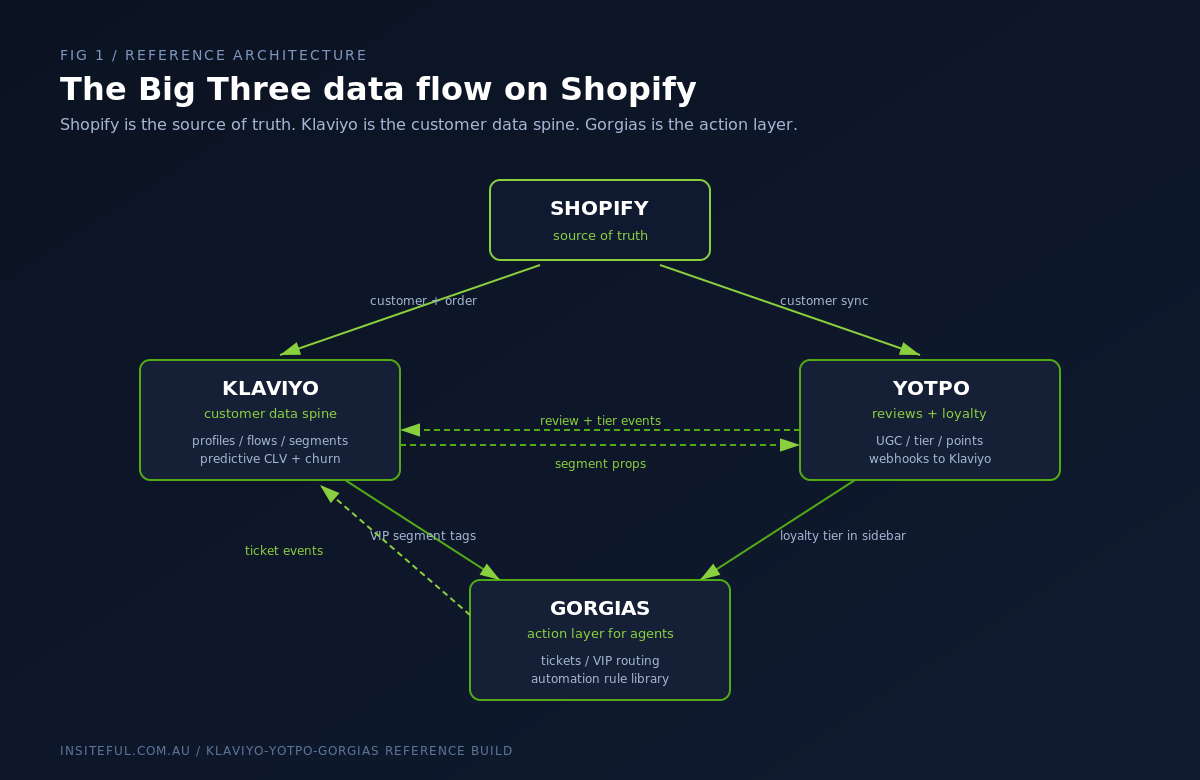
Three rules sit underneath that diagram:
- Shopify is the single source of truth for customer and order data. Klaviyo and Gorgias both pull from Shopify directly. Yotpo posts back to Shopify customer metafields where the review or loyalty data matters at the storefront.
- Klaviyo is the customer data spine. Every event that matters – review submitted, loyalty tier changed, ticket created, ticket resolved – lands on the Klaviyo customer profile as an event or property. Klaviyo is where segmentation happens.
- Gorgias is the action layer for the agent. Gorgias does not just receive data, it shows the agent everything they need in one view: Klaviyo profile, Yotpo loyalty status, Shopify order history, all surfaced in the ticket sidebar.
When this is drawn out clearly and signed off by the client at the start of the build, the rest of the integration becomes a checklist instead of a hunt.
Phase 1: Wire Klaviyo as the data spine
We always start with Klaviyo because it sets the data contract that the other two integrations have to honour. Three jobs in this phase.
Klaviyo profile property schema
The first job is defining the customer property schema that the other apps will write into. This is not in the Klaviyo onboarding docs because the vendors expect you to use their default property names. We override most of them because the default names collide once two or three apps are writing to the same profile.
The schema we standardise on for the Big Three:
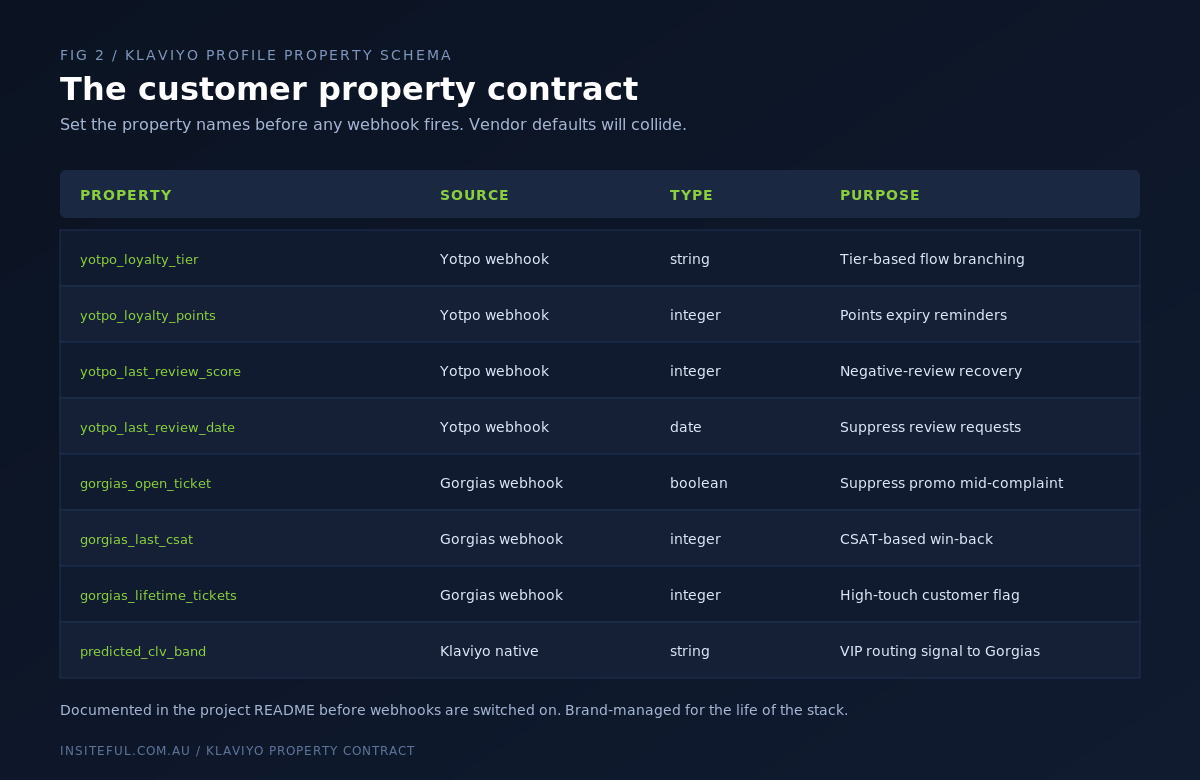
These property names are written into the project README before any webhook is wired. Doing it the other way around (letting each app dump its default properties in) is how you end up with three different fields all describing the customer’s loyalty status, only one of which is actually current.
Klaviyo flow library, version 1
The second job is shipping the flow library before the integrations are switched on. Once Yotpo and Gorgias start firing webhooks, every new event triggers something. If the flows do not exist, the events disappear into the audit log. The minimum set we ship at this phase:
- Welcome series (3 emails plus 1 SMS, branching on signup source)
- Browse abandonment (45-minute trigger, suppresses anyone who has bought in 7 days)
- Cart abandonment (multi-step: 1hr, 23hr, 71hr, with declining discount)
- Post-purchase (delivered the night the order ships, with care content)
- Review request (handed off to Yotpo in Phase 2, placeholder flow only)
- Replenishment (only for consumable brands, fires at predicted reorder day minus 3)
- Win-back (90-day inactive, with intent-classification branching)
The Klaviyo benchmarks make clear why this matters. Flows drive 41% of email revenue from 5.3% of sends in 2026. Without these flows in place, the customer data we are about to start pumping in from Yotpo and Gorgias has nowhere to land.
Predictive analytics segments
Klaviyo’s predictive CLV and churn risk are calculated on Shopify order data. We turn both on during Phase 1 because Phase 3 will use them as the VIP signal we push to Gorgias. The segments we build:
Predicted CLV: Top 10%(used for Gorgias VIP routing)Predicted CLV: Bottom 50%(suppressed from high-discount campaigns)Churn risk: High(auto-enters win-back flow)Churn risk: Low + High CLV(eligible for loyalty tier upsell flow)
The benchmark we hold ourselves to here is straightforward. Once Phase 1 ships, the brand’s Klaviyo revenue contribution should already be on its way from whatever baseline it was at to above 20% of store revenue within 60 days. If it is not moving, the rest of the integration will not save it.
Phase 2: Pipe Yotpo into Klaviyo
With the Klaviyo schema and flow library in place, we plug Yotpo in. There are two distinct integrations here: Yotpo Reviews and Yotpo Loyalty & Referrals. Most brands install one and forget about the other. Both need to flow into Klaviyo for the architecture to do its job.
Reviews to Klaviyo
The Yotpo Reviews to Klaviyo integration sends review events to Klaviyo as triggers, and review properties (last score, last date, reviewer status) onto the customer profile. Initial sync takes 24 to 48 hours according to Yotpo’s documentation, so we schedule the connect step early in the sprint and let it backfill while the rest of the build continues.
The Klaviyo flows that go live the moment Reviews is wired in:
- Post-review thank-you flow – fires on
Submitted Reviewevent with a score property branch. 5-star reviewers get a thank-you, a UGC permission ask, and a low-discount cross-sell. 1 to 3-star reviewers get routed into the negative-review recovery flow. - Negative-review recovery flow – fires automatically on score less than or equal to 3. Sends a personalised apology from the brand owner (templated from the brand voice doc), offers a refund or replacement, and creates a Gorgias ticket via webhook so the support team picks up the conversation in their inbox rather than in Klaviyo replies.
- Review-request flow – replaces the placeholder from Phase 1. Fires 14 days post-delivery, suppressed if the customer already has a Yotpo review on the product or has an open Gorgias ticket.
Loyalty & Referrals to Klaviyo
The Yotpo Loyalty integration syncs tier and points data as Klaviyo customer properties, and fires webhook events Klaviyo can trigger flows from. Tier changes, points earned, points expiring soon, and reward redeemed all fire as events.
The Loyalty flows we ship in this phase:
- Tier upgrade celebration – fires on
Reached Tierevent, sends a congratulations message plus the benefits available at the new tier. This is the rare flow we put real production budget behind because the open and click rates run at 2 to 3x the Klaviyo average. - Points expiry reminder – fires 14 days, 7 days, and 1 day before points expire. Cleanest revenue lift flow we ship. Customers who would have walked away come back to redeem.
- Reward redeemed nudge – fires immediately after a redemption with a curated cross-sell of products eligible for the redeemed reward type.
A specific guard we put in: the Loyalty-to-Klaviyo sync only includes opted-in users by default. Referral-source customers sync regardless. We document this clearly in the project handover because most brands assume their entire loyalty database is in Klaviyo when only the opted-in portion is.
Yotpo as a Klaviyo signal, not just a sender
The detail that brands miss with Yotpo is that the loyalty tier is one of the most valuable segmentation signals you have. A “Silver tier customer who has not purchased in 30 days” is a different shopper to “first-time buyer who has not purchased in 30 days”. We build segments in Klaviyo on yotpo_loyalty_tier and yotpo_loyalty_points so the campaigns the brand sends from then on use that signal automatically.
A small client we shipped this for at the end of 2025 (jewellery brand, around $4M AUD on Shopify) saw their “Gold tier inactive 45 days” segment generate the highest revenue-per-recipient of any segment they had ever sent to. That segment did not exist before the integration, because the loyalty data was not in Klaviyo to filter on.
Phase 3: Bring Gorgias into the customer profile
The final phase is the one most brands never finish. Gorgias gets installed and connected to Shopify, the support team starts answering tickets, and the data trail stops there. The Gorgias-to-Klaviyo integration is left in the optional column.
The reason this phase pays the highest return is the same reason it gets skipped: support data is the highest-signal data the brand owns. A customer who has just complained should not get the promotional SMS that goes out 30 minutes later. A customer who has rated their last support interaction 1/5 should be in a different lifecycle flow to a customer who has rated 5/5. None of that is possible until Gorgias events are landing on the Klaviyo profile.
Wire Gorgias events into Klaviyo
The integration in the Gorgias app store handles the basic event sync. The events that matter for the architecture:
Ticket Created– setsgorgias_open_ticketto true on the Klaviyo profileTicket Resolved– setsgorgias_open_ticketto false, incrementsgorgias_lifetime_ticketsCSAT Submitted– writes the score togorgias_last_csatReturns/Refund Requested– separate event tag, used for suppression logic
We then build the suppression rules in Klaviyo. Every promotional campaign sent by the brand from this point excludes profiles where gorgias_open_ticket = true. Every win-back flow excludes profiles where gorgias_last_csat <= 2 (those go into a separate recovery flow that the support manager owns, not the marketing manager).
Send Klaviyo segment membership back to Gorgias
This is the move most agencies skip. Gorgias can read Klaviyo customer profile data and surface it in the ticket sidebar, but only if you push the segment membership across as a customer tag in Shopify (which Gorgias reads natively).
The Shopify Flow workflow we set up looks like this:
TRIGGER:  Klaviyo segment membership change
          (via webhook to a custom Shopify Flow endpoint)

CONDITION: Segment name is "Predicted CLV: Top 10%"
           OR "VIP - Active 30 days"
           OR "Churn risk: High + Past purchaser"

ACTION:    Apply Shopify customer tag matching segment name
           e.g. tag = "klaviyo:vip-top-clv"

EFFECT:    Gorgias reads the tag from Shopify
           Gorgias rule routes the ticket to senior agents
           Gorgias rule applies SLA of 1 hour first response
The outcome: when a top-10% predicted-CLV customer raises a ticket, it lands in the senior queue, the SLA is tighter, and the agent opens the ticket with a sidebar that shows the customer’s Yotpo loyalty tier, last review score, last 5 orders, and lifetime spend. Without the integration, that same customer is in a queue of 400 tickets waiting on a junior agent for 8 hours.
Gorgias automation rules that the integration enables
Once the data is flowing, the rules in Gorgias that pay for the whole stack:
- Where Is My Order (WISMO) auto-reply – resolves 70 to 85% of order-status tickets within the first week of going live. The rule pulls the Shopify shipping status and writes a templated response. No human involvement.
- VIP fast-track routing – applies a
priority: VIPtag when the customer carries theklaviyo:vip-top-clvShopify tag, routes to a senior agent macro. - Refund self-service – for orders under a value threshold (we typically set this at $80 AUD), auto-issues the refund via the Shopify integration and sends a templated apology, then logs the event back to Klaviyo.
- Negative review escalation – any ticket created from a Yotpo 1 or 2-star review (Phase 2 webhook) routes straight to the brand manager, not the general agent queue.
The published Gorgias data suggests up to 60% of all support inquiries can be resolved without human intervention once these rules are tuned. Most brands we audit are sitting at 10 to 20% pre-build. The lift from running this phase properly often justifies the whole agency engagement on its own. A similar pattern shows up in our deeper write-up on ERP integrations on Shopify: the cost is in the build, but so is the entire payback.
The flows that print money once everything is wired
A cheat-sheet for the brand once the architecture is in place. These are flows that simply cannot exist without all three apps talking to each other.
| Flow | Trigger source | Why it is only possible with all three |
|---|---|---|
| Loyal complainer win-back | Gorgias 1-star CSAT + Yotpo Gold tier | Needs Gorgias CSAT, Yotpo tier, Klaviyo orchestration |
| Silent VIP nudge | Klaviyo CLV top 10% + 60 days no purchase + no open ticket | Needs Klaviyo CLV, Gorgias ticket status |
| Photo-review thank-you cross-sell | Yotpo 5-star review with image | Needs Yotpo event, Klaviyo flow logic |
| Refund-then-rescue | Gorgias refund issued + Yotpo Silver+ | Needs Gorgias event, Yotpo tier check |
| Tier-jump amplifier | Yotpo tier upgrade + Klaviyo high engagement | Needs Yotpo event, Klaviyo engagement scoring |
We track these specifically in the post-launch dashboard because the lift on each is measurable and direct. The “loyal complainer win-back” alone is regularly the highest revenue-per-recipient flow in the brand’s library 90 days after go-live.
The five ways this integration breaks (and how we stop it)
Every Big Three integration we have rebuilt for a client failed in one of five ways before they hired us. The audit checklist we run when we take on a rescue:
- Multiple sources of loyalty truth. The brand installed Yotpo Loyalty, then installed a Klaviyo loyalty tier app, then set up tier metafields in Shopify by hand. Three systems, three different versions of the same customer. We pick Yotpo as the source and rip out the others.
- Gorgias events not landing on Klaviyo profiles. The integration was enabled but never tested. We send a fake ticket, watch for the event in Klaviyo, and audit every step of the data flow with the Klaviyo profile viewer open.
- Promotional sends going out mid-complaint. The
gorgias_open_ticketsuppression rule was not added to the campaign template, only to the flows. Every new campaign needs it. We bake it into the campaign workflow checklist. - Webhook timeouts on high-volume sends. Yotpo can fire thousands of review-submitted events in a campaign window. If Klaviyo’s webhook intake is rate-limited, events get dropped. We monitor the Yotpo webhook log for failures weekly for the first 8 weeks post-launch.
- App stack bloat hiding the integration. Average Shopify store has 6 to 8 apps installed but uses only 3 to 4 actively per the 2026 industry data. When we audit, we routinely remove 4 to 6 dormant apps that conflict with the Big Three’s event flow. The Klaviyo signup form fires twice because the brand installed a popup app three years ago and forgot. The Yotpo review widget renders below a competing review widget that is also installed.
How We Do It at Insiteful
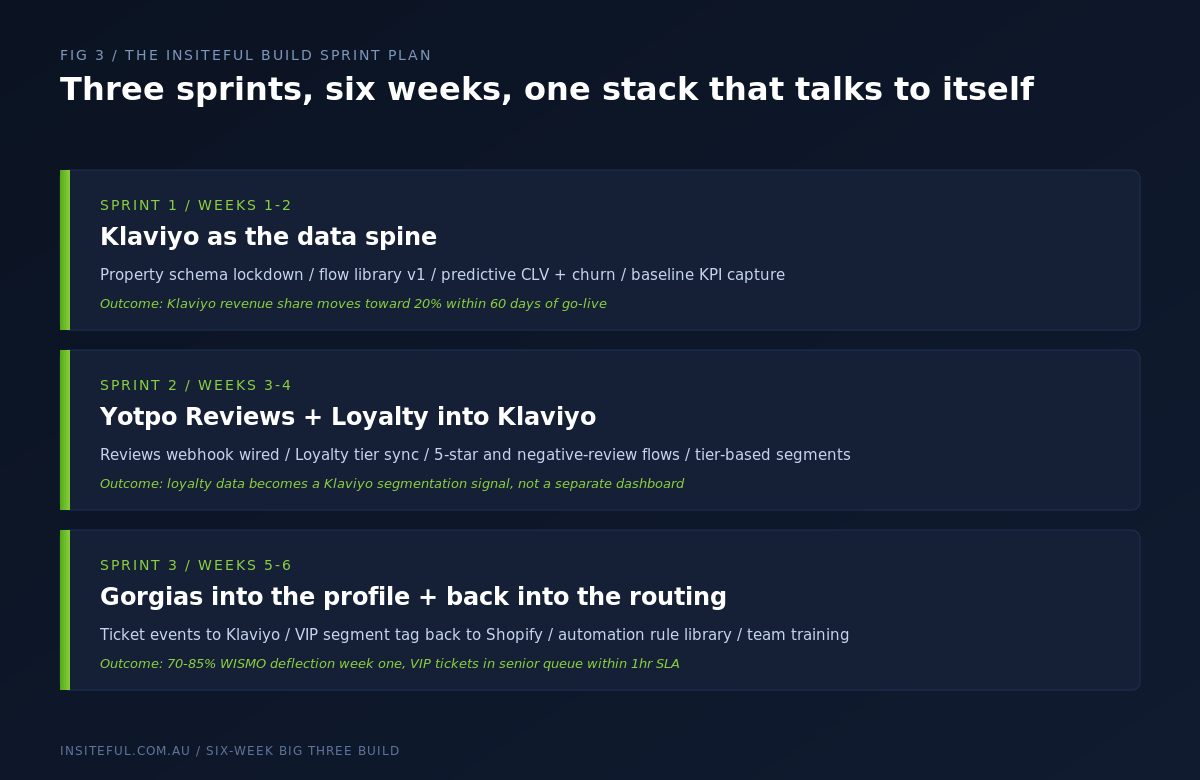
When we run this integration for a Plus or scaling Shopify client, the build runs over three sprints (typically six weeks end to end). Sprint one is Klaviyo: property schema, flow library, predictive segments, baseline measurement. Sprint two is Yotpo: Reviews and Loyalty wired up, flows ported across, segments rebuilt on loyalty signals. Sprint three is Gorgias: ticket event sync, VIP routing, automation rule library, support team training.
Three things we always include in the engagement that the DIY teams skip:
- A documented data dictionary for every Klaviyo property the integration writes, so the brand can self-service for the next two years without ringing us back.
- A weekly webhook health report for the first 8 weeks post-launch, because the most expensive failure mode is silent webhook failure and brands do not catch it without instrumentation.
- A handover session for the brand’s email manager and support manager together. The integration cuts across both functions, and the worst outcome is the email team sending broadcasts that override the support team’s careful customer recovery work. The session forces them to agree on the suppression rules.
The pricing for the full Big Three rewire sits in the upper end of our standard build range. We have run this integration for clients between $2M and $25M AUD annual revenue, and the payback is reliably under 90 days on the email and loyalty side alone, before any of the support cost savings hit. The architecture sits on the same kind of foundations we talked through in our recent app audit case study.
If your Klaviyo, Yotpo, and Gorgias are installed but not talking to each other, the lift on the table is bigger than any new traffic channel you could open in the same window. Most brands have already paid for the apps. The build is what activates them.
Ready to wire the Big Three properly?
If you have Klaviyo, Yotpo, and Gorgias on your Shopify or Plus store and the integration is feeling like three apps rather than one stack, book a build assessment with the Insiteful team via the Insiteful homepage. We will audit the current data flow, map the gaps, and give you a fixed-scope plan to get the architecture working the way the vendors promised.