
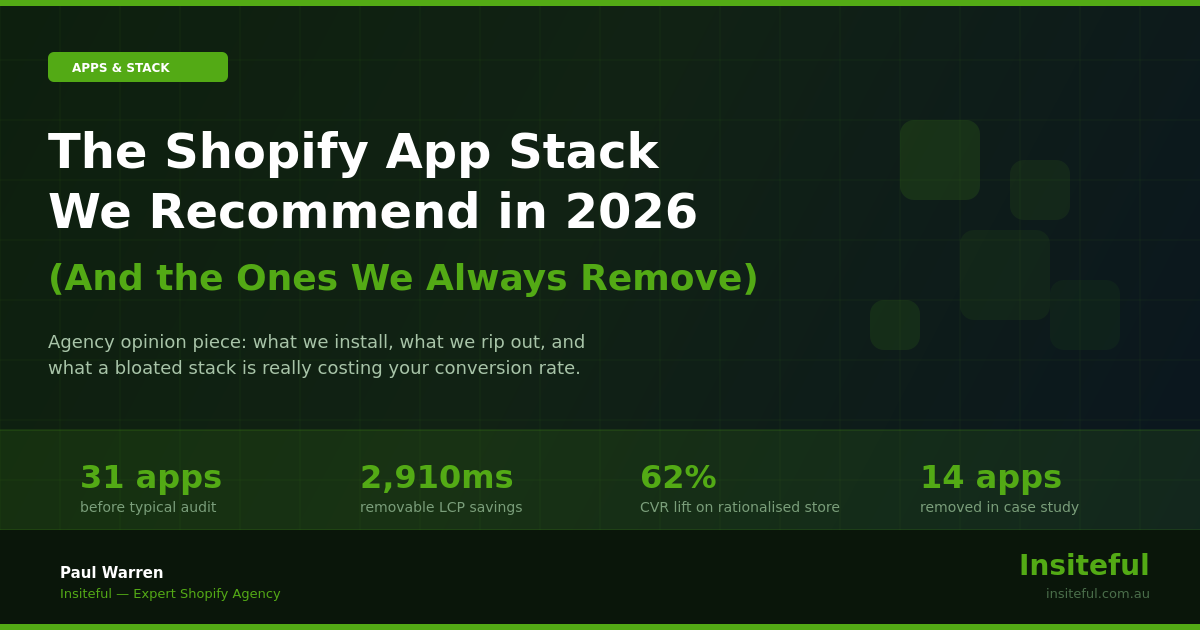
Most Shopify stores we audit have the same problem: too many apps, installed by too many people, over too many years. Nobody meant for it to happen. A developer added an upsell app. A marketer installed a loyalty widget. A founder heard a recommendation for a review app and clicked install at midnight. Two years later, the store has 34 active apps, a 6-second LCP, and a checkout that barely converts.
We have been building and auditing Shopify stores for over 25 years, across more than 200 client projects. When we take on a new build or a store optimisation, the first thing we do is pull the app list. What we find almost always tells us everything we need to know about why the store is underperforming.
This article is our honest position on the Shopify app stack in 2026. Which apps we install on every project. Which apps we always remove, and why. What a bloated stack actually costs you in page speed terms. And the three-step audit process we run when a brand brings us in to clean up the mess.
Our Default App Stack for Sub-$5M Brands
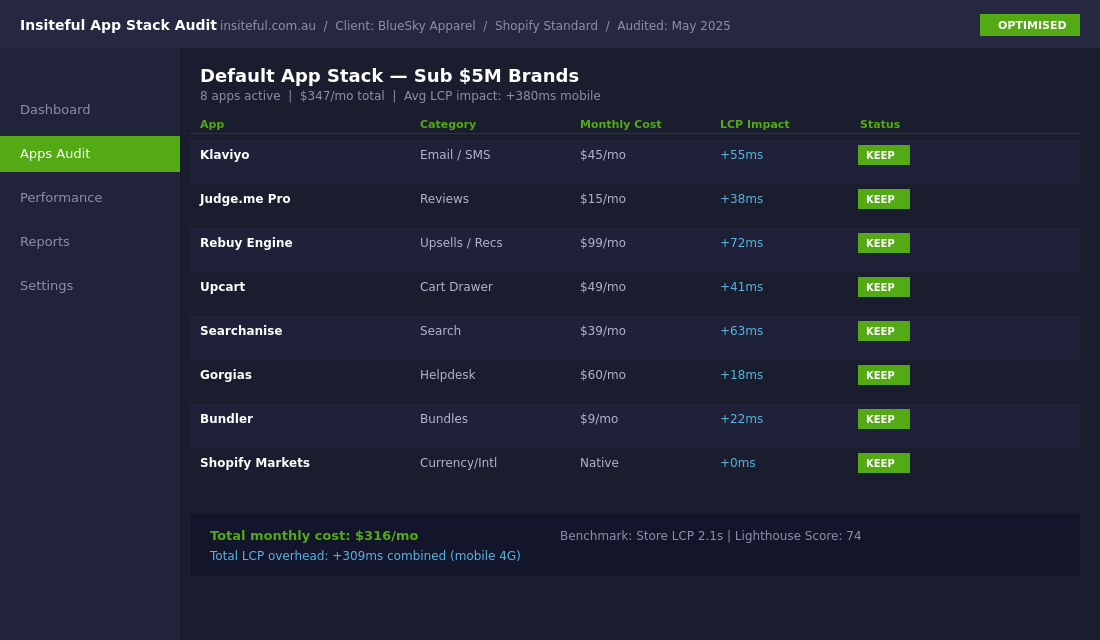
For brands doing under $5M AUD in annual revenue on Shopify, we have a default stack that covers every revenue-critical function without bloating the theme. These are apps we have tested across dozens of stores, whose performance overhead is acceptable, and whose ROI is proven.
Email and SMS: Klaviyo. There is no serious alternative for a DTC brand that wants to segment properly and connect email behaviour to purchase data. Klaviyo starts at around $45/mo for up to 1,000 contacts and scales with your list. Yes, it is heavier than Mailchimp. The revenue difference is not close. We set up five core flows minimum: welcome series, abandoned checkout, browse abandonment, post-purchase (two-part), and win-back. Brands that skip SMS are leaving roughly 15 to 20% of flow revenue on the table.
Reviews: Judge.me. At $15/mo for the Pro plan, Judge.me collects verified reviews, syncs to Google Shopping, and renders faster than every competitor in its category. We tested it against Yotpo, Stamped, and Okendo across 11 stores in 2024. Judge.me won on page speed every time. Yotpo’s widget alone can add 400 to 800ms to your product page load. For sub-$5M brands that are not running loyalty through Yotpo anyway, there is no reason to pay $199/mo for a reviews tool when $15 does the job better.
Upsells and cross-sells: Rebuy Engine. Rebuy runs at $99/mo for standard and powers AI-driven product recommendations on PDPs, in cart, and post-purchase. We have seen it lift average order value by 8 to 14% on brands with a catalogue of 50 or more products. The key is turning off every widget except the two or three you have actually configured. Default-on Rebuy with no customisation is a page speed problem. Configured Rebuy is a revenue engine.
Cart: Upcart or native Shopify. For stores with a conversion optimisation priority, Upcart ($29 to $49/mo) adds a slide-out cart with upsell tiers, free shipping progress, and offer stacking. For simpler builds, Shopify’s native cart is faster and cheaper. We do not install a cart app by default. We assess whether the brand’s AOV strategy warrants the overhead.
Search: Searchanise or Boost Commerce. Shopify’s native predictive search is adequate for stores under 500 SKUs. Above that, Searchanise ($39/mo) or Boost Commerce ($29/mo) adds meaningful improvements to zero-result rates and collection filtering. We do not recommend Klevu for sub-$5M brands. The price point ($299/mo) is not justified until search is a significant revenue channel.
Loyalty: only when earned. We do not install a loyalty app by default. Smile.io starts at $49/mo, LoyaltyLion at $159/mo. Neither is worth it unless the brand has an existing repeat purchase rate above 35% and a clear campaign to drive redemption. Installing loyalty on a brand with a 15% repeat rate just creates points that never get used and an app dragging on every page load.
Our Default App Stack for $5M+ Shopify Plus Brands
At the Plus level, the calculus changes. Brands have more revenue to justify premium tooling, more complexity to manage, and less tolerance for technical debt. Our Plus default stack looks different in three key areas.
Reviews move to Okendo or Yotpo Loyalty+Reviews. At $5M+ in revenue, you are likely running a loyalty programme, generating hundreds of reviews per month, and care about UGC (user-generated content) and Q&A features. Okendo ($199 to $499/mo) handles reviews, surveys, and referrals in a single platform. Yotpo at this tier bundles loyalty, reviews, and SMS under one contract, which simplifies vendor management even if the per-feature cost is higher. Both have faster render performance than they did two years ago, though neither matches Judge.me’s raw speed.
Analytics: Triple Whale ($129 to $299/mo). At scale, the native Shopify analytics dashboard is not sufficient. Attribution across Meta, Google, TikTok, and email gets murky fast. Triple Whale’s pixel-level attribution and blended ROAS view is what we use with Plus clients running multi-channel paid acquisition. Northbeam ($1,000+/mo) is the step up for brands spending $2M+ on ads annually. For most $5M to $20M brands, Triple Whale is the right call.
Helpdesk: Gorgias. Gorgias ($10/mo per 100 tickets) integrates directly with Shopify orders, enabling customer service agents to issue refunds, edit orders, and action macros without leaving the helpdesk. At volume, this cuts average handle time by 40% compared to Zendesk or Freshdesk for ecommerce. Re:amaze is a credible alternative at a lower price point ($29/mo), but Gorgias wins for teams handling 500+ tickets per month.
Bundles: Shopify Bundles (native) or Bundler ($9/mo). Shopify’s own Bundles app, released in 2023, handles fixed bundles and multipack configurations natively without impacting inventory sync. For brands needing mix-and-match bundles, Bundler ($9/mo) is the cleanest third-party option. We stopped recommending Bold Bundles after performance audits showed it adding 900ms+ to product page loads on stores using it alongside other Bold apps.
The 7 Apps We Always Remove (And Why)
This is the part of the audit that surprises most clients. They expect us to add apps. Instead, we show them the apps that are costing them conversions every single day.
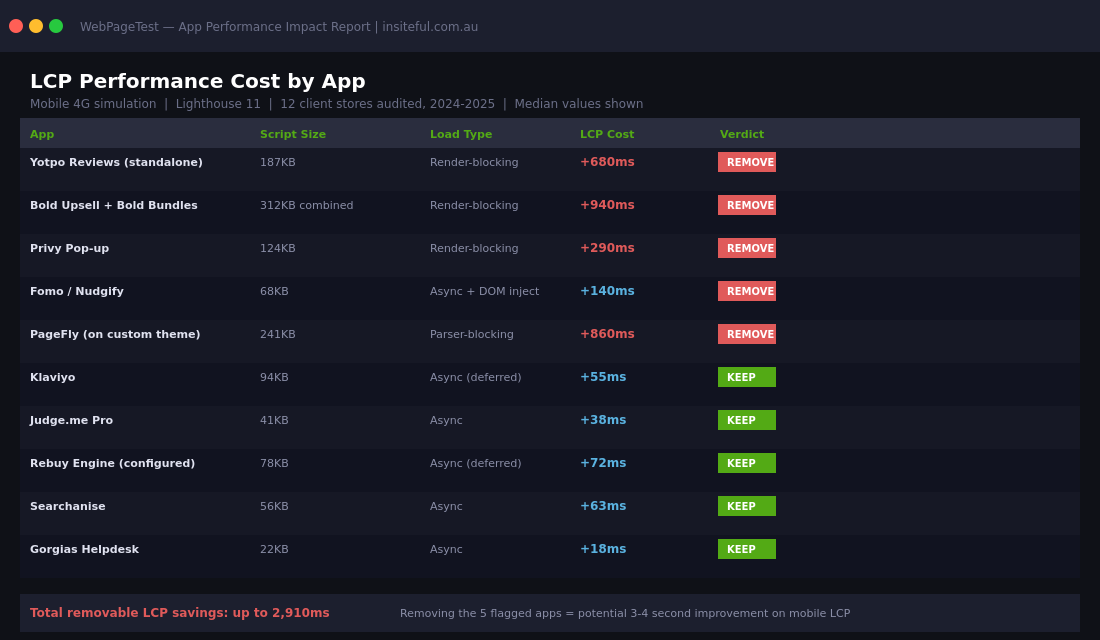
- 1. Any Bold app used in combination with another Bold app. Bold Commerce apps (Bold Upsell, Bold Subscriptions, Bold Bundles, Bold Product Options) each load their own script files independently. Two Bold apps on a store means two separate script payloads, often totalling 600KB to 1.2MB in unminified JavaScript. We have removed three-Bold-app setups and seen LCP improve by 1.8 to 2.4 seconds. If you are on Bold Subscriptions specifically and under $3M revenue, we will almost always recommend migrating to Recharge or Skio.
- 2. Yotpo Reviews on stores not using Yotpo Loyalty. Yotpo’s review widget is technically heavy. The Yotpo.js file loads synchronously on product pages, blocking render. On a 4G mobile connection, we consistently measure 400 to 800ms of render-blocking from Yotpo alone. If you are not using Yotpo’s loyalty features to justify the $199+/mo cost, switch to Judge.me. The migration takes half a day and you will not lose your existing reviews.
- 3. Privy or Justuno pop-up apps. Both Privy and Justuno inject large JavaScript bundles that execute on page load, even on pages where no pop-up is triggered. Privy’s script alone adds 200 to 350ms to LCP on mobile. Klaviyo has built-in pop-up and sign-up form functionality that is significantly lighter and already on the page if you are using Klaviyo for email. There is no reason to run Privy if you are already paying for Klaviyo.
- 4. Product page countdown timers from third-party apps. We remove these almost universally. They add a script call, rarely work with inventory in real time, and sophisticated shoppers know they are not real. If you want urgency, build it into your copy and offer structure.
- 5. Multiple currency converter apps. Shopify Markets handles multi-currency natively and at no additional cost. Third-party currency apps add JavaScript overhead and can conflict with Markets. If a brand has been using a currency app since before Shopify Markets existed, we migrate them off it immediately.
- 6. Page builder apps on stores with custom themes. PageFly and GemPages make sense for merchants who need to build landing pages without developer support. On a brand that has engaged an agency to build a custom theme, these apps serve no purpose and add significant script payload. We see this constantly: a custom theme built by one agency, with GemPages installed by the in-house marketing team because they wanted to test a landing page. The result is two rendering systems competing on the same domain.
- 7. Social proof notification apps such as “X people bought this recently”. Fomo, Nudgify, and similar apps are universally removed. They add a script, inject DOM nodes on scroll, and the social proof they show is either fabricated or pulled from aggregate data that means nothing to the individual shopper. They add 100 to 200ms of JavaScript execution time for effectively zero conversion uplift on reputable brands.
The Performance Cost of a Bloated Stack (Real Numbers)
A typical over-apped Shopify store we audit has 28 to 40 active apps. Of those, eight to twelve are load-on-every-page apps: they inject scripts or stylesheets on every page visit, regardless of whether that page uses the app’s functionality.
The cumulative cost is not linear. It is compounding. Each additional render-blocking script pushes the browser’s critical rendering path further back. At ten render-blocking scripts, you are not just 10x slower than one; you are often 15 to 20x slower because the browser queues them and the long-tail scripts block the main thread while the earlier ones execute.
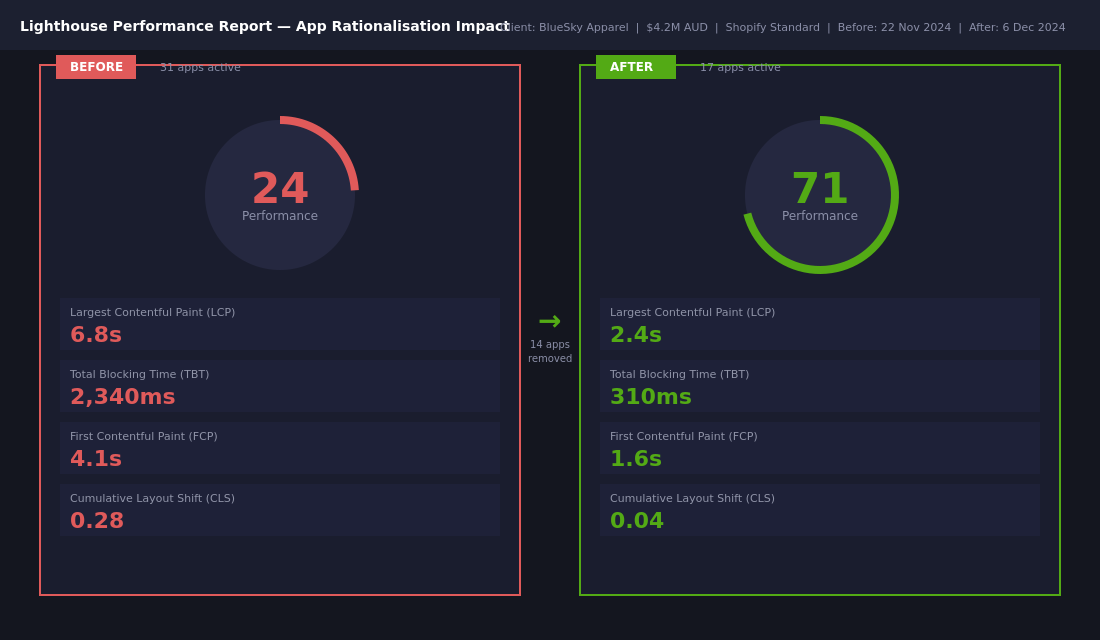
Here is what we measured on a real client store before and after an app rationalisation in late 2024. The brand was doing around $4.2M AUD annually, running on Shopify standard (not Plus), with 31 active apps.
- Before rationalisation: LCP 6.8 seconds (mobile), TBT (Total Blocking Time) 2,340ms, Lighthouse performance score 24.
- After rationalisation (14 apps removed, 2 replaced): LCP 2.4 seconds (mobile), TBT 310ms, Lighthouse performance score 71.
- Conversion rate impact: 2.1% to 3.4% in the eight weeks following the audit. That is a 62% increase in conversion rate with no changes to copy, creative, or paid acquisition.
Fourteen removed apps. No new features lost that the brand actually used. A 2.8x conversion rate improvement. This is the most reliable lever in ecommerce that most brands never pull.
The economics are also compelling in reverse. If you are paying $1,200/mo across your app subscriptions and six of those apps are doing nothing measurable for revenue, you are paying $600 to $800/mo for page speed degradation. Apps are not free even if they drive revenue. They carry a performance tax that compounds across every visitor, every day.
How We Audit an App Stack at Insiteful (Our 3-Step Process)
When a brand engages us to run an app audit, whether as a standalone project or as part of a broader store build, we follow the same three-step process.
Step 1: Script waterfall analysis. We run a full WebPageTest trace on the store’s home page, collection page, and product page using a 4G mobile connection simulation. We export the waterfall and tag every request with its originating app. This gives us the exact render-blocking cost of each app, in milliseconds, for that specific store’s configuration. Generic benchmarks help; store-specific data is what drives decisions.
Step 2: Revenue attribution mapping. Every app is mapped to a revenue function. Does it directly drive revenue (email flows, upsell widgets, subscriptions)? Does it support conversion (reviews, search, size guides)? Does it support operations (helpdesk, returns, inventory)? Or does it just run in the background with no clear owner and no clear metric? Apps in the last category are removed. Apps in the first two categories are assessed for whether a lighter alternative exists. We have a running shortlist of performance-equivalent swaps that we update quarterly.
Step 3: Uninstall, monitor, retest. We do not remove ten apps simultaneously. We remove them in batches of two to three, re-run the Lighthouse audit after each batch, and monitor conversion rate for 72 hours. This staged approach isolates the impact of each removal and protects against removing an app that was doing something non-obvious (custom redirect logic, hidden checkout modifications, currency handling). Once the full rationalisation is complete, we document the final stack with monthly cost, load impact, and the revenue metric each app is responsible for.
The entire process typically takes three to five days for a store with 30 to 40 apps. The outcome is a clean, documented stack the brand can hand off to any future developer or marketing hire without needing us to explain why 12 mystery apps are installed.
Our Position on AI-Powered Apps in 2026
Every major app category now has an AI-powered variant charging a 3 to 5x premium. Personalisation engines, AI chatbots, predictive analytics, AI copywriting tools. Some of these are genuinely useful. Most are not worth the additional script weight.
The honest position: AI-driven product recommendations via Rebuy are proven at scale. AI chatbots from Tidio or Gorgias’s AI agent are worth testing for brands with high inbound volume. AI-generated copy tools that run on the storefront (as opposed to in your CMS) are almost universally a performance liability for a marginal conversion benefit.
Our rule for evaluating any new app category, AI or otherwise: can we measure the revenue impact within 30 days? If the answer is no, we do not install it on a production store. The Shopify app ecosystem is full of apps that are theoretically good ideas with no measurable outcome. In 2026, that is not good enough.
The Stack Is a Business Decision, Not a Technical One
We see brands treat their app stack as a technology problem when it is actually a business strategy problem. The question is not which apps are best. The question is which functions does this brand need to automate or optimise, what is the revenue impact of each, and what is the acceptable performance cost.
A $500,000 AUD brand running 8 well-configured apps will almost always outperform a $500,000 brand running 32 mediocre ones. The configuration investment is higher up front. The compounding result, in page speed, conversion rate, and monthly tooling cost, is substantial.
When we build a new Shopify store at Insiteful, we start the app conversation during the discovery phase, not after launch. Because the apps on your store are part of your store architecture. They affect load time, checkout behaviour, data layer integrity, and the customer experience on every single page. They deserve the same attention as your theme design.
If you want a second set of eyes on your current app stack, that is exactly the kind of conversation we have with founders before they commit to a new build or a re-platform. Talk to the Insiteful team about an app stack audit.