
Every brand we onboard above roughly $5M AUD in annual revenue arrives with the same problem. Their finance team is reconciling Shopify orders to Xero by hand, their warehouse is running on a separate inventory tool that pretends to be in sync but isn’t, and a procurement spreadsheet is somehow still the source of truth for what they actually own. Sooner or later, someone in the leadership team says the word ERP, and the integration conversation begins.
The three names that come up in almost every Australian conversation are NetSuite, Cin7, and Unleashed. They are not the same product, they are not aimed at the same buyer, and the implementation cost between them spans more than a factor of ten. Choosing the wrong one is the single most expensive decision a growing Shopify brand can make in their tech stack, and we have seen merchants spend $250,000 AUD over two years before admitting they picked the wrong platform.
This is the honest agency-side comparison, written from real implementation work on Australian brands turning over $2M to $50M AUD. We have integrated all three with Shopify and Shopify Plus stores, rebuilt integrations that broke at scale, and told prospective clients to walk away from an ERP project entirely because their actual problem was a $400 a month inventory app that needed configuring properly.
What “ERP Integration” Actually Means for Shopify
ERP is a category that has been stretched well past its original meaning. A genuine Enterprise Resource Planning system handles finance, inventory, purchasing, manufacturing, and often CRM in one connected data model. NetSuite is one of those. Cin7 and Unleashed are not, strictly speaking, ERPs at all. They are inventory and order management systems that have grown ERP-adjacent features over time. The distinction matters because it changes what the Shopify integration actually needs to do.
When we scope an ERP-to-Shopify integration, we map the data flow across five surfaces. Products and variants flow from the ERP into Shopify so the catalogue is authoritative in one place. Inventory levels sync continuously, ideally per-location, so the storefront never oversells. Orders flow from Shopify into the ERP within seconds of placement so picking, packing, and accounting all start from the same record. Customer data syncs both ways so refunds, exchanges, and B2B credit limits land where they need to land. And fulfilment status flows back from the ERP into Shopify so tracking emails and customer accounts stay accurate.
Most failed implementations we’ve audited fail on the same surfaces. Inventory desyncs because the integration polls every fifteen minutes and a flash sale moves stock faster than the poll cycle. Orders arrive into the ERP missing line-item discounts because the connector maps Shopify’s order JSON to a simplified ERP schema. Fulfilment status comes back as a single “shipped” flag when the warehouse actually does partial shipments. These are not exotic edge cases. They are the standard failure modes that turn up in week three of go-live.
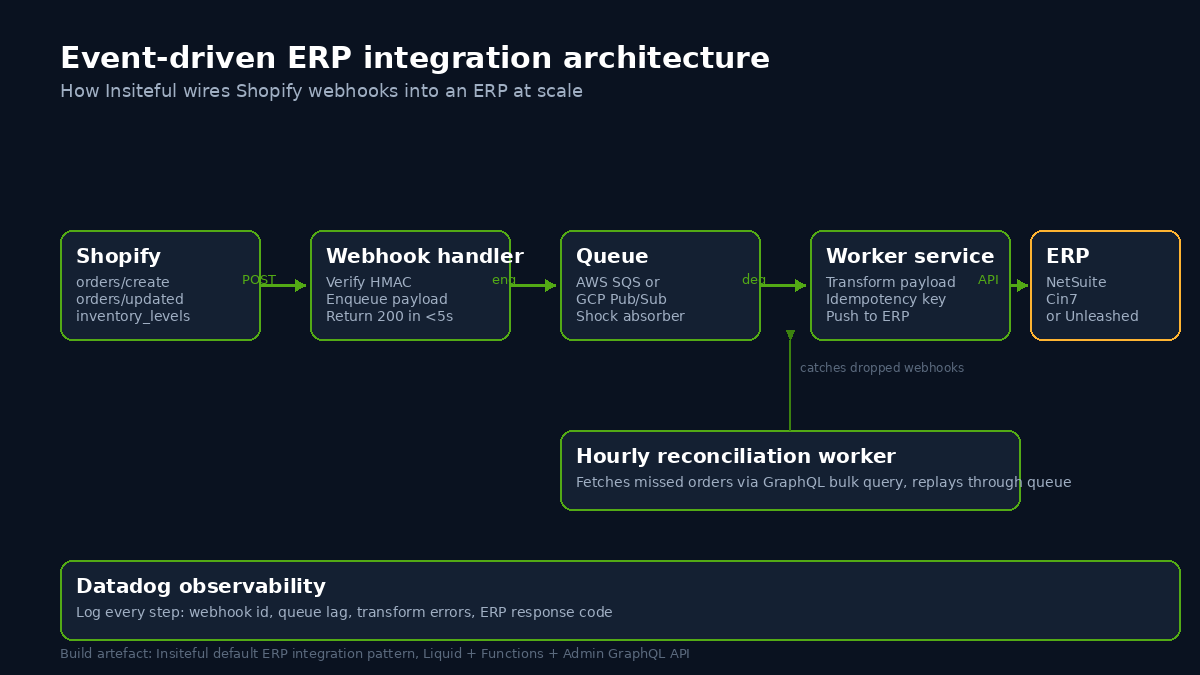
The architecture choice is therefore as important as the platform choice. A real-time, webhook-driven integration sitting behind a queue handles every scenario above. A polling-based, native connector with a fifteen-minute interval will not, regardless of which ERP sits on the other end.
The Three Patterns We See on Australian Brands
Before we compare the platforms themselves, the broader pattern matters. Australian Shopify brands at this scale fall into three buckets, and the right ERP answer differs across them.
The first bucket is the high-SKU, lower-AOV brand. Apparel, beauty, accessories, kids. Tens of thousands of variants when you count sizes and colours. The integration pain point is inventory accuracy across two or three warehouses, plus the wholesale or marketplace side bleeding into the same stock pool. Cin7 is the dominant answer here, almost always Cin7 Core for brands under $10M AUD and Cin7 Omni for brands above. NetSuite is overkill for this profile in almost every case we’ve seen.
The second bucket is the manufacturing or assembly brand. Food, supplements, hardware, anything with a bill of materials. The integration challenge is not inventory of finished goods but tracking raw materials, batches, and production runs back into finished SKUs that then sell on Shopify. Unleashed dominates this bucket because it was built for that exact use case. Cin7 Core handles light manufacturing but reaches its limits quickly when production complexity grows.
The third bucket is the multi-entity, multi-channel enterprise. A brand operating in Australia, New Zealand, and the US, with retail stores, wholesale, and DTC, plus a 3PL handling fulfilment and a finance team that needs consolidated reporting across all of it. NetSuite is genuinely the only option once the brand exceeds roughly $25M AUD in combined revenue, because nothing else handles multi-subsidiary financial reporting natively. The implementation cost is significant, but the alternative is hiring a finance manager to do the consolidation manually every month.
NetSuite Plus Shopify: When It Wins, When It Loses
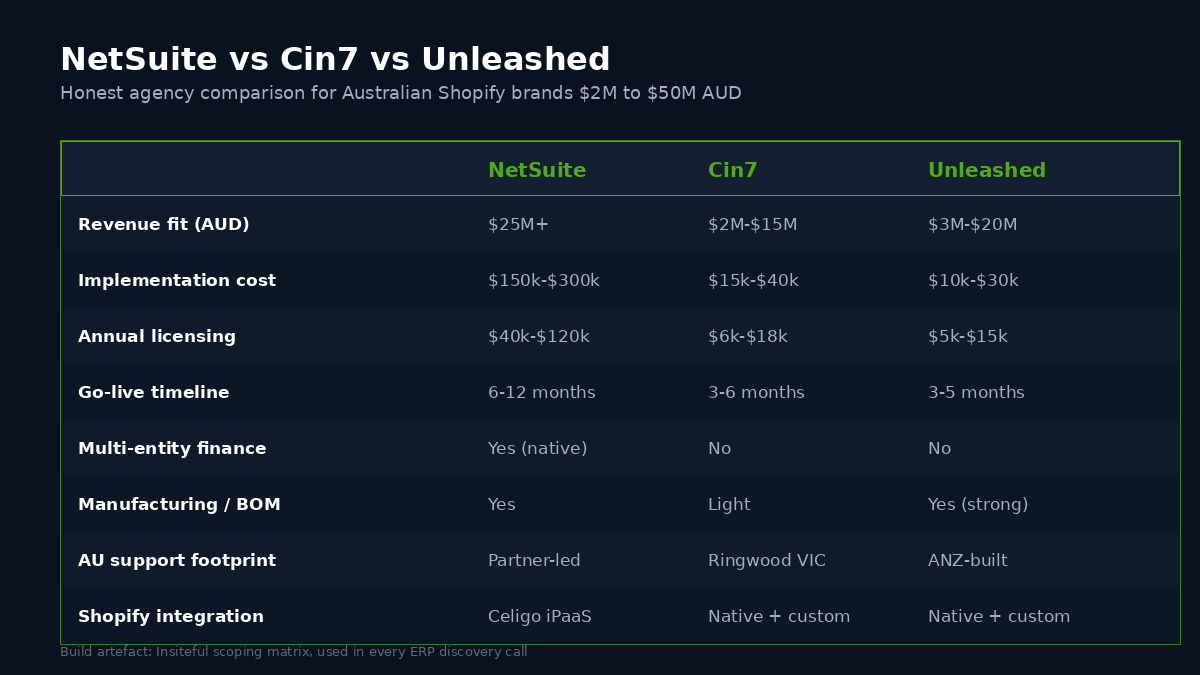
NetSuite is the largest cloud ERP on earth, owned by Oracle, used by roughly 41,000 organisations globally. For a Shopify Plus merchant doing $25M AUD or more across multiple subsidiaries, it is the default choice for good reason. The financial reporting depth, the multi-currency and multi-tax handling, the audit trail, the subsidiary consolidation, none of the alternatives in this comparison touch what NetSuite does at the enterprise end of the market.
The NetSuite-to-Shopify integration almost never runs on a native connector. The pattern that works is an iPaaS platform sitting between the two, most commonly Celigo, occasionally Boomi for brands that already use Boomi elsewhere. The Celigo Shopify-to-NetSuite Integration App is mature, well documented, and handles the corner cases that matter: multi-shipment orders, partial refunds, gift cards, store credits, multi-currency, inventory by location. Celigo’s standard integration apps typically go live in two to six weeks, with customisation extending that to two to three months when the brand has non-standard workflows.
Where NetSuite plus Shopify wins: any brand with multiple legal entities, complex revenue recognition, international subsidiaries, advanced inventory across multiple distribution centres, or a CFO who needs audit-ready financials to support due diligence, board reporting, or a future capital raise. We have implemented this stack for brands preparing for acquisition where the buyer demanded NetSuite as a precondition of the deal.
Where NetSuite plus Shopify loses: any brand under $10M AUD without a clear three-year path to a much larger operation. The implementation cost is the headline issue. NetSuite licensing typically runs $40,000 to $120,000 AUD per year depending on user count and modules, plus a Celigo subscription starting around $25,000 AUD per year, plus implementation consulting that lands between $50,000 and $250,000 AUD depending on scope. The total first-year cost of a NetSuite plus Shopify build for a mid-market brand is rarely under $150,000 AUD, and frequently closer to $300,000 AUD. If the brand doesn’t need the financial reporting depth that NetSuite uniquely provides, that money is spent on capability they will never use.
The other failure mode we see is timeline. NetSuite implementations consistently run six to twelve months end-to-end. Brands that need their inventory and order operations sorted in the next quarter cannot wait for that timeline, and the temptation to short-cut the implementation produces the worst NetSuite environments we’ve audited.
Cin7 Plus Shopify: The Australian Mid-Market Default
Cin7 is the platform we recommend most often for Australian brands in the $2M to $15M AUD range, and there is a structural reason for that. Cin7 was originally a New Zealand company before its global expansion, with strong Australian distribution, an office in Ringwood Victoria, and a customer base that skews heavily ANZ. Local support that actually understands Australian GST, the Australia Post shipping landscape, and the GS1 barcode standard matters more in week six of go-live than in the sales process.
There are two Cin7 products and they are not the same platform. Cin7 Core (formerly DEAR Systems, acquired by Cin7 in 2021) is the SMB and lower-mid-market product. Pricing starts around $510 AUD per month for the entry plan and runs to roughly $1,500 AUD per month for the higher tiers, all priced in USD on the official Cin7 site. Cin7 Omni is the enterprise product with custom pricing, designed for brands with multiple sales channels, EDI requirements, 3PL integrations, and full customisability. Implementation cost for Cin7 Omni in Australia typically lands between $15,000 and $40,000 AUD depending on complexity.
The Shopify integration for both Cin7 products is a native connector available through the Shopify App Store. Two-way sync covers products, inventory, customers, and orders. The connector handles multi-location inventory which matters for brands running a retail store plus DTC plus wholesale on the same SKU pool. The native connector polls rather than using event-driven webhooks for some surfaces, which is the source of most of the integration complaints in public Cin7 reviews. Inventory sync intervals of fifteen to thirty minutes are not fast enough for brands running flash sales or BFCM-style traffic.
Our build pattern for Cin7-to-Shopify integrations of any complexity is to use the native connector for the standard flows and supplement it with a custom Shopify Flow workflow plus a small webhook-driven service that handles the time-sensitive surfaces, primarily inventory adjustments during high-velocity periods. The native connector is fine for ninety percent of the data flow. The other ten percent is where most stores experience the “Cin7 broke our store” failure mode, and that ten percent is solved by acknowledging the connector’s polling limitation and routing around it.
Where Cin7 plus Shopify wins: Australian brands $2M to $15M AUD, multi-channel inventory complexity, retail plus DTC plus wholesale on the same stock pool, moderate financial complexity that Xero can still handle on the books side. Implementation timeline is realistic at three to six months including data migration from the old system.
Where Cin7 plus Shopify loses: brands with serious manufacturing or BOM complexity, brands needing genuine consolidated multi-entity financials, brands above roughly $20M AUD where the inventory volume starts exposing the connector’s polling limits even with our supplementary workflow in place.
Unleashed Plus Shopify: Manufacturing’s Quiet Favourite
Unleashed is the platform almost nobody recommends until you describe a brand making something rather than reselling it. Founded in New Zealand, now owned by The Access Group, Unleashed was built specifically for product-based businesses with manufacturing, assembly, or batch-tracked production. Pricing starts around $399 AUD per month including GST and scales with user count and warehouse count.
The features that matter for manufacturers are baked in rather than bolted on. Bills of materials with multi-level assemblies. Batch and serial number tracking with full traceability back to raw material lots, which matters for food, supplement, and regulated product brands. Landed cost tracking that correctly accounts for freight, duty, and GST when calculating the true cost of goods sold. Production runs that consume raw materials and produce finished SKUs in a single transaction. Cin7 Core can technically do some of this, but Unleashed’s implementation is materially better because the product was designed around it from day one.
The Shopify integration for Unleashed is solid but less commonly built than the Cin7 connector, which means agency expertise is less plentiful. The native integration handles product, inventory, customer, and order sync. The same polling limitations apply as Cin7, which we solve with the same architectural pattern: native connector for baseline sync, webhook plus queue for time-sensitive surfaces.
Where Unleashed plus Shopify wins: any brand manufacturing, assembling, or producing their finished goods. Food and supplements brands needing batch traceability. Brands with complex landed cost calculations across imported raw materials. Brands above $3M AUD where Cin7 Core’s manufacturing module starts to feel cramped.
Where Unleashed plus Shopify loses: pure resellers with no manufacturing element. The product’s strengths sit unused, and a brand in that profile is paying for capability they will never need.
The Middleware Decision: Native Connector or Custom Integration
Across all three platforms, the second-most-important decision after the ERP choice is the integration architecture. There are three patterns and they have very different total cost of ownership.
The first pattern is the native connector. Cin7 and Unleashed both have official Shopify App Store connectors. NetSuite does not have an official Oracle connector, but Celigo’s NetSuite Integration App is effectively the de-facto standard. Native connectors are the cheapest to set up, the cheapest to maintain, and the fastest to deploy. They are also the least flexible, the most opinionated about data mapping, and the source of most integration complaints when the brand’s workflow deviates from the connector’s assumptions.
The second pattern is an iPaaS platform sitting between Shopify and the ERP. Celigo for NetSuite-heavy stacks. Boomi for brands that already run Boomi for other systems. Workato for brands prioritising recipe-based citizen integration. Pricing starts around $25,000 to $50,000 AUD per year for a Shopify-plus-ERP scope, scaling significantly when more endpoints get added. The advantage is flexibility, version control on integration logic, and the ability to handle complex transformations the native connectors won’t touch.
The third pattern is a custom integration built on Shopify webhooks plus a queue plus a small Node or Python service plus the ERP’s REST or SOAP API. We build these for brands where the native connector hits its ceiling and the iPaaS subscription cost isn’t justified by the volume. The cost is concentrated in the build phase, typically $25,000 to $80,000 AUD, after which the running cost is minimal: a small server instance, queue charges, and the occasional bug fix when an API contract changes. We have brands running this pattern at $20M AUD revenue with sub-five-second order sync latency, which neither the native connector nor the iPaaS approach can match.
The architecture that works at scale, regardless of pattern, is event-driven. Shopify emits webhooks for orders, refunds, inventory, fulfilment. Those webhooks land in a queue (we use AWS SQS or Google Cloud Pub/Sub depending on the client’s cloud preference) which acts as a shock absorber during peak traffic. A worker process consumes the queue, applies any transformation, and pushes the result to the ERP. The webhook handler itself responds with HTTP 200 within five seconds, which Shopify requires, and the heavy lifting happens asynchronously. This is the architectural pattern we deploy on every custom build, and it is the pattern that the better iPaaS platforms approximate underneath their abstractions.
The Hidden Costs Nobody Quotes For
Every ERP-to-Shopify project we’ve audited has the same three hidden cost lines that didn’t make the original budget. Surfacing them in scoping prevents the brutal mid-project conversation where the brand realises the project has doubled in cost.
The first hidden cost is data migration. Moving an existing brand’s product catalogue, customer history, and historical orders into the new ERP is rarely included in the connector subscription. For a brand with five years of trading history and 8,000 SKUs, data migration commonly runs 80 to 200 hours of consulting work, landing at $15,000 to $40,000 AUD. Skipping this step produces an ERP with no historical context, which makes the financial reporting and customer service teams furious within the first month.
The second hidden cost is process redesign. The ERP forces choices about how the business operates: when an order is “allocated” versus “committed”, how returns are processed, who can apply credits, what triggers a purchase order. Most growing brands have informal processes that lived inside spreadsheets and tribal knowledge. Mapping those into the ERP’s workflow takes time from operations and finance leadership, and that time is invisible in the implementation quote. Budget at least 60 hours of internal leadership time across the project.
The third hidden cost is the inevitable second integration round. Six to nine months after go-live, the brand realises they need an integration the original scope didn’t cover. Klaviyo needs the new customer segment data. Their 3PL is changing. The accounting team wants a custom GL mapping. Budget $15,000 to $40,000 AUD per year ongoing for integration maintenance and small new builds.
A Decision Framework for $2M to $50M AUD Brands
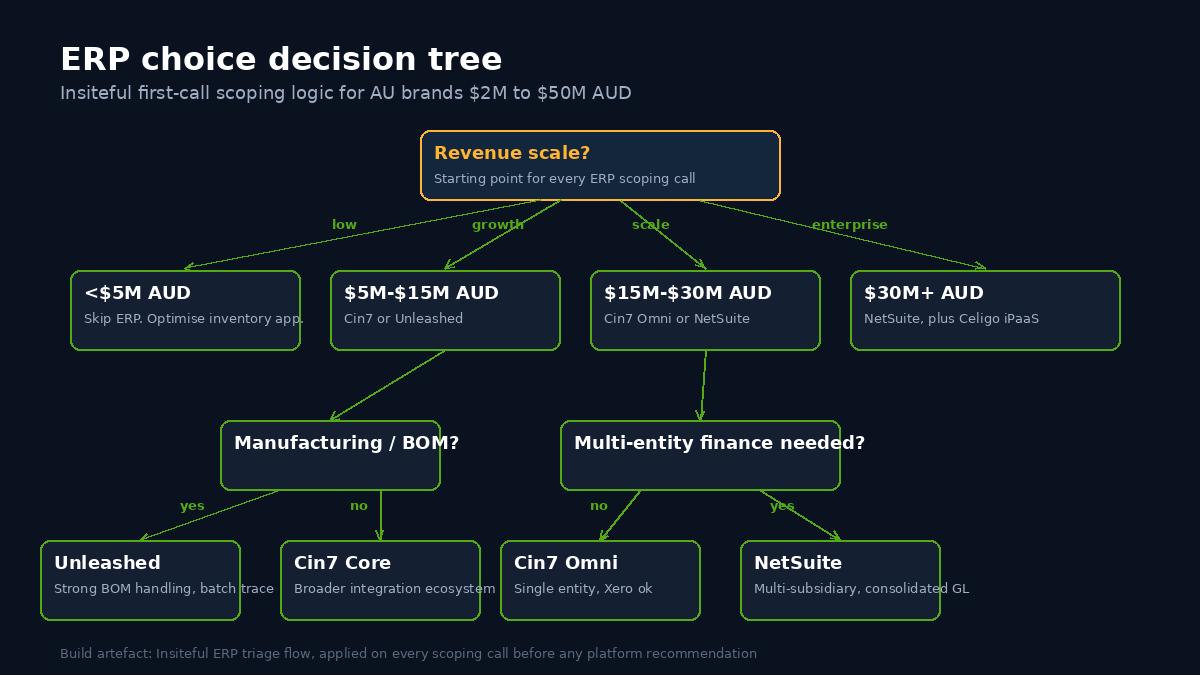
The honest answer to “which ERP do we need” is almost always conditional on three variables: revenue scale, operating model, and capital efficiency goals.
For brands at $2M to $7M AUD with a single warehouse, no manufacturing, and Xero on the books side, the ERP question is usually premature. The right answer is to optimise the existing inventory app (commonly Stocky, TradeGecko legacy, or a Shopify-native solution) and reserve the ERP project for the $10M AUD mark. We have steered multiple brands away from a Cin7 implementation at $4M revenue because the operational pain was solvable for $400 per month rather than $40,000.
For brands at $5M to $15M AUD with multi-channel inventory, light manufacturing or kitting, and growing complexity, Cin7 Core or Unleashed is the right answer. The choice between them comes down to manufacturing complexity. If there’s a meaningful BOM, choose Unleashed. If it’s mostly reselling with light assembly, choose Cin7 Core for the broader integration ecosystem.
For brands at $15M to $30M AUD with multi-channel, multi-location, and serious operational complexity, the choice expands to Cin7 Omni at the upper limit of its capability, or NetSuite at the lower limit of its sweet spot. The decision usually comes down to financial reporting needs. A brand with a single legal entity and a competent fractional CFO running Xero can stretch Cin7 Omni further than most expect. A brand with multiple entities, international subsidiaries, or near-term capital raise plans should commit to NetSuite earlier rather than later.
For brands above $30M AUD, NetSuite is genuinely the only answer that scales without forcing a second migration two years later. The implementation cost stings, but the alternative is paying a finance team to do consolidation work that an ERP should do automatically.
How We Do It at Insiteful
When a brand engages us for an ERP-to-Shopify integration, the work starts well before any connector configuration. We run a discovery phase that maps the current data flow across every system: where products live, where inventory truly lives, how orders move from cart to fulfilment to finance, where the manual workarounds and spreadsheets actually sit. That map is rarely what the brand thinks it is on day one.
From the discovery we produce three deliverables. A current-state architecture diagram showing every integration that exists today, including the broken or unofficial ones. A future-state architecture diagram showing where each piece of data will live after the new ERP is in place. And a sequenced migration plan that orders the work to minimise operational risk: data migration first, sandbox integration testing second, parallel running of old and new for at least two weeks, then cutover with a 72-hour war room.
On the integration build itself, our default architecture is the event-driven pattern: Shopify webhooks land in a queue, a worker service handles transformation and ERP push, and a separate scheduled reconciliation job runs every hour to catch any webhook that failed to deliver. We instrument every step with logging that goes to Datadog or the brand’s preferred observability platform, so when something fails at 2am we can see exactly which order, which webhook, and which step in the pipeline broke. This is the same pattern we use whether the ERP on the other end is NetSuite, Cin7, or Unleashed.
We work natively in Liquid, Shopify Functions, and the Admin GraphQL API, with no headless storefront layer because we don’t build headless. The integration sits behind Shopify, not in front of it, which keeps the storefront fast and the integration logic isolated from the customer-facing experience. We’ve deployed this pattern on Australian brands turning over $3M to $35M AUD, with go-live timelines of eight to sixteen weeks for the integration phase, depending on which ERP is involved and how clean the source data is.
The brands who get the most value from us treat the ERP implementation as a redesign of how the business runs, not as a software install. The ones who want plug-and-play with no process change we turn away at scoping, because the project will fail and both sides will be unhappy at the end.
Get the Integration Architecture Right Before You Spend
The biggest cost saving on an ERP-to-Shopify project happens before the platform is chosen. A two-week architecture discovery costs a fraction of a wrong-platform choice that takes 18 months to unwind. We’ve run this discovery for brands who arrived convinced they needed NetSuite and walked away with a $1,500 a month Cin7 Core implementation that solved their actual problem. We’ve also done the opposite, where the brand assumed Cin7 would be enough and the discovery surfaced multi-entity reporting requirements that mandated NetSuite from day one.
If you’re evaluating an ERP-to-Shopify integration in 2026, the question to answer first is what data flow your business actually needs, not which platform sounds enterprise-grade. The platform follows the data flow, not the other way around.
Get an honest agency-side scoping conversation about your ERP-to-Shopify integration. We’ll tell you whi