
Most Shopify brands that sell wholesale are running the wrong architecture for their situation. Some are running a clunky workaround using discount codes and a password-protected page. Others have stood up a second Shopify store that now requires double the maintenance, double the app stack, and double the operational overhead. A few have upgraded to Shopify Plus and turned on the B2B features without fully understanding what they do and do not cover.
The right answer depends on four things: your order volumes, your buyer complexity, your internal team, and how tightly your B2B and DTC operations need to share inventory. Get it wrong and you will be re-platforming in eighteen months. Get it right and a well-structured Shopify B2B store can handle seven-figure wholesale revenue without a dedicated ops hire.
We have built B2B architecture on Shopify across retail, food and beverage, homewares, and industrial categories. Here is how we think about the decision.
What Shopify Plus B2B Actually Does (and Does Not Do)
Shopify rolled out its dedicated B2B feature set progressively from 2022 onwards, completing the core suite by mid-2023. It lives entirely within a single Shopify Plus store and is accessed via the Companies section in the admin. This is not a bolt-on app. It is a native capability built into the platform.
Here is what the Shopify Plus B2B feature set actually gives you:
- Company accounts with multiple locations. A single buyer (say, a national retailer) can have multiple ship-to locations under one company umbrella. Each location can have its own payment terms and credit limits.
- Customer-specific price lists. You can assign a price list per company or per location. Price lists support fixed prices, percentage discounts off retail, or volume tiers. A single product can have ten different prices active at once across ten different buyers.
- Customer-specific catalogues. Beyond pricing, you can control which products a given buyer can even see. A grocery chain might see only your food-safe SKUs. An industrial reseller might see only the B2B-packaged variants. Catalogues are assigned at the company or location level.
- Payment terms. Net 30, Net 60, Net 90, and due-on-fulfilment are all native. Buyers can place orders on terms without requiring a credit card at checkout. This is enormous for trade accounts and was previously only achievable through custom code or third-party apps.
- B2B-specific checkout experience. When a B2B buyer logs into a Plus store, the checkout surface can be different from the DTC checkout. PO number fields, terms acknowledgement, and tax-exempt status all work natively.
- Draft orders into B2B orders. Your sales team can create draft orders and convert them to B2B orders tied to a company account, with the correct pricing and payment terms automatically applied.
- Vaulted payment methods. Regular buyers can save a payment method to their company account, removing friction from repeat ordering.
That is a genuinely strong feature set. For many mid-market brands, it removes the need for a separate wholesale store entirely.
But there are real constraints. Shopify Plus B2B does not natively support: complex tiered volume pricing that varies by product category and company simultaneously, multi-level sales rep hierarchies, integrated EDI, full ERP-grade purchase order management, or custom approval workflows for large orders. If you need any of those, you are looking at custom Shopify Functions or a purpose-built B2B middleware layer sitting in front of Shopify.
The other constraint is price. Shopify Plus starts at approximately USD 2,300 per month on the revenue-based pricing plan, and that is before apps, development, and maintenance. For a brand doing less than AUD $2M per year in wholesale, that cost structure is hard to justify on B2B revenue alone.
The Separate Wholesale Store Approach
Before Shopify Plus B2B existed, the dominant pattern for wholesale on Shopify was a dedicated second store. You would stand up a separate Shopify instance, password-protect it or restrict checkout to approved accounts, and manage it as a completely independent operation.
This approach still makes sense in specific scenarios. But it comes with costs that are easy to underestimate.
The operational overhead compounds quickly. Two stores means two app stacks. If you are running Klaviyo for email, you need separate Klaviyo instances or careful list segmentation. Your inventory sync between the stores requires either a third-party tool (Trunk, Syncio, or a custom solution) or manual reconciliation. Theme updates need to happen twice. When you add a new product, it needs to be added to both stores. Customer service teams need to switch between two admin panels.
Brands that have run this model for more than two years consistently tell us the same thing: the invisible tax of double-maintenance accumulates until it becomes a serious drag on the team. We have audited wholesale operations where roughly 30% of a marketing coordinator’s time was consumed by keeping the two stores in sync.
That said, a separate store gives you complete flexibility. You can run a different theme, a different checkout flow, different apps, and different pricing logic without any of it touching the DTC experience. If your wholesale catalogue is fundamentally different from your retail catalogue (different SKUs, different packaging, different minimum order quantities), a separate store often makes more architectural sense than trying to manage product visibility rules inside a single store.
A separate store also sidesteps the Shopify Plus requirement. You can run a standalone wholesale store on basic Shopify, which starts at approximately USD $79 per month. For a brand in the AUD $500K to $2M wholesale range, this cost difference is material.
Architecture Decision Matrix: 5 Scenarios
The right architecture is not universal. Here is how we score the two approaches across five common situations we see in the market.
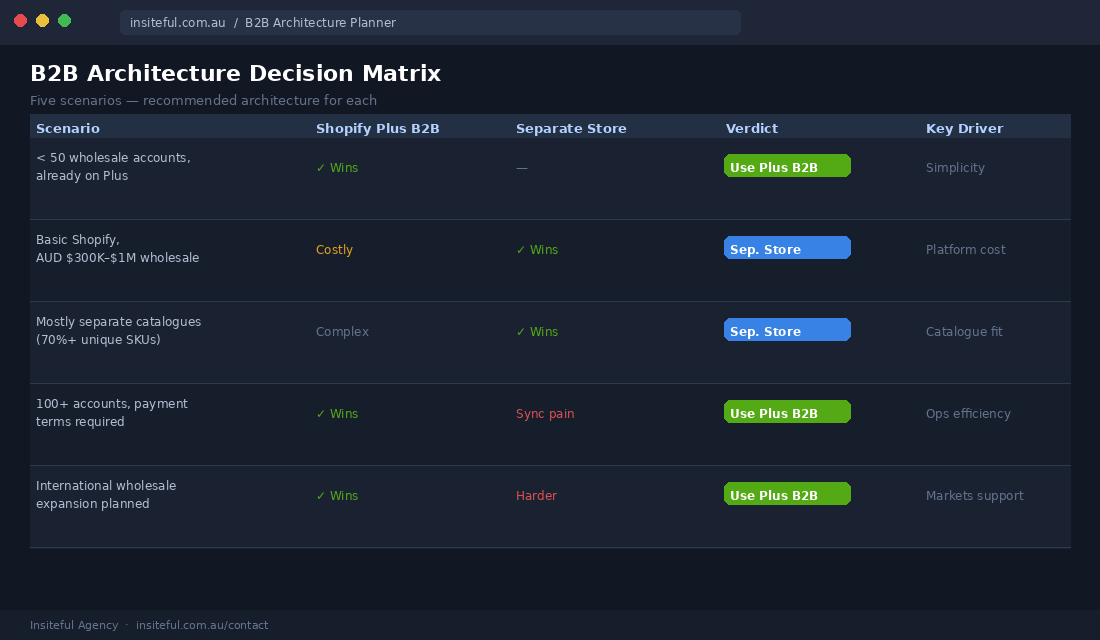
Scenario 1: Brand on Shopify Plus with under 50 wholesale accounts. Native B2B wins. The complexity is low, the feature set is more than sufficient, and keeping everything in one store is the right operational call. The maintenance overhead of a second store is not justified.
Scenario 2: Brand on basic Shopify doing AUD $300K-$1M wholesale, DTC on the same store. Separate store wins on cost grounds alone. The upgrade to Shopify Plus costs roughly AUD $40K-$50K per year in platform fees. Unless the native B2B features create equivalent value through operational savings or revenue gains, the economics do not stack up.
Scenario 3: Brand with fundamentally different wholesale and retail catalogues. Separate store wins. Managing product visibility and catalogue rules inside a single store adds ongoing administrative complexity. If 70% of your SKUs are wholesale-only, it is cleaner to separate the operations entirely.
Scenario 4: Brand doing AUD $3M+ wholesale with 100+ accounts, complex pricing, and payment terms requirements. Native B2B on Shopify Plus wins decisively. The native payment terms, company account management, and price list features will save the team hours per week. At this scale, the Shopify Plus cost is a rounding error against the operational efficiencies.
Scenario 5: Brand planning international wholesale expansion across multiple markets. Native B2B on Shopify Plus combined with Shopify Markets is the only architecture that handles multi-currency, multi-language, and per-market pricing at scale without building a custom solution. A separate wholesale store can be made to work internationally, but you will be fighting the platform rather than working with it.
Customer Experience Comparison
B2B buyers have different expectations from DTC shoppers. They are ordering for a business. They care about PO numbers, invoice history, reordering efficiency, and account-specific pricing visibility. The customer experience your architecture delivers on these dimensions matters as much as the internal operations.
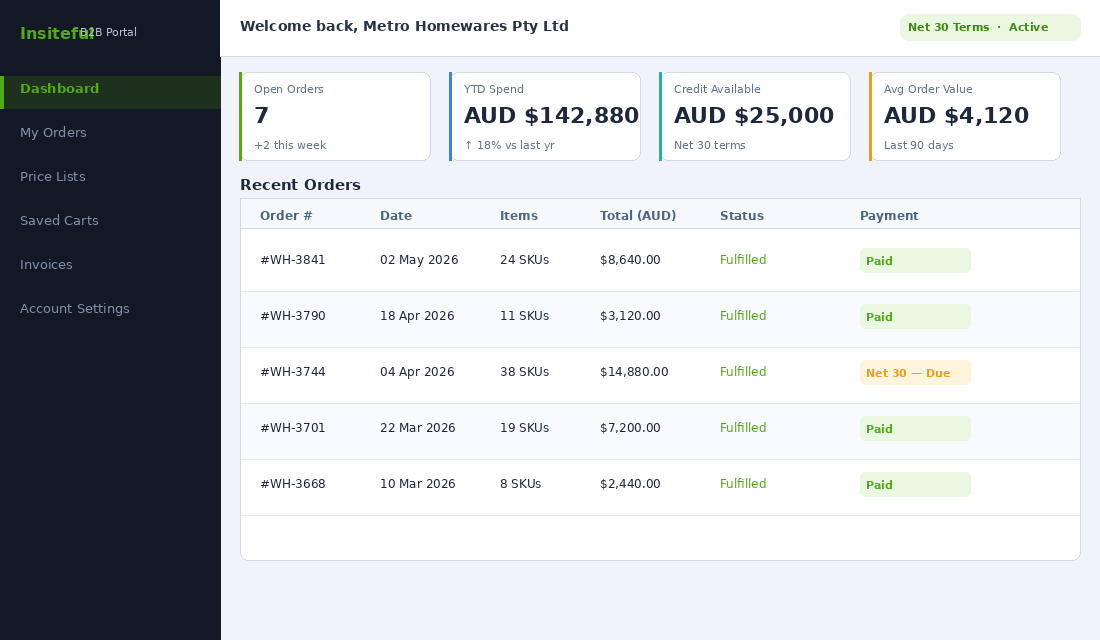
With Shopify Plus B2B, buyers log into the same storefront they might already know but see a personalised experience. Their price list is applied automatically. Their payment terms appear at checkout. They can see their company’s order history and download invoices. They do not need to call a rep to place a repeat order.
The Shopify B2B customer portal is not as feature-rich as a purpose-built B2B platform like Handshake or a full ERP portal. But for most wholesale buyers, it covers 90% of what they actually need. The self-service reorder flow alone reduces inbound emails to customer service by 40-60% in our experience.
With a separate wholesale store, the customer experience is entirely up to you. You control the theme, the account portal (if you build one), and the checkout flow. This flexibility is genuine, but it requires investment. Most brands running a separate wholesale store have not built a proper account portal, which means buyers are emailing or calling to place orders, check pricing, or get invoices. That is a solvable problem, but it requires development time you may not have budgeted.
One area where a separate store consistently wins on customer experience: the checkout flow can be stripped down to exactly what B2B buyers need, without the constraints of the DTC checkout. If your DTC checkout has gift messaging, shipping upsells, and post-purchase offers, those create friction for a wholesale buyer placing a 200-SKU order. A dedicated wholesale store checkout can be clean and fast.
Inventory and Order Management Implications
Inventory is where the two-store approach most often falls apart. When you have one inventory pool feeding two stores, you need a reliable sync mechanism. The options are:
- Third-party inventory sync apps (Trunk, Syncio, SKULabs). These work, but they add latency, cost around AUD $50-$300 per month, and require careful configuration. They also introduce a failure mode: if the sync falls over during a busy period, you can oversell on both channels.
- ERP or 3PL integration. If you are running an ERP (MYOB, Netsuite, Cin7) as the inventory master, both Shopify stores can pull from the same source of truth. This is the right approach at scale, but it adds integration complexity and cost.
- Manual management. This is what most small brands default to, and it does not scale beyond a handful of wholesale accounts without someone on the team spending significant time on it.
With Shopify Plus B2B running on a single store, inventory is shared by default. A B2B order and a DTC order draw from the same pool. There is no sync required, no failure mode to manage, and no latency. This is a meaningful operational advantage, particularly during high-velocity periods like peak season, when inventory accuracy is most critical.
Order management follows the same logic. With a single store, all orders sit in one place. Your fulfilment team sees B2B and DTC orders in a unified queue. Reporting on fulfilment rates, order values, and customer behaviour is straightforward. With two stores, you are either switching between admin panels or aggregating data in a BI tool, neither of which is ideal.
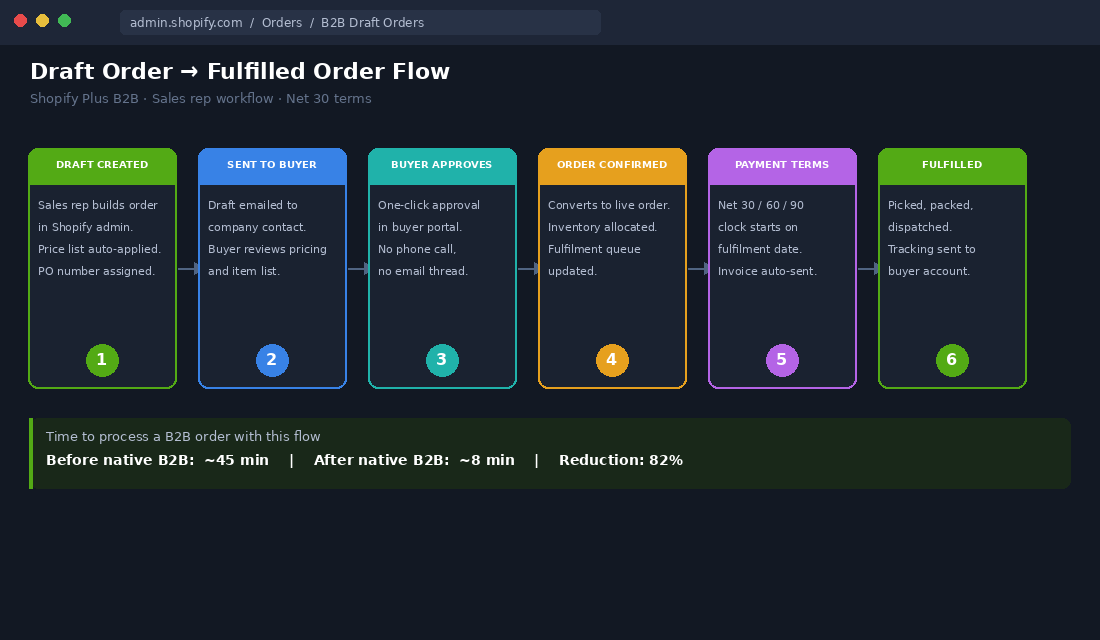
The draft order to fulfilled order flow in Shopify Plus B2B is worth understanding specifically. A sales rep creates a draft order, assigns it to a company account, applies the correct price list, sets payment terms, and sends it to the buyer for review. The buyer approves it and it converts to a live order. No manual pricing, no email threads, no chance of the wrong price being quoted. We have seen brands cut their average order processing time from 45 minutes to under 8 minutes by moving this workflow into native Shopify B2B.
The Legacy Wholesale Channel (And Why You Should Not Build On It)
Before Shopify Plus B2B launched, there was a third option: the Wholesale Channel. This was a Shopify-built add-on that created a password-protected subdirectory for wholesale buyers, with basic price list functionality layered on top of the main store.
Shopify deprecated the Wholesale Channel in 2023 and migrated existing users to the new B2B feature set. If your store is still using the Wholesale Channel, you are on legacy infrastructure that is no longer being developed.
We still audit Shopify Plus stores that are running on the old Wholesale Channel because migration was not mandatory. But the gaps are significant. The Wholesale Channel does not support company account structures, multi-location buyers, or the native payment terms that the new B2B feature set provides. If you are on it, migration to the new B2B features should be on your roadmap.
How We Scope B2B Builds at Insiteful
When a brand comes to us with a B2B brief, we run through a structured discovery process before recommending an architecture. The key questions are:
- How many active wholesale accounts do you have, and how many do you plan to have in 24 months?
- Do your wholesale and retail catalogues overlap substantially, or are they largely separate?
- Do you require payment terms (Net 30/60/90)?
- Are you currently on Shopify Plus, or would an upgrade be required?
- What is your current inventory management setup, and where does the source of truth live?
- How complex is your pricing structure? Fixed discounts per account, or tiered volume pricing by SKU?
- Do you have a sales rep team that creates orders on behalf of buyers?
The answers to these questions determine whether we recommend native Shopify Plus B2B, a separate wholesale store, or a hybrid approach where B2B runs on Plus and a lightweight wholesale portal is built using Shopify’s Storefront API for buyers who need a custom ordering interface.
The hybrid approach is worth mentioning because it solves a specific problem: brands that need the operational benefits of single-store inventory management but also need a bespoke buyer portal that Shopify’s native B2B checkout cannot deliver. In this architecture, Shopify handles the commerce infrastructure (inventory, orders, pricing, payment terms) and a custom-built portal handles the buyer-facing UX. It is more expensive to build and maintain, but for a brand with 200+ accounts and complex ordering workflows, it is often the right call.
What we never recommend: building on the old Wholesale Channel, using discount codes as a wholesale pricing mechanism at scale, or standing up a second store as a permanent solution without a clear plan for inventory sync and operational overhead management.
B2B architecture decisions have long tails. The store you build today needs to handle the volume you project for three years from now, not just the volume you have today. A brand doing AUD $800K in wholesale now but projecting $3M in two years should be building on Shopify Plus B2B infrastructure from day one, even if some of the more advanced features are not in use yet.
If you are weighing up B2B architecture on your own Shopify build, that is exactly the kind of call we help founders make. Talk to the Insiteful team and we will map the right approach for your catalogue, your buyer structure, and your growth trajectory.