
Most Shopify founders hit $2 million in annual revenue and start fielding the same question from peers, consultants, and their Shopify account manager: “Shouldn’t you be on Plus by now?”
The honest answer is not straightforward. Shopify Plus is genuinely transformative for the right business. For the wrong one, it is USD $2,300 per month (around $3,600 AUD) spent on infrastructure you will never fully use.
We have migrated dozens of Australian brands to Shopify Plus and talked many more out of it when the timing was wrong. This is the breakdown we give every client who asks: the real shopify plus pricing structure, the actual feature gap versus Advanced, and the revenue maths that determine whether upgrading stacks up.
What You Actually Pay for Shopify Plus
The base fee is USD $2,300 per month. At current exchange rates (approximately 0.63 AUD/USD), that is around $3,634 AUD per month, or $43,608 AUD per year. That annual number is the one that matters most when you are weighing the decision.
That flat fee applies to brands under USD $800,000 in monthly revenue (roughly $1.27 million AUD/month, or approximately $15.2 million AUD annually). Once you exceed that threshold, Shopify shifts to a variable model: 0.25% of your monthly revenue, capped at USD $40,000 per month.
The variable model changes the maths significantly for high-volume brands. An Aussie retailer turning over $30 million AUD annually crosses into variable territory and pays approximately USD $3,930 per month (around $6,222 AUD). At $60 million AUD annually, you are approaching USD $7,900 per month. The cap protects brands at the very top: at $300 million AUD annually, you are still paying no more than AUD $63,000 per month.
One detail that gets glossed over in Plus sales conversations: the base fee covers your primary store only. Expansion stores (for international markets, wholesale storefronts, or additional brands) cost USD $250 per month each (around $396 AUD). Your first three expansion stores are included at no additional charge, but from store four onwards, the cost compounds. A DTC brand running four regional storefronts pays the base plus $396 AUD per month for that fourth store.
Shopify Plus contracts are negotiable at higher volumes. Brands clearing $50 million AUD annually have real leverage to push on both the monthly rate and the included professional services. Annual pre-payment typically yields a modest discount. Come to the Plus conversation prepared to negotiate.
What You Actually Get: The Feature Delta That Matters
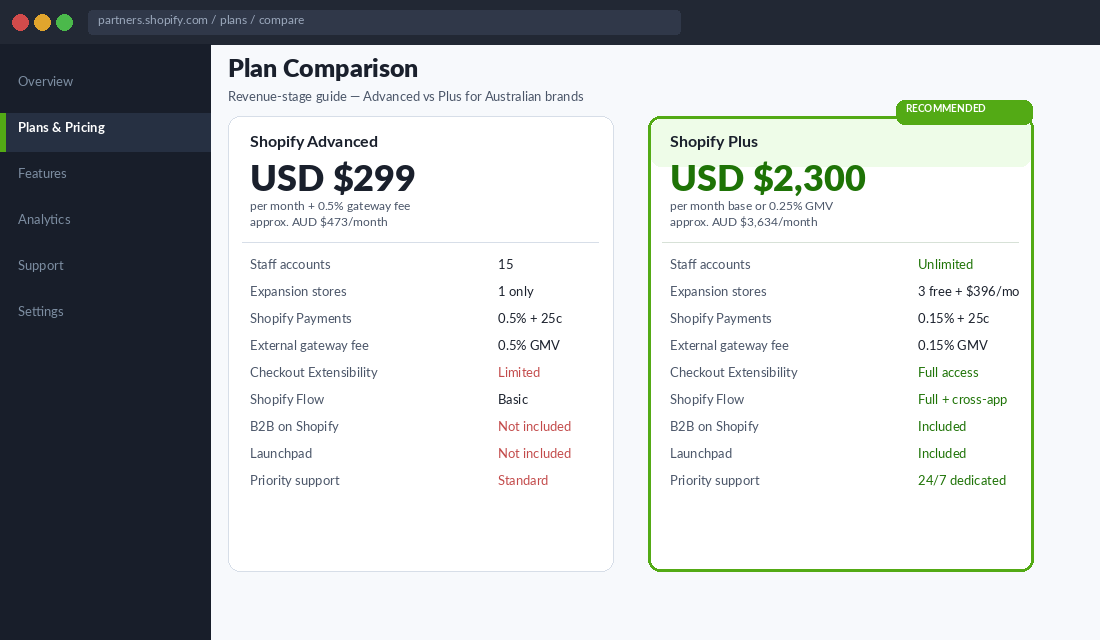
The gap between Shopify Advanced and Shopify Plus is more specific than most upgrade guides acknowledge. Some features genuinely move the needle. Others sound compelling in a sales deck and collect dust in practice. Here is the breakdown.
Checkout Extensibility
This is the headline feature and, for most brands doing $2M+, the legitimate reason to upgrade. Checkout Extensibility lets you customise checkout using Shopify’s Checkout UI Extensions, Shopify Functions, and the Checkout Editor. You can add upsell blocks, custom input fields, loyalty program integrations, and fully branded checkout experiences.
Important context: checkout.liquid is deprecated and unavailable to new Shopify merchants regardless of plan. All new checkout customisation work should be built on Extensibility. The Plus upgrade unlocks the full Checkout Editor and the complete extension framework needed to build on top of it.
Brands that implement checkout upsell blocks via Extensibility typically see a 3% to 8% lift in average order value. On a store processing $200,000 AUD per month, a 5% AOV lift is $10,000 per month in additional revenue. That single outcome funds the Plus upgrade many times over.
Shopify Flow
An automation builder that triggers workflows based on order events, customer tags, inventory levels, fulfilment status, and more. Flow is available in limited form on standard plans. Plus unlocks the full trigger library, cross-app connectors, and multi-step automation sequences.
Practical use cases we build for clients: automatic VIP customer tagging at a revenue threshold, low-stock reorder alerts to suppliers, high-risk order flagging, and post-purchase tag sequencing for loyalty and email flows. Teams that previously managed these manually save 5 to 10 hours per week once Flow is properly configured.
B2B on Shopify
Native wholesale functionality available exclusively on Plus. You get company profiles, custom price lists per company, buyer portals, NET payment terms, draft orders, and company-specific product catalogues. Before this existed natively, brands needed either a separate Shopify store or third-party apps like Wholesale Helper or Handshake.
If you are running B2B alongside DTC, the native solution consolidates your operations meaningfully. Managing two separate storefronts adds complexity in inventory management, fulfilment routing, and reporting that compounds over time. B2B on Plus removes that operational overhead cleanly.
Launchpad, Unlimited Staff Accounts, and Priority Support
Launchpad is a campaign scheduler for product drops, flash sales, price changes, and theme swaps. Schedule a BFCM sale to activate at midnight without manual intervention. Not the most sophisticated tool in the Plus suite, but genuinely valuable for planned campaigns at scale. Brands running 4 to 6 major campaign launches per year get significant operational time back from this single feature.
Shopify Advanced limits you to 15 staff accounts. Plus removes that cap entirely. For brands with separate marketing, fulfilment, customer service, and warehouse teams plus agency access, 15 accounts becomes a real constraint faster than most founders expect.
Priority support provides 24/7 access to a dedicated Plus support team with faster escalation paths. Most of the time you will not use it. When a checkout bug surfaces at 11pm on a BFCM Saturday, it is the most valuable line item in the entire Plus subscription.
The $2M Revenue Threshold Maths
Let us run the actual numbers for an Australian brand at $2 million AUD in annual revenue. That is roughly $1.27 million USD annually, or approximately $105,000 USD per month in GMV.
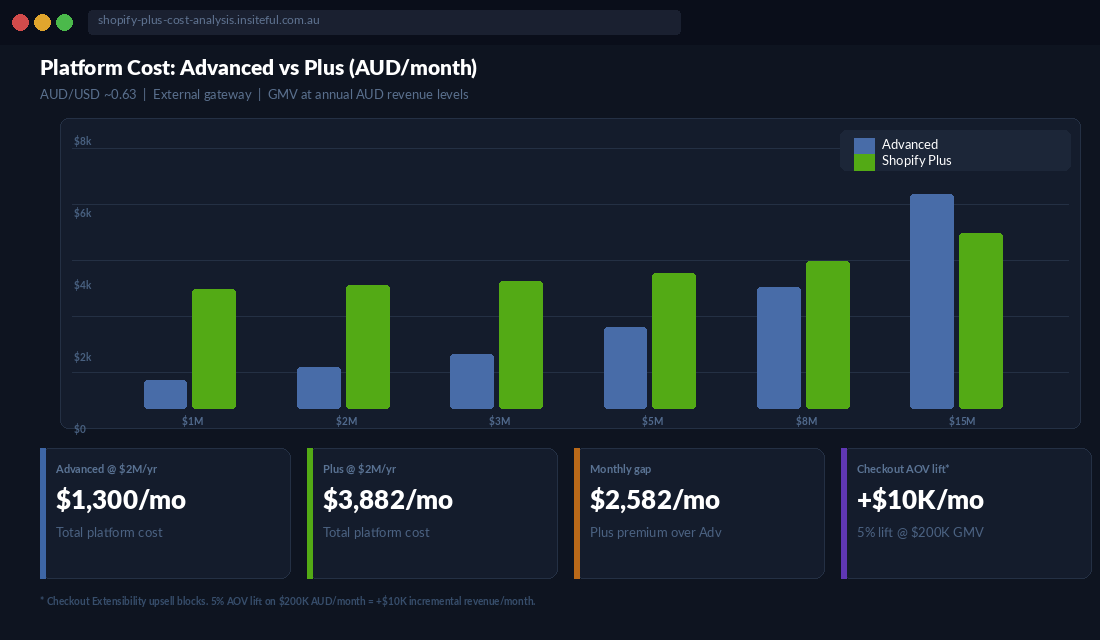
On Shopify Advanced: plan fee of USD $299/month (approximately $473 AUD). Shopify Payments processing at 0.5% + $0.25 per transaction. If using an external payment gateway (Afterpay, PayPal as primary, etc.), add 0.5% of GMV in transaction fees. At $105,000 USD/month GMV, that is approximately $525 in additional fees. Total monthly platform cost: approximately USD $824/month ($1,300 AUD).
On Shopify Plus: plan fee of USD $2,300/month ($3,634 AUD). Shopify Payments processing drops to 0.15% + $0.25 per transaction. External gateway fee: 0.15% of GMV, or approximately $157.50 per month at the same volume. Total monthly platform cost: approximately USD $2,457/month ($3,882 AUD).
The monthly gap is approximately USD $1,633/month ($2,582 AUD/month) more than Advanced. The transaction fee savings on an external gateway amount to roughly USD $367.50/month at this revenue level. Fee arbitrage alone does not justify the upgrade at $2M AUD.
The breakeven on transaction savings only occurs if you are processing USD $920,000+ per month on an external gateway, which is close to the $800K threshold where Plus pricing shifts to variable anyway. At that point, the fee model changes the maths entirely.
The real calculation at $2M-$5M AUD: if Plus-specific features generate at least $2,582 AUD per month in incremental revenue or operational cost savings, the upgrade pays. Checkout upsells converting at 5% AOV lift on $200K monthly revenue is $10,000 per month. That maths closes in the first quarter of operating on Plus.
| Feature / Cost | Shopify Advanced | Shopify Plus |
|---|---|---|
| Monthly plan cost (AUD approx) | $473/month | $3,634/month |
| Annual plan cost (AUD approx) | $5,676 | $43,608 |
| Staff accounts | 15 | Unlimited |
| Expansion stores | 1 primary only | 3 free, $396/mo after |
| Shopify Payments rate | 0.5% + 25c | 0.15% + 25c |
| External gateway fee | 0.5% of GMV | 0.15% of GMV |
| Checkout Extensibility | Limited | Full access |
| Shopify Flow | Basic triggers only | Full + cross-app |
| B2B on Shopify | Not included | Included |
| Launchpad | Not included | Included |
| Priority support | Standard | 24/7 dedicated |
| ShopifyQL Notebooks | Not included | Included |
AUD/USD approximately 0.63 at time of writing. Verify current rates when budgeting for a real upgrade decision.
Hidden Costs: The Budget Items No One Mentions
The USD $2,300 base fee is where the conversation starts, not where the cost lands. Here is what typically layers on top for brands making the move.
Checkout Rebuild (One-Time)
If you have existing checkout customisations built on checkout.liquid (custom discount logic, gift message fields, conditional upsell banners), these need to be rebuilt as Checkout UI Extensions and Shopify Functions. A Shopify developer at $150-$200 AUD per hour, with a 20-40 hour scope, means $3,000-$8,000 AUD before you have activated a single Plus feature. This is a one-time investment, but it must be budgeted from the start, not discovered after sign-off.
App Stack Step-Ups
Several apps used at scale carry Plus-tier pricing. Klaviyo steps up at higher contact volumes, Rebuy’s enterprise tier unlocks at Plus level, and Yotpo’s advanced reviews and loyalty tiers often coincide with a Plus upgrade. In aggregate, budget $500-$2,000 AUD per month in additional app costs. Audit your stack before committing, not after.
Theme Update or Rebuild
If your theme is more than two years old and heavily customised, it may not take full advantage of the Online Store 2.0 metafield architecture that supports Plus features properly. A theme upgrade is often triggered alongside a Plus migration. Budget $5,000-$15,000 AUD if a full theme rebuild lands in the same project window.
Developer Time for Flow and B2B Configuration
Flow and the B2B portal are not self-serve for most non-technical teams. Getting the first five Flow automations built correctly, and the B2B portal configured with price lists and buyer permissions, is typically 10-20 hours of agency time at $150-$200 AUD per hour. Build this into your migration budget from day one.
Total migration budgets for Australian brands range from $5,000 AUD (clean store, minimal customisations, straightforward checkout rebuild) to $30,000 AUD or more for complex builds with B2B portal setup, multi-store architecture, and full theme rebuild. The spread is wide because the scope is genuinely variable.
When Standard Is Still the Right Call
Many agencies push clients toward Plus because their project rate increases on a Plus contract. Here is the version you hear from us.
Stay on Advanced if you are operating a single DTC storefront with a simple product range and no B2B component. The $37,932 AUD annual saving versus Plus is real capital better deployed in paid acquisition, inventory, or headcount. You can revisit the Plus conversation when the feature need is concrete.
Stay on Advanced if you do not have development capacity to use Plus features. Checkout Extensibility without a developer to build on it is a monthly cost with no return. Flow requires setup investment before it pays off. Committing to Plus without the team to execute on it means paying for potential you are not realising.
Stay on Advanced if you are still validating international expansion. Shopify Markets is available on non-Plus plans and covers most early-stage international use cases. Wait until a second market has confirmed revenue before paying for Plus infrastructure to scale it.
Move to Plus when you are launching a B2B or wholesale channel alongside DTC. Two separate storefronts for the same inventory is operationally expensive and creates reporting fragmentation that compounds over time. B2B on Plus consolidates this cleanly and removes the need for a separate wholesale platform.
Move to Plus when you have a specific checkout optimisation scoped and a developer ready to execute. The upgrade should trigger a project, not wait for one to appear. Brands that move to Plus with a live checkout build queued for week two recover the upgrade cost in the first quarter.
Move to Plus when BFCM campaign complexity is outgrowing what Advanced can handle. Multiple discount tiers, midnight product drops, coordinated theme swaps, and bulk price changes are the exact use case Launchpad was built for. Running that manually at scale creates operational risk that is disproportionate to the Launchpad cost.
How We Run Plus Migrations at Insiteful
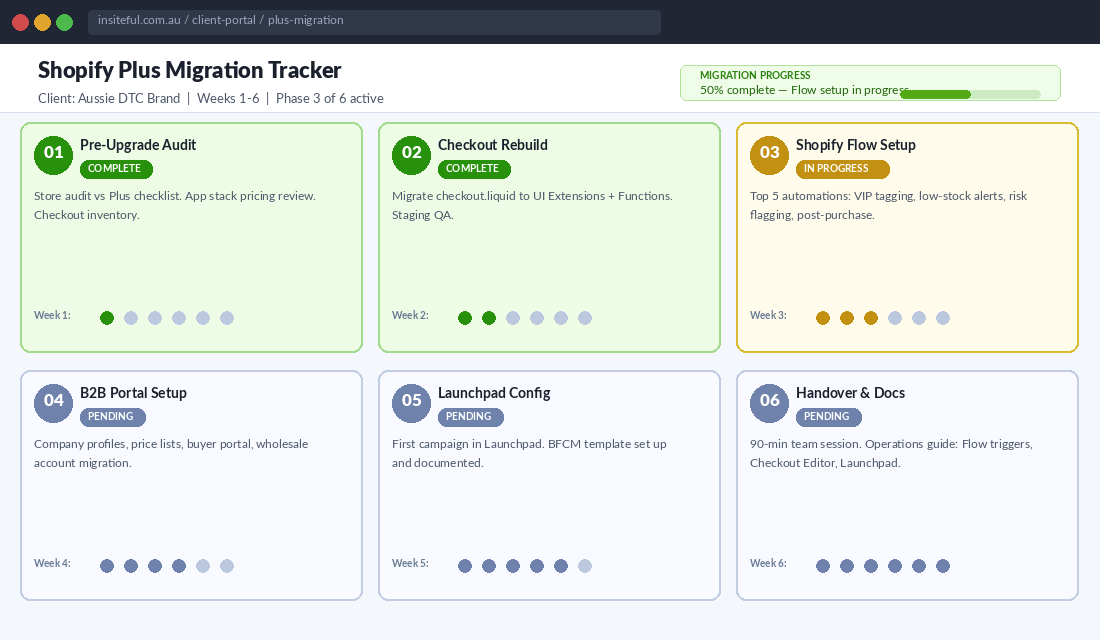
When an Insiteful client upgrades to Plus, we treat it as a structured migration, not a plan change in the admin. Here is the process we run.
Phase 1: Pre-Upgrade Audit. Before touching anything, we audit the existing store against the Plus feature checklist. Which checkout customisations exist and what needs rebuilding in the new framework? Is there B2B volume that justifies the native portal? What does the app stack look like, and which apps carry Plus-tier pricing implications? We do not recommend the upgrade until the scoping is complete and the client understands the total cost of ownership, not just the plan fee.
Phase 2: Checkout Rebuild. The highest-risk piece of any Plus migration is rebuilding checkout customisations in Checkout UI Extensions and Functions. We build and test in a development environment before touching the live store. Full QA against the live order flow and all active discount combinations happens before any cutover. This step has no shortcuts.
Phase 3: Shopify Flow Configuration. In the first two weeks post-upgrade, we identify the top 3-5 automation candidates and build them in Flow. The most common starting set: VIP customer tagging at a revenue threshold, low-stock supplier alerts, high-risk order flagging, and post-purchase tag sequencing for Klaviyo flows.
Phase 4: B2B Portal Setup. For brands with wholesale customers, we configure the B2B portal with company profiles, custom price lists, and buyer permissions. Existing wholesale accounts are migrated into the new company structure. The handover includes a walkthrough with the brand’s sales team so they can manage it independently.
Phase 5: Launchpad Configuration. For brands running regular campaign launches, we set up the first full campaign in Launchpad as part of the project deliverables. Most clients who see Launchpad execute a scheduled launch for the first time ask why they did not have it years earlier.
Phase 6: Handover and Documentation. A 90-minute session with the team covering each Plus feature in the context of their specific setup. We deliver a working operations guide built around the configuration we delivered, covering Flow trigger logic, Launchpad campaign setup, and the Checkout Editor. Documentation built around someone else’s setup is rarely used. We build it around theirs.
Full migration timeline: 4-6 weeks for a mid-complexity store, 8-10 weeks for brands with heavy customisation, B2B buildout, or multi-store architecture.
The Upgrade Decision in Plain Terms
Shopify Plus is worth it when you have specific features you need, development capacity to execute on them, and a clear plan for the tools it unlocks. Without all three, it is $43,608 AUD per year in overhead, not infrastructure.
The brands that get the most from Plus are those who upgrade with a project already scoped: a checkout upsell build ready to go live in week two, a B2B portal migration queued for week four, a BFCM Launchpad campaign in the brief. The upgrade pays in the first quarter. Brands that upgrade because it feels like the right milestone take 12 months or more to recover the cost differential.
If you are at $2M+ and questioning whether Plus is right for your store, that is exactly the assessment we run for Insiteful clients before any upgrade conversation happens. Talk to the Insiteful team and we will give you an honest read on whether the numbers stack up for your specific situation.